Electrodialysis Equipment Market Size, Share, and Trends Analysis Report
CAGR :

| Market Size 2023 (Base Year) | USD 637.1 Million |
| Market Size 2032 (Forecast Year) | USD 1060.27 Million |
| CAGR | 5.4% |
| Forecast Period | 2024 - 2032 |
| Historical Period | 2018 - 2023 |
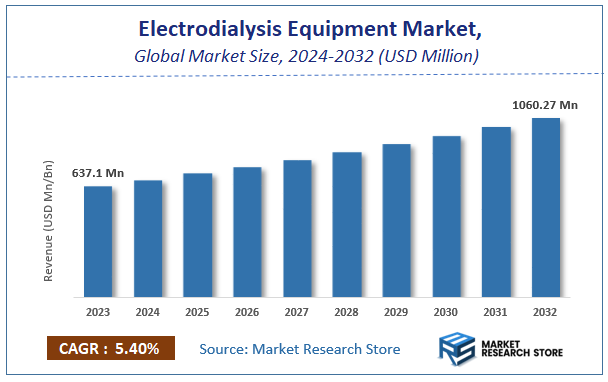
According to a recent study by Market Research Store, the global electrodialysis equipment market size was valued at approximately USD 637.1 Million in 2023. The market is projected to grow significantly, reaching USD 1060.27 Million by 2032, growing at a compound annual growth rate (CAGR) of 5.4% during the forecast period from 2024 to 2032. The report highlights key growth drivers such as rising demand, technological advancements, and expanding applications. It also outlines potential challenges like regulatory changes and market competition, while emphasizing emerging opportunities for innovation and investment in the electrodialysis equipment industry.
To Get more Insights, Request a Free Sample
Electrodialysis Equipment Market: Overview
The growth of the electrodialysis equipment market is fueled by rising global demand across various industries and applications. The report highlights lucrative opportunities, analyzing cost structures, key segments, emerging trends, regional dynamics, and advancements by leading players to provide comprehensive market insights. The electrodialysis equipment market report offers a detailed industry analysis from 2024 to 2032, combining quantitative and qualitative insights. It examines key factors such as pricing, market penetration, GDP impact, industry dynamics, major players, consumer behavior, and socio-economic conditions. Structured into multiple sections, the report provides a comprehensive perspective on the market from all angles.
Key sections of the electrodialysis equipment market report include market segments, outlook, competitive landscape, and company profiles. Market Segments offer in-depth details based on Technology Type, Application, End-User Industries, Membrane Type, Operational Mode, and other relevant classifications to support strategic marketing initiatives. Market Outlook thoroughly analyzes market trends, growth drivers, restraints, opportunities, challenges, Porter’s Five Forces framework, macroeconomic factors, value chain analysis, and pricing trends shaping the market now and in the future. The Competitive Landscape and Company Profiles section highlights major players, their strategies, and market positioning to guide investment and business decisions. The report also identifies innovation trends, new business opportunities, and investment prospects for the forecast period.
Key Highlights:
- As per the analysis shared by our research analyst, the global electrodialysis equipment market is estimated to grow annually at a CAGR of around 5.4% over the forecast period (2024-2032).
- In terms of revenue, the global electrodialysis equipment market size was valued at around USD 637.1 Million in 2023 and is projected to reach USD 1060.27 Million by 2032.
- The market is projected to grow at a significant rate due to rising demand for wastewater treatment, desalination, and sustainable industrial processes, coupled with advancements in energy-efficient membrane technologies.
- Based on the Technology Type, the Continuous Electrodialysis segment is growing at a high rate and will continue to dominate the global market as per industry projections.
- On the basis of Application, the Water Treatment segment is anticipated to command the largest market share.
- In terms of End-User Industries, the Municipal Water Utilities segment is projected to lead the global market.
- By Membrane Type, the Cation Exchange Membranes segment is predicted to dominate the global market.
- Based on the Operational Mode, the Batch Mode segment is expected to swipe the largest market share.
- Based on region, North America is projected to dominate the global market during the forecast period.
Electrodialysis Equipment Market: Report Scope
This report thoroughly analyzes the electrodialysis equipment market, exploring its historical trends, current state, and future projections. The market estimates presented result from a robust research methodology, incorporating primary research, secondary sources, and expert opinions. These estimates are influenced by the prevailing market dynamics as well as key economic, social, and political factors. Furthermore, the report considers the impact of regulations, government expenditures, and advancements in research and development on the market. Both positive and negative shifts are evaluated to ensure a comprehensive and accurate market outlook.
| Report Attributes | Report Details |
|---|---|
| Report Name | Electrodialysis Equipment Market |
| Market Size in 2023 | USD 637.1 Million |
| Market Forecast in 2032 | USD 1060.27 Million |
| Growth Rate | CAGR of 5.4% |
| Number of Pages | 248 |
| Key Companies Covered | GE Water & Process Technologies (SUEZ), Evoqua, Hangzhou Lanran, PCCell GmbH, Eurodia, FuMA-Tech, AGC Engineering, Astom, C-Tech Innovation Ltd, Saltworks Technologies Inc, Electrosynthesis Company, Innovative Enterprise, WGM Sistemas, Magna Imperio Systems, mega, Veolia, Novasep, YASA ET, Pure Water Group |
| Segments Covered | By Technology Type, By Application, By End-User Industries, By Membrane Type, By Operational Mode, and By Region |
| Regions Covered | North America, Europe, Asia Pacific (APAC), Latin America, Middle East, and Africa (MEA) |
| Base Year | 2023 |
| Historical Year | 2018 to 2023 |
| Forecast Year | 2024 to 2032 |
| Customization Scope | Avail customized purchase options to meet your exact research needs. Request For Customization |
Electrodialysis Equipment Market: Dynamics
Key Growth Drivers
The electrodialysis (ED) equipment market is primarily propelled by the escalating global need for advanced water treatment and desalination solutions. Increasing freshwater scarcity, driven by population growth, rapid urbanization, and industrial expansion, makes efficient water purification technologies like ED essential. Stringent environmental regulations worldwide are compelling industries to treat and reuse wastewater, further boosting the demand for ED systems due to their ability to demineralize and concentrate solutions with low chemical usage. Furthermore, the inherent advantages of ED, such as its energy efficiency compared to some other desalination methods like reverse osmosis (RO) for brackish water, and its modular scalability, make it an increasingly attractive option for various applications across industrial, municipal, and agricultural sectors.
Restraints
Despite its advantages, the electrodialysis equipment market faces certain restraints. The relatively high initial capital investment required for purchasing and installing ED systems, especially for large-scale applications, can be a significant barrier for some potential end-users, particularly in developing economies or for smaller organizations. The complexity of operating and maintaining ED equipment, which involves managing ion exchange membranes and electrical currents, often necessitates skilled personnel and specialized technical expertise, adding to operational costs. Furthermore, while ED is effective for removing ions, it may not effectively remove non-ionic contaminants like colloids or certain organic compounds, necessitating pre-treatment steps which add to the overall system complexity and cost. Competition from established alternative water treatment technologies, such as Reverse Osmosis (RO), can also limit market penetration in certain segments where RO might be perceived as a more mature or broadly applicable solution.
Opportunities
The electrodialysis equipment market presents numerous opportunities for innovation and growth. Ongoing technological advancements in membrane materials, focusing on improved selectivity, durability, and fouling resistance, are enhancing the efficiency and longevity of ED systems. The integration of artificial intelligence (AI) and Internet of Things (IoT) technologies for real-time monitoring, predictive maintenance, and optimized performance of ED plants offers significant operational efficiencies and cost savings. The increasing global focus on the circular economy and resource recovery is driving demand for ED in applications like lithium extraction, acid/alkali production from waste streams, and the recovery of valuable products from industrial effluents. Furthermore, the development of more compact, modular, and energy-efficient ED systems, potentially integrated with renewable energy sources like solar power, can expand their adoption in remote areas and niche applications.
Challenges
The electrodialysis equipment market faces several key challenges. Ensuring the consistent performance and long-term reliability of ion exchange membranes under varying feed water conditions and potential fouling remains a critical technical challenge. Managing the energy consumption, particularly for large-scale desalination projects, while striving for even greater energy efficiency, is an ongoing hurdle. The need to educate potential customers, especially in emerging markets, about the specific benefits and cost-effectiveness of ED compared to alternative technologies is crucial for wider adoption. Navigating complex and evolving regulatory frameworks related to water discharge, wastewater treatment, and chemical handling across different geographies also poses a significant challenge. Lastly, the high cost of research and development for new membrane materials and advanced system designs can impact the profitability of manufacturers in a competitive market.
Electrodialysis Equipment Market: Segmentation Insights
The global electrodialysis equipment market is segmented based on Technology Type, Application, End-User Industries, Membrane Type, Operational Mode, and Region. All the segments of the electrodialysis equipment market have been analyzed based on present & future trends and the market is estimated from 2024 to 2032.
Based on Technology Type, the global electrodialysis equipment market is divided into Continuous Electrodialysis, Batch Electrodialysis, Hybrid Electrodialysis Systems.
On the basis of Application, the global electrodialysis equipment market is bifurcated into Water Treatment, Food and Beverages Processing, Pharmaceutical Manufacturing, Heavy Metal Recovery.
In terms of End-User Industries, the global electrodialysis equipment market is categorized into Municipal Water Utilities, Industrial Manufacturing, Food and Beverage Industry, Pharmaceutical Industry, Agriculture (Fertigation Systems).
Based on Membrane Type, the global electrodialysis equipment market is split into Cation Exchange Membranes, Anion Exchange Membranes, Bipolar Membranes.
By Operational Mode, the global electrodialysis equipment market is divided into Batch Mode, Continuous Mode, Semi-continuous Mode.
Electrodialysis Equipment Market: Regional Insights
The Electrodialysis Equipment Market is currently dominated by Asia-Pacific (APAC), which holds the largest market share (over 40%), driven by rapid industrialization, stringent wastewater regulations, and high demand for desalination and water reuse in China, Japan, and South Korea. The region benefits from government initiatives promoting sustainable water management and heavy investments in industrial and municipal water treatment infrastructure. North America follows as the second-largest market, supported by advanced technological adoption and strict environmental policies in the U.S. and Canada, particularly in pharmaceuticals and food & beverage industries. Europe shows steady growth, led by Germany, France, and the UK, due to EU directives on water purity and circular economy practices. Meanwhile, Latin America and the Middle East & Africa are emerging markets, with increasing applications in mining and oil & gas sectors. APAC’s dominance is reinforced by local manufacturers like Astom Corporation (Japan) and rising R&D in energy-efficient systems.
Electrodialysis Equipment Market: Competitive Landscape
The electrodialysis equipment market Report offers a thorough analysis of both established and emerging players within the market. It includes a detailed list of key companies, categorized based on the types of products they offer and other relevant factors. The report also highlights the market entry year for each player, providing further context for the research analysis.
The "Global Electrodialysis Equipment Market" study offers valuable insights, focusing on the global market landscape, with an emphasis on major industry players such as;
- GE Water & Process Technologies (SUEZ)
- Evoqua
- Hangzhou Lanran
- PCCell GmbH
- Eurodia
- FuMA-Tech
- AGC Engineering
- Astom
- C-Tech Innovation Ltd
- Saltworks Technologies Inc
- Electrosynthesis Company
- Innovative Enterprise
- WGM Sistemas
- Magna Imperio Systems
- mega
- Veolia
- Novasep
- YASA ET
- Pure Water Group
The Global Electrodialysis Equipment Market is Segmented as Follows:
By Technology Type
- Continuous Electrodialysis
- Batch Electrodialysis
- Hybrid Electrodialysis Systems
By Application
- Water Treatment
- Food and Beverages Processing
- Pharmaceutical Manufacturing
- Heavy Metal Recovery
By End-User Industries
- Municipal Water Utilities
- Industrial Manufacturing
- Food and Beverage Industry
- Pharmaceutical Industry
- Agriculture (Fertigation Systems)
By Membrane Type
- Cation Exchange Membranes
- Anion Exchange Membranes
- Bipolar Membranes
By Operational Mode
- Batch Mode
- Continuous Mode
- Semi-continuous Mode
By Region
- North America
- The U.S.
- Canada
- Mexico
- Europe
- France
- The UK
- Spain
- Germany
- Italy
- Rest of Europe
- Asia Pacific
- China
- Japan
- India
- Australia
- South Korea
- Rest of Asia Pacific
- The Middle East & Africa
- Saudi Arabia
- UAE
- Egypt
- Kuwait
- South Africa
- Rest of the Middle East & Africa
- Latin America
- Brazil
- Argentina
- Rest of Latin America
Market Evolution
This section evaluates the market position of the product or service by examining its development pathway and competitive dynamics. It provides a detailed overview of the product's growth stages, including the early (historical) phase, the mid-stage, and anticipated future advancements influenced by innovation and emerging technologies.
Porter’s Analysis
Porter’s Five Forces framework offers a strategic lens for assessing competitor behavior and the positioning of key players in the electrodialysis equipment industry. This section explores the external factors shaping competitive dynamics and influencing market strategies in the years ahead. The analysis focuses on five critical forces:
- Competitive Rivalry
- Threat of New Entrants
- Threat of Substitutes
- Supplier Bargaining Power
- Buyer Bargaining Power
Value Chain & Market Attractiveness Analysis
The value chain analysis helps businesses optimize operations by mapping the product flow from suppliers to end consumers, identifying opportunities to streamline processes and gain a competitive edge. Segment-wise market attractiveness analysis evaluates key dimensions like product categories, demographics, and regions, assessing growth potential, market size, and profitability. This enables businesses to focus resources on high-potential segments for better ROI and long-term value.
PESTEL Analysis
PESTEL analysis is a powerful tool in market research reports that enhances market understanding by systematically examining the external macro-environmental factors influencing a business or industry. The acronym stands for Political, Economic, Social, Technological, Environmental, and Legal factors. By evaluating these dimensions, PESTEL analysis provides a comprehensive overview of the broader context within which a market operates, helping businesses identify potential opportunities and threats.
- Political factors assess government policies, stability, trade regulations, and political risks that could impact market operations.
- Economic factors examine variables like inflation, exchange rates, economic growth, and consumer spending power to determine market viability.
- Social factors explore cultural trends, demographics, and lifestyle changes that shape consumer behavior and preferences.
- Technological factors evaluate innovation, R&D, and technological advancements affecting product development and operational efficiencies.
- Environmental factors focus on sustainability, climate change impacts, and eco-friendly practices shaping market trends.
- Legal factors address compliance requirements, industry regulations, and intellectual property laws impacting market entry and operations.
Import-Export Analysis & Pricing Analysis
An import-export analysis is vital for market research, revealing global trade dynamics, trends, and opportunities. It examines trade volumes, product categories, and regional competitiveness, offering insights into supply chains and market demand. This section also analyzes past and future pricing trends, helping businesses optimize strategies and enabling consumers to assess product value effectively.
Electrodialysis Equipment Market: Company Profiles
The report identifies key players in the electrodialysis equipment market through a competitive landscape and company profiles, evaluating their offerings, financial performance, strategies, and market positioning. It includes a SWOT analysis of the top 3-5 companies, assessing strengths, weaknesses, opportunities, and threats. The competitive landscape highlights rankings, recent activities (mergers, acquisitions, partnerships, product launches), and regional footprints using the Ace matrix. Customization is available to meet client-specific needs.
Regional & Industry Footprint
This section details the geographic reach, sales networks, and market penetration of companies profiled in the electrodialysis equipment report, showcasing their operations and distribution across regions. It analyzes the alignment of companies with specific industry verticals, highlighting the industries they serve and the scope of their products and services within those sectors.
Ace Matrix
This section categorizes companies into four distinct groups—Active, Cutting Edge, Innovator, and Emerging—based on their product and business strategies. The evaluation of product strategy focuses on aspects such as the range and depth of offerings, commitment to innovation, product functionalities, and scalability. Key elements like global reach, sector coverage, strategic acquisitions, and long-term growth plans are considered for business strategy. This analysis provides a detailed view of companies' position within the market and highlights their potential for future growth and development.
Research Methodology
The qualitative and quantitative insights for the electrodialysis equipment market are derived through a multi-faceted research approach, combining input from subject matter experts, primary research, and secondary data sources. Primary research includes gathering critical information via face-to-face or telephonic interviews, surveys, questionnaires, and feedback from industry professionals, key opinion leaders (KOLs), and customers. Regular interviews with industry experts are conducted to deepen the analysis and reinforce the existing data, ensuring a robust and well-rounded market understanding.
Secondary research for this report was carried out by the Market Research Store team, drawing on a variety of authoritative sources, such as:
- Official company websites, annual reports, financial statements, investor presentations, and SEC filings
- Internal and external proprietary databases, as well as relevant patent and regulatory databases
- Government publications, national statistical databases, and industry-specific market reports
- Media coverage, including news articles, press releases, and webcasts about market participants
- Paid industry databases for detailed market insights
Market Research Store conducted in-depth consultations with various key opinion leaders in the industry, including senior executives from top companies and regional leaders from end-user organizations. This effort aimed to gather critical insights on factors such as the market share of dominant brands in specific countries and regions, along with pricing strategies for products and services.
To determine total sales data, the research team conducted primary interviews across multiple countries with influential stakeholders, including:
- Distributors
- Marketing, Brand, and Product Managers
- Procurement and Production Managers
- Sales and Regional Sales Managers, Country Managers
- Technical Specialists
- C-Level Executives
These subject matter experts, with their extensive industry experience, helped validate and refine the findings. For secondary research, data were sourced from a wide range of materials, including online resources, company annual reports, industry publications, research papers, association reports, and government websites. These various sources provide a comprehensive and well-rounded perspective on the market.
Frequently Asked Questions
Table Of Content
Table of Content 1 Report Overview 1.1 Study Scope 1.2 Key Market Segments 1.3 Regulatory Scenario by Region/Country 1.4 Market Investment Scenario Strategic 1.5 Market Analysis by Type 1.5.1 Global Electrodialysis Equipment Market Share by Type (2020-2026) 1.5.2 Continuous Electrodialysis 1.5.3 Batch Electrodialysis 1.6 Market by Application 1.6.1 Global Electrodialysis Equipment Market Share by Application (2020-2026) 1.6.2 Seawater Desalination 1.6.3 Foods/Pharmaceutical 1.6.4 Recycling Environments 1.6.5 Laboratory 1.6.6 Others 1.7 Electrodialysis Equipment Industry Development Trends under COVID-19 Outbreak 1.7.1 Global COVID-19 Status Overview 1.7.2 Influence of COVID-19 Outbreak on Electrodialysis Equipment Industry Development 2. Global Market Growth Trends 2.1 Industry Trends 2.1.1 SWOT Analysis 2.1.2 Porter’s Five Forces Analysis 2.2 Potential Market and Growth Potential Analysis 2.3 Industry News and Policies by Regions 2.3.1 Industry News 2.3.2 Industry Policies 2.4 Industry Trends Under COVID-19 3 Value Chain of Electrodialysis Equipment Market 3.1 Value Chain Status 3.2 Electrodialysis Equipment Manufacturing Cost Structure Analysis 3.2.1 Production Process Analysis 3.2.2 Manufacturing Cost Structure of Electrodialysis Equipment 3.2.3 Labor Cost of Electrodialysis Equipment 3.2.3.1 Labor Cost of Electrodialysis Equipment Under COVID-19 3.3 Sales and Marketing Model Analysis 3.4 Downstream Major Customer Analysis (by Region) 3.5 Value Chain Status Under COVID-19 4 Players Profiles 4.1 FuMA-Tech 4.1.1 FuMA-Tech Basic Information 4.1.2 Electrodialysis Equipment Product Profiles, Application and Specification 4.1.3 FuMA-Tech Electrodialysis Equipment Market Performance (2015-2020) 4.1.4 FuMA-Tech Business Overview 4.2 AGC ENGINEERING 4.2.1 AGC ENGINEERING Basic Information 4.2.2 Electrodialysis Equipment Product Profiles, Application and Specification 4.2.3 AGC ENGINEERING Electrodialysis Equipment Market Performance (2015-2020) 4.2.4 AGC ENGINEERING Business Overview 4.3 Innovative Enterprise 4.3.1 Innovative Enterprise Basic Information 4.3.2 Electrodialysis Equipment Product Profiles, Application and Specification 4.3.3 Innovative Enterprise Electrodialysis Equipment Market Performance (2015-2020) 4.3.4 Innovative Enterprise Business Overview 4.4 EURODIA 4.4.1 EURODIA Basic Information 4.4.2 Electrodialysis Equipment Product Profiles, Application and Specification 4.4.3 EURODIA Electrodialysis Equipment Market Performance (2015-2020) 4.4.4 EURODIA Business Overview 4.5 Evoqua Water Technologies LLC 4.5.1 Evoqua Water Technologies LLC Basic Information 4.5.2 Electrodialysis Equipment Product Profiles, Application and Specification 4.5.3 Evoqua Water Technologies LLC Electrodialysis Equipment Market Performance (2015-2020) 4.5.4 Evoqua Water Technologies LLC Business Overview 4.6 Hangzhou Iontech Environmental Technology Co 4.6.1 Hangzhou Iontech Environmental Technology Co Basic Information 4.6.2 Electrodialysis Equipment Product Profiles, Application and Specification 4.6.3 Hangzhou Iontech Environmental Technology Co Electrodialysis Equipment Market Performance (2015-2020) 4.6.4 Hangzhou Iontech Environmental Technology Co Business Overview 4.7 Shandong Tianwei Membrane Technology 4.7.1 Shandong Tianwei Membrane Technology Basic Information 4.7.2 Electrodialysis Equipment Product Profiles, Application and Specification 4.7.3 Shandong Tianwei Membrane Technology Electrodialysis Equipment Market Performance (2015-2020) 4.7.4 Shandong Tianwei Membrane Technology Business Overview 4.8 WGM Sistemas 4.8.1 WGM Sistemas Basic Information 4.8.2 Electrodialysis Equipment Product Profiles, Application and Specification 4.8.3 WGM Sistemas Electrodialysis Equipment Market Performance (2015-2020) 4.8.4 WGM Sistemas Business Overview 4.9 Doromil 4.9.1 Doromil Basic Information 4.9.2 Electrodialysis Equipment Product Profiles, Application and Specification 4.9.3 Doromil Electrodialysis Equipment Market Performance (2015-2020) 4.9.4 Doromil Business Overview 4.10 PCCell GmbH 4.10.1 PCCell GmbH Basic Information 4.10.2 Electrodialysis Equipment Product Profiles, Application and Specification 4.10.3 PCCell GmbH Electrodialysis Equipment Market Performance (2015-2020) 4.10.4 PCCell GmbH Business Overview 4.11 C-Tech Innovation Ltd 4.11.1 C-Tech Innovation Ltd Basic Information 4.11.2 Electrodialysis Equipment Product Profiles, Application and Specification 4.11.3 C-Tech Innovation Ltd Electrodialysis Equipment Market Performance (2015-2020) 4.11.4 C-Tech Innovation Ltd Business Overview 4.12 Electrosynthesis Company 4.12.1 Electrosynthesis Company Basic Information 4.12.2 Electrodialysis Equipment Product Profiles, Application and Specification 4.12.3 Electrosynthesis Company Electrodialysis Equipment Market Performance (2015-2020) 4.12.4 Electrosynthesis Company Business Overview 4.13 ASTOM 4.13.1 ASTOM Basic Information 4.13.2 Electrodialysis Equipment Product Profiles, Application and Specification 4.13.3 ASTOM Electrodialysis Equipment Market Performance (2015-2020) 4.13.4 ASTOM Business Overview 4.14 GE Water & Process Technologies 4.14.1 GE Water & Process Technologies Basic Information 4.14.2 Electrodialysis Equipment Product Profiles, Application and Specification 4.14.3 GE Water & Process Technologies Electrodialysis Equipment Market Performance (2015-2020) 4.14.4 GE Water & Process Technologies Business Overview 4.15 Saltworks Technologies Inc 4.15.1 Saltworks Technologies Inc Basic Information 4.15.2 Electrodialysis Equipment Product Profiles, Application and Specification 4.15.3 Saltworks Technologies Inc Electrodialysis Equipment Market Performance (2015-2020) 4.15.4 Saltworks Technologies Inc Business Overview 5 Global Electrodialysis Equipment Market Analysis by Regions 5.1 Global Electrodialysis Equipment Sales, Revenue and Market Share by Regions 5.1.1 Global Electrodialysis Equipment Sales by Regions (2015-2020) 5.1.2 Global Electrodialysis Equipment Revenue by Regions (2015-2020) 5.2 North America Electrodialysis Equipment Sales and Growth Rate (2015-2020) 5.3 Europe Electrodialysis Equipment Sales and Growth Rate (2015-2020) 5.4 Asia-Pacific Electrodialysis Equipment Sales and Growth Rate (2015-2020) 5.5 Middle East and Africa Electrodialysis Equipment Sales and Growth Rate (2015-2020) 5.6 South America Electrodialysis Equipment Sales and Growth Rate (2015-2020) 6 North America Electrodialysis Equipment Market Analysis by Countries 6.1 North America Electrodialysis Equipment Sales, Revenue and Market Share by Countries 6.1.1 North America Electrodialysis Equipment Sales by Countries (2015-2020) 6.1.2 North America Electrodialysis Equipment Revenue by Countries (2015-2020) 6.1.3 North America Electrodialysis Equipment Market Under COVID-19 6.2 United States Electrodialysis Equipment Sales and Growth Rate (2015-2020) 6.2.1 United States Electrodialysis Equipment Market Under COVID-19 6.3 Canada Electrodialysis Equipment Sales and Growth Rate (2015-2020) 6.4 Mexico Electrodialysis Equipment Sales and Growth Rate (2015-2020) 7 Europe Electrodialysis Equipment Market Analysis by Countries 7.1 Europe Electrodialysis Equipment Sales, Revenue and Market Share by Countries 7.1.1 Europe Electrodialysis Equipment Sales by Countries (2015-2020) 7.1.2 Europe Electrodialysis Equipment Revenue by Countries (2015-2020) 7.1.3 Europe Electrodialysis Equipment Market Under COVID-19 7.2 Germany Electrodialysis Equipment Sales and Growth Rate (2015-2020) 7.2.1 Germany Electrodialysis Equipment Market Under COVID-19 7.3 UK Electrodialysis Equipment Sales and Growth Rate (2015-2020) 7.3.1 UK Electrodialysis Equipment Market Under COVID-19 7.4 France Electrodialysis Equipment Sales and Growth Rate (2015-2020) 7.4.1 France Electrodialysis Equipment Market Under COVID-19 7.5 Italy Electrodialysis Equipment Sales and Growth Rate (2015-2020) 7.5.1 Italy Electrodialysis Equipment Market Under COVID-19 7.6 Spain Electrodialysis Equipment Sales and Growth Rate (2015-2020) 7.6.1 Spain Electrodialysis Equipment Market Under COVID-19 7.7 Russia Electrodialysis Equipment Sales and Growth Rate (2015-2020) 7.7.1 Russia Electrodialysis Equipment Market Under COVID-19 8 Asia-Pacific Electrodialysis Equipment Market Analysis by Countries 8.1 Asia-Pacific Electrodialysis Equipment Sales, Revenue and Market Share by Countries 8.1.1 Asia-Pacific Electrodialysis Equipment Sales by Countries (2015-2020) 8.1.2 Asia-Pacific Electrodialysis Equipment Revenue by Countries (2015-2020) 8.1.3 Asia-Pacific Electrodialysis Equipment Market Under COVID-19 8.2 China Electrodialysis Equipment Sales and Growth Rate (2015-2020) 8.2.1 China Electrodialysis Equipment Market Under COVID-19 8.3 Japan Electrodialysis Equipment Sales and Growth Rate (2015-2020) 8.3.1 Japan Electrodialysis Equipment Market Under COVID-19 8.4 South Korea Electrodialysis Equipment Sales and Growth Rate (2015-2020) 8.4.1 South Korea Electrodialysis Equipment Market Under COVID-19 8.5 Australia Electrodialysis Equipment Sales and Growth Rate (2015-2020) 8.6 India Electrodialysis Equipment Sales and Growth Rate (2015-2020) 8.6.1 India Electrodialysis Equipment Market Under COVID-19 8.7 Southeast Asia Electrodialysis Equipment Sales and Growth Rate (2015-2020) 8.7.1 Southeast Asia Electrodialysis Equipment Market Under COVID-19 9 Middle East and Africa Electrodialysis Equipment Market Analysis by Countries 9.1 Middle East and Africa Electrodialysis Equipment Sales, Revenue and Market Share by Countries 9.1.1 Middle East and Africa Electrodialysis Equipment Sales by Countries (2015-2020) 9.1.2 Middle East and Africa Electrodialysis Equipment Revenue by Countries (2015-2020) 9.1.3 Middle East and Africa Electrodialysis Equipment Market Under COVID-19 9.2 Saudi Arabia Electrodialysis Equipment Sales and Growth Rate (2015-2020) 9.3 UAE Electrodialysis Equipment Sales and Growth Rate (2015-2020) 9.4 Egypt Electrodialysis Equipment Sales and Growth Rate (2015-2020) 9.5 Nigeria Electrodialysis Equipment Sales and Growth Rate (2015-2020) 9.6 South Africa Electrodialysis Equipment Sales and Growth Rate (2015-2020) 10 South America Electrodialysis Equipment Market Analysis by Countries 10.1 South America Electrodialysis Equipment Sales, Revenue and Market Share by Countries 10.1.1 South America Electrodialysis Equipment Sales by Countries (2015-2020) 10.1.2 South America Electrodialysis Equipment Revenue by Countries (2015-2020) 10.1.3 South America Electrodialysis Equipment Market Under COVID-19 10.2 Brazil Electrodialysis Equipment Sales and Growth Rate (2015-2020) 10.2.1 Brazil Electrodialysis Equipment Market Under COVID-19 10.3 Argentina Electrodialysis Equipment Sales and Growth Rate (2015-2020) 10.4 Columbia Electrodialysis Equipment Sales and Growth Rate (2015-2020) 10.5 Chile Electrodialysis Equipment Sales and Growth Rate (2015-2020) 11 Global Electrodialysis Equipment Market Segment by Types 11.1 Global Electrodialysis Equipment Sales, Revenue and Market Share by Types (2015-2020) 11.1.1 Global Electrodialysis Equipment Sales and Market Share by Types (2015-2020) 11.1.2 Global Electrodialysis Equipment Revenue and Market Share by Types (2015-2020) 11.2 Continuous Electrodialysis Sales and Price (2015-2020) 11.3 Batch Electrodialysis Sales and Price (2015-2020) 12 Global Electrodialysis Equipment Market Segment by Applications 12.1 Global Electrodialysis Equipment Sales, Revenue and Market Share by Applications (2015-2020) 12.1.1 Global Electrodialysis Equipment Sales and Market Share by Applications (2015-2020) 12.1.2 Global Electrodialysis Equipment Revenue and Market Share by Applications (2015-2020) 12.2 Seawater Desalination Sales, Revenue and Growth Rate (2015-2020) 12.3 Foods/Pharmaceutical Sales, Revenue and Growth Rate (2015-2020) 12.4 Recycling Environments Sales, Revenue and Growth Rate (2015-2020) 12.5 Laboratory Sales, Revenue and Growth Rate (2015-2020) 12.6 Others Sales, Revenue and Growth Rate (2015-2020) 13 Electrodialysis Equipment Market Forecast by Regions (2020-2026) 13.1 Global Electrodialysis Equipment Sales, Revenue and Growth Rate (2020-2026) 13.2 Electrodialysis Equipment Market Forecast by Regions (2020-2026) 13.2.1 North America Electrodialysis Equipment Market Forecast (2020-2026) 13.2.2 Europe Electrodialysis Equipment Market Forecast (2020-2026) 13.2.3 Asia-Pacific Electrodialysis Equipment Market Forecast (2020-2026) 13.2.4 Middle East and Africa Electrodialysis Equipment Market Forecast (2020-2026) 13.2.5 South America Electrodialysis Equipment Market Forecast (2020-2026) 13.3 Electrodialysis Equipment Market Forecast by Types (2020-2026) 13.4 Electrodialysis Equipment Market Forecast by Applications (2020-2026) 13.5 Electrodialysis Equipment Market Forecast Under COVID-19 14 Appendix 14.1 Methodology 14.2 Research Data Source
Inquiry For Buying
Electrodialysis Equipment
Request Sample
Electrodialysis Equipment
