Naval Vessels MRO Market Size, Share, and Trends Analysis Report
CAGR :

| Market Size 2024 (Base Year) | USD 12.19 Billion |
| Market Size 2032 (Forecast Year) | USD 20.47 Billion |
| CAGR | 7.69% |
| Forecast Period | 2025 - 2032 |
| Historical Period | 2020 - 2024 |
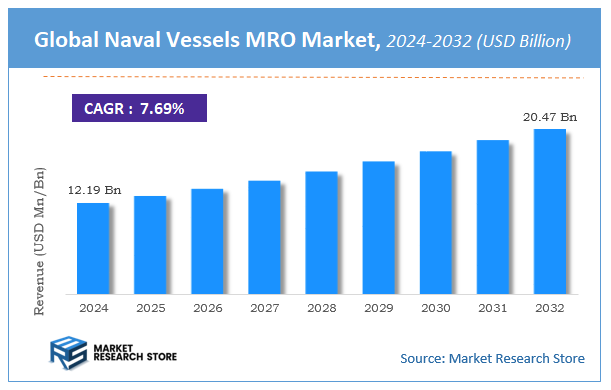
Market Research Store has published a report on the global naval vessels MRO market, estimating its value at USD 12.19 Billion in 2024, with projections indicating it will reach USD 20.47 Billion by the end of 2032. The market is expected to expand at a compound annual growth rate (CAGR) of around 7.69% over the forecast period. The report examines the factors driving market growth, the obstacles that could hinder this expansion, and the opportunities that may emerge in the naval vessels MRO industry. Additionally, it offers a detailed analysis of how these elements will affect demand dynamics and market performance throughout the forecast period.
To Get more Insights, Request a Free Sample
Naval Vessels MRO Market: Overview
The growth of the naval vessels MRO market is fueled by rising global demand across various industries and applications. The report highlights lucrative opportunities, analyzing cost structures, key segments, emerging trends, regional dynamics, and advancements by leading players to provide comprehensive market insights. The naval vessels MRO market report offers a detailed industry analysis from 2024 to 2032, combining quantitative and qualitative insights. It examines key factors such as pricing, market penetration, GDP impact, industry dynamics, major players, consumer behavior, and socio-economic conditions. Structured into multiple sections, the report provides a comprehensive perspective on the market from all angles.
Key sections of the naval vessels MRO market report include market segments, outlook, competitive landscape, and company profiles. Market Segments offer in-depth details based on Vessel Type, MRO Type, MRO Service, and other relevant classifications to support strategic marketing initiatives. Market Outlook thoroughly analyzes market trends, growth drivers, restraints, opportunities, challenges, Porter’s Five Forces framework, macroeconomic factors, value chain analysis, and pricing trends shaping the market now and in the future. The Competitive Landscape and Company Profiles section highlights major players, their strategies, and market positioning to guide investment and business decisions. The report also identifies innovation trends, new business opportunities, and investment prospects for the forecast period.
Key Highlights:
- As per the analysis shared by our research analyst, the global naval vessels MRO market is estimated to grow annually at a CAGR of around 7.69% over the forecast period (2024-2032).
- In terms of revenue, the global naval vessels MRO market size was valued at around USD 12.19 Billion in 2024 and is projected to reach USD 20.47 Billion by 2032.
- The market is projected to grow at a significant rate due to increasingly complex fleets, rising geopolitical tensions and defense budgets, and adoption of advanced technologies like AI, IoT, predictive maintenance, and green retrofits.
- Based on the Vessel Type, the Corvettes segment is growing at a high rate and will continue to dominate the global market as per industry projections.
- On the basis of MRO Type, the Component MRO segment is anticipated to command the largest market share.
- In terms of MRO Service, the Maintenance & Repair (MR) segment is projected to lead the global market.
- Based on region, North America is projected to dominate the global market during the forecast period.
Naval Vessels MRO Market: Report Scope
This report thoroughly analyzes the naval vessels MRO market, exploring its historical trends, current state, and future projections. The market estimates presented result from a robust research methodology, incorporating primary research, secondary sources, and expert opinions. These estimates are influenced by the prevailing market dynamics as well as key economic, social, and political factors. Furthermore, the report considers the impact of regulations, government expenditures, and advancements in research and development on the market. Both positive and negative shifts are evaluated to ensure a comprehensive and accurate market outlook.
| Report Attributes | Report Details |
|---|---|
| Report Name | Naval Vessels MRO Market |
| Market Size in 2024 | USD 12.19 Billion |
| Market Forecast in 2032 | USD 20.47 Billion |
| Growth Rate | CAGR of 7.69% |
| Number of Pages | 213 |
| Key Companies Covered | BAE Systems (UK), General Dynamics Corporation (US), Lockheed Martin Corporation (US), Raytheon Technologies Corporation (US), Northrop Grumman Corporation (US), Saab AB (Sweden), Huntington Ingalls Industries Inc. (US), Thales Group (France), Naval Group (France), Babcock International Group PLC (UK), Kongsberg Maritime (Norway), Teledyne Brown Engineering (US), Vouvray Acquisition Limited (UK), Chidambaram Shipcare Pvt. Ltd (India) |
| Segments Covered | By Vessel Type, By MRO Type, By MRO Service, and By Region |
| Regions Covered | North America, Europe, Asia Pacific (APAC), Latin America, Middle East, and Africa (MEA) |
| Base Year | 2024 |
| Historical Year | 2020 to 2024 |
| Forecast Year | 2025 to 2032 |
| Customization Scope | Avail customized purchase options to meet your exact research needs. Request For Customization |
Naval Vessels MRO Market: Dynamics
Key Growth Drivers
The Naval Vessels MRO market is primarily driven by the aging global naval fleets, necessitating extensive maintenance, repair, and modernization to ensure continued operational readiness and to extend the service life of existing vessels due to the high cost and long lead times for new ship construction. The escalating geopolitical tensions and increased maritime security concerns worldwide compel navies to maintain a high state of readiness, leading to greater demand for MRO services to keep warships deployed and combat-capable. Furthermore, the introduction of technologically advanced and complex naval platforms (e.g., stealth destroyers, nuclear submarines, aircraft carriers) requires specialized MRO expertise, sophisticated diagnostic tools, and state-of-the-art facilities, driving investment in the MRO sector itself.
Restraints
Despite the strong growth drivers, the Naval Vessels MRO market faces several significant restraints. Strict defense budget constraints and austerity measures in many countries can lead to deferred maintenance, reduced MRO spending, and prolonged vessel lay-ups, directly impacting market growth. The high cost and long lead times associated with procuring specialized spare parts and components, particularly for older or foreign-built vessels, can create significant logistical challenges and increase MRO expenses. The technical complexity and proprietary nature of naval vessel systems, coupled with the need for highly skilled and security-cleared personnel, create a limited pool of qualified MRO providers and add to operational difficulties. Additionally, geopolitical shifts or changes in defense priorities can lead to uncertainty in MRO demand for specific vessel types.
Opportunities
The Naval Vessels MRO market presents numerous opportunities for innovation and expansion. The increasing adoption of advanced technologies like predictive maintenance, AI-driven diagnostics, and digital twin technology offers significant potential to optimize MRO schedules, reduce downtime, and improve operational efficiency. The growing focus on indigenous defense manufacturing and MRO capabilities in various countries, including India's "Make in India" initiative and self-reliance in defense, creates opportunities for local shipyards and private players to secure MRO contracts. The modernization and upgrade programs for existing fleets to incorporate new weapon systems, sensors, and communication technologies represent a substantial and continuous revenue stream. Furthermore, the rising demand for specialized MRO services for next-generation naval vessels like unmanned surface vessels (USVs) and unmanned underwater vehicles (UUVs) is an emerging high-growth segment.
Challenges
The Naval Vessels MRO market faces critical challenges related to maintaining the secrecy and security of sensitive defense technologies and data during MRO operations, requiring robust cybersecurity measures and strict access controls. Managing the long and complex project lifecycles associated with major refits and overhauls, which can span years and involve multiple stakeholders, demands exceptional project management capabilities. The scarcity of highly specialized technical personnel with expertise in naval engineering, propulsion systems, and combat systems, coupled with the need for continuous training to keep pace with evolving technologies, remains a persistent workforce challenge. Lastly, navigating complex international defense procurement regulations, export controls, and offset obligations can add layers of complexity for global MRO providers.
Naval Vessels MRO Market: Segmentation Insights
The global naval vessels MRO market is segmented based on Vessel Type, MRO Type, MRO Service, and Region. All the segments of the naval vessels MRO market have been analyzed based on present & future trends and the market is estimated from 2024 to 2032.
Based on Vessel Type, the global naval vessels MRO market is divided into Corvettes, Submarines, Destroyers, Frigates, others.
On the basis of MRO Type, the global naval vessels MRO market is bifurcated into Component MRO, Engine MRO, Regular Maintenance, Dry Dock MRO.
In terms of MRO Service, the global naval vessels MRO market is categorized into Maintenance & Repair (MR), Overhaul.
Naval Vessels MRO Market: Regional Insights
The Asia-Pacific (APAC) region, led by China, South Korea, and India, dominates the global naval vessels MRO (Maintenance, Repair, and Overhaul) market, accounting for over 40% of market share in 2024. This dominance is driven by rapid naval modernization programs, rising geopolitical tensions, and expanding indigenous shipbuilding capabilities. China’s PLA Navy expansion (adding 20+ vessels annually) and South Korea’s advanced destroyer/SSK submarine fleets fuel demand for dry-docking, propulsion upgrades, and combat system retrofits. The region benefits from cost-competitive labor, government-led naval budgets (China’s $230B defense outlay), and strategic port infrastructure like Gwadar (Pakistan) and Cam Ranh Bay (Vietnam). North America follows, with the U.S. Navy’s $30B+ annual MRO spending on carrier refits and Virginia-class submarine maintenance, while Europe focuses on frigate life-extension programs. APAC’s lead is reinforced by India’s “Make in India” naval MRO hubs and Southeast Asia’s coastal defense vessel overhauls, with the market projected to grow at 6.5% CAGR through 2030, outpacing other regions.
Naval Vessels MRO Market: Competitive Landscape
The naval vessels MRO market report offers a thorough analysis of both established and emerging players within the market. It includes a detailed list of key companies, categorized based on the types of products they offer and other relevant factors. The report also highlights the market entry year for each player, providing further context for the research analysis.
The "Global Naval Vessels MRO Market" study offers valuable insights, focusing on the global market landscape, with an emphasis on major industry players such as;
- BAE Systems (UK)
- General Dynamics Corporation (US)
- Lockheed Martin Corporation (US)
- Raytheon Technologies Corporation (US)
- Northrop Grumman Corporation (US)
- Saab AB (Sweden)
- Huntington Ingalls Industries Inc. (US)
- Thales Group (France)
- Naval Group (France)
- Babcock International Group PLC (UK)
- Kongsberg Maritime (Norway)
- Teledyne Brown Engineering (US)
- Vouvray Acquisition Limited (UK)
- Chidambaram Shipcare Pvt. Ltd (India)
The Global Naval Vessels MRO Market is Segmented as Follows:
By Vessel Type
- Corvettes
- Submarines
- Destroyers
- Frigates
- others
By MRO Type
- Component MRO
- Engine MRO
- Regular Maintenance
- Dry Dock MRO
By MRO Service
- Maintenance & Repair (MR)
- Overhaul
By Region
- North America
- The U.S.
- Canada
- Mexico
- Europe
- France
- The UK
- Spain
- Germany
- Italy
- Rest of Europe
- Asia Pacific
- China
- Japan
- India
- Australia
- South Korea
- Rest of Asia Pacific
- The Middle East & Africa
- Saudi Arabia
- UAE
- Egypt
- Kuwait
- South Africa
- Rest of the Middle East & Africa
- Latin America
- Brazil
- Argentina
- Rest of Latin America
Frequently Asked Questions
Table Of Content
Table of Content 1 Report Overview 1.1 Study Scope 1.2 Key Market Segments 1.3 Regulatory Scenario by Region/Country 1.4 Market Investment Scenario Strategic 1.5 Market Analysis by Type 1.5.1 Global Naval Vessels MRO Market Share by Type (2020-2026) 1.5.2 Engine MRO 1.5.3 Dry Dock MRO 1.5.4 Regular Maintenance MRO 1.5.5 Component MRO 1.6 Market by Application 1.6.1 Global Naval Vessels MRO Market Share by Application (2020-2026) 1.6.2 Small and Medium Sized Vessels 1.6.3 Large Vessels 1.7 Naval Vessels MRO Industry Development Trends under COVID-19 Outbreak 1.7.1 Global COVID-19 Status Overview 1.7.2 Influence of COVID-19 Outbreak on Naval Vessels MRO Industry Development 2. Global Market Growth Trends 2.1 Industry Trends 2.1.1 SWOT Analysis 2.1.2 Porter’s Five Forces Analysis 2.2 Potential Market and Growth Potential Analysis 2.3 Industry News and Policies by Regions 2.3.1 Industry News 2.3.2 Industry Policies 2.4 Industry Trends Under COVID-19 3 Value Chain of Naval Vessels MRO Market 3.1 Value Chain Status 3.2 Naval Vessels MRO Manufacturing Cost Structure Analysis 3.2.1 Production Process Analysis 3.2.2 Manufacturing Cost Structure of Naval Vessels MRO 3.2.3 Labor Cost of Naval Vessels MRO 3.2.3.1 Labor Cost of Naval Vessels MRO Under COVID-19 3.3 Sales and Marketing Model Analysis 3.4 Downstream Major Customer Analysis (by Region) 3.5 Value Chain Status Under COVID-19 4 Players Profiles 4.1 PO Sevmash 4.1.1 PO Sevmash Basic Information 4.1.2 Naval Vessels MRO Product Profiles, Application and Specification 4.1.3 PO Sevmash Naval Vessels MRO Market Performance (2015-2020) 4.1.4 PO Sevmash Business Overview 4.2 Fincantieri SpA 4.2.1 Fincantieri SpA Basic Information 4.2.2 Naval Vessels MRO Product Profiles, Application and Specification 4.2.3 Fincantieri SpA Naval Vessels MRO Market Performance (2015-2020) 4.2.4 Fincantieri SpA Business Overview 4.3 BAE Systems Plc 4.3.1 BAE Systems Plc Basic Information 4.3.2 Naval Vessels MRO Product Profiles, Application and Specification 4.3.3 BAE Systems Plc Naval Vessels MRO Market Performance (2015-2020) 4.3.4 BAE Systems Plc Business Overview 4.4 Lockheed Martin Corporation 4.4.1 Lockheed Martin Corporation Basic Information 4.4.2 Naval Vessels MRO Product Profiles, Application and Specification 4.4.3 Lockheed Martin Corporation Naval Vessels MRO Market Performance (2015-2020) 4.4.4 Lockheed Martin Corporation Business Overview 4.5 Huntington Ingalls Industries 4.5.1 Huntington Ingalls Industries Basic Information 4.5.2 Naval Vessels MRO Product Profiles, Application and Specification 4.5.3 Huntington Ingalls Industries Naval Vessels MRO Market Performance (2015-2020) 4.5.4 Huntington Ingalls Industries Business Overview 4.6 Damen Schelde Naval Shipbuilding (DSNS) 4.6.1 Damen Schelde Naval Shipbuilding (DSNS) Basic Information 4.6.2 Naval Vessels MRO Product Profiles, Application and Specification 4.6.3 Damen Schelde Naval Shipbuilding (DSNS) Naval Vessels MRO Market Performance (2015-2020) 4.6.4 Damen Schelde Naval Shipbuilding (DSNS) Business Overview 4.7 Thales 4.7.1 Thales Basic Information 4.7.2 Naval Vessels MRO Product Profiles, Application and Specification 4.7.3 Thales Naval Vessels MRO Market Performance (2015-2020) 4.7.4 Thales Business Overview 4.8 ThyssenKrupp Marine Systems AG 4.8.1 ThyssenKrupp Marine Systems AG Basic Information 4.8.2 Naval Vessels MRO Product Profiles, Application and Specification 4.8.3 ThyssenKrupp Marine Systems AG Naval Vessels MRO Market Performance (2015-2020) 4.8.4 ThyssenKrupp Marine Systems AG Business Overview 5 Global Naval Vessels MRO Market Analysis by Regions 5.1 Global Naval Vessels MRO Sales, Revenue and Market Share by Regions 5.1.1 Global Naval Vessels MRO Sales by Regions (2015-2020) 5.1.2 Global Naval Vessels MRO Revenue by Regions (2015-2020) 5.2 North America Naval Vessels MRO Sales and Growth Rate (2015-2020) 5.3 Europe Naval Vessels MRO Sales and Growth Rate (2015-2020) 5.4 Asia-Pacific Naval Vessels MRO Sales and Growth Rate (2015-2020) 5.5 Middle East and Africa Naval Vessels MRO Sales and Growth Rate (2015-2020) 5.6 South America Naval Vessels MRO Sales and Growth Rate (2015-2020) 6 North America Naval Vessels MRO Market Analysis by Countries 6.1 North America Naval Vessels MRO Sales, Revenue and Market Share by Countries 6.1.1 North America Naval Vessels MRO Sales by Countries (2015-2020) 6.1.2 North America Naval Vessels MRO Revenue by Countries (2015-2020) 6.1.3 North America Naval Vessels MRO Market Under COVID-19 6.2 United States Naval Vessels MRO Sales and Growth Rate (2015-2020) 6.2.1 United States Naval Vessels MRO Market Under COVID-19 6.3 Canada Naval Vessels MRO Sales and Growth Rate (2015-2020) 6.4 Mexico Naval Vessels MRO Sales and Growth Rate (2015-2020) 7 Europe Naval Vessels MRO Market Analysis by Countries 7.1 Europe Naval Vessels MRO Sales, Revenue and Market Share by Countries 7.1.1 Europe Naval Vessels MRO Sales by Countries (2015-2020) 7.1.2 Europe Naval Vessels MRO Revenue by Countries (2015-2020) 7.1.3 Europe Naval Vessels MRO Market Under COVID-19 7.2 Germany Naval Vessels MRO Sales and Growth Rate (2015-2020) 7.2.1 Germany Naval Vessels MRO Market Under COVID-19 7.3 UK Naval Vessels MRO Sales and Growth Rate (2015-2020) 7.3.1 UK Naval Vessels MRO Market Under COVID-19 7.4 France Naval Vessels MRO Sales and Growth Rate (2015-2020) 7.4.1 France Naval Vessels MRO Market Under COVID-19 7.5 Italy Naval Vessels MRO Sales and Growth Rate (2015-2020) 7.5.1 Italy Naval Vessels MRO Market Under COVID-19 7.6 Spain Naval Vessels MRO Sales and Growth Rate (2015-2020) 7.6.1 Spain Naval Vessels MRO Market Under COVID-19 7.7 Russia Naval Vessels MRO Sales and Growth Rate (2015-2020) 7.7.1 Russia Naval Vessels MRO Market Under COVID-19 8 Asia-Pacific Naval Vessels MRO Market Analysis by Countries 8.1 Asia-Pacific Naval Vessels MRO Sales, Revenue and Market Share by Countries 8.1.1 Asia-Pacific Naval Vessels MRO Sales by Countries (2015-2020) 8.1.2 Asia-Pacific Naval Vessels MRO Revenue by Countries (2015-2020) 8.1.3 Asia-Pacific Naval Vessels MRO Market Under COVID-19 8.2 China Naval Vessels MRO Sales and Growth Rate (2015-2020) 8.2.1 China Naval Vessels MRO Market Under COVID-19 8.3 Japan Naval Vessels MRO Sales and Growth Rate (2015-2020) 8.3.1 Japan Naval Vessels MRO Market Under COVID-19 8.4 South Korea Naval Vessels MRO Sales and Growth Rate (2015-2020) 8.4.1 South Korea Naval Vessels MRO Market Under COVID-19 8.5 Australia Naval Vessels MRO Sales and Growth Rate (2015-2020) 8.6 India Naval Vessels MRO Sales and Growth Rate (2015-2020) 8.6.1 India Naval Vessels MRO Market Under COVID-19 8.7 Southeast Asia Naval Vessels MRO Sales and Growth Rate (2015-2020) 8.7.1 Southeast Asia Naval Vessels MRO Market Under COVID-19 9 Middle East and Africa Naval Vessels MRO Market Analysis by Countries 9.1 Middle East and Africa Naval Vessels MRO Sales, Revenue and Market Share by Countries 9.1.1 Middle East and Africa Naval Vessels MRO Sales by Countries (2015-2020) 9.1.2 Middle East and Africa Naval Vessels MRO Revenue by Countries (2015-2020) 9.1.3 Middle East and Africa Naval Vessels MRO Market Under COVID-19 9.2 Saudi Arabia Naval Vessels MRO Sales and Growth Rate (2015-2020) 9.3 UAE Naval Vessels MRO Sales and Growth Rate (2015-2020) 9.4 Egypt Naval Vessels MRO Sales and Growth Rate (2015-2020) 9.5 Nigeria Naval Vessels MRO Sales and Growth Rate (2015-2020) 9.6 South Africa Naval Vessels MRO Sales and Growth Rate (2015-2020) 10 South America Naval Vessels MRO Market Analysis by Countries 10.1 South America Naval Vessels MRO Sales, Revenue and Market Share by Countries 10.1.1 South America Naval Vessels MRO Sales by Countries (2015-2020) 10.1.2 South America Naval Vessels MRO Revenue by Countries (2015-2020) 10.1.3 South America Naval Vessels MRO Market Under COVID-19 10.2 Brazil Naval Vessels MRO Sales and Growth Rate (2015-2020) 10.2.1 Brazil Naval Vessels MRO Market Under COVID-19 10.3 Argentina Naval Vessels MRO Sales and Growth Rate (2015-2020) 10.4 Columbia Naval Vessels MRO Sales and Growth Rate (2015-2020) 10.5 Chile Naval Vessels MRO Sales and Growth Rate (2015-2020) 11 Global Naval Vessels MRO Market Segment by Types 11.1 Global Naval Vessels MRO Sales, Revenue and Market Share by Types (2015-2020) 11.1.1 Global Naval Vessels MRO Sales and Market Share by Types (2015-2020) 11.1.2 Global Naval Vessels MRO Revenue and Market Share by Types (2015-2020) 11.2 Engine MRO Sales and Price (2015-2020) 11.3 Dry Dock MRO Sales and Price (2015-2020) 11.4 Regular Maintenance MRO Sales and Price (2015-2020) 11.5 Component MRO Sales and Price (2015-2020) 12 Global Naval Vessels MRO Market Segment by Applications 12.1 Global Naval Vessels MRO Sales, Revenue and Market Share by Applications (2015-2020) 12.1.1 Global Naval Vessels MRO Sales and Market Share by Applications (2015-2020) 12.1.2 Global Naval Vessels MRO Revenue and Market Share by Applications (2015-2020) 12.2 Small and Medium Sized Vessels Sales, Revenue and Growth Rate (2015-2020) 12.3 Large Vessels Sales, Revenue and Growth Rate (2015-2020) 13 Naval Vessels MRO Market Forecast by Regions (2020-2026) 13.1 Global Naval Vessels MRO Sales, Revenue and Growth Rate (2020-2026) 13.2 Naval Vessels MRO Market Forecast by Regions (2020-2026) 13.2.1 North America Naval Vessels MRO Market Forecast (2020-2026) 13.2.2 Europe Naval Vessels MRO Market Forecast (2020-2026) 13.2.3 Asia-Pacific Naval Vessels MRO Market Forecast (2020-2026) 13.2.4 Middle East and Africa Naval Vessels MRO Market Forecast (2020-2026) 13.2.5 South America Naval Vessels MRO Market Forecast (2020-2026) 13.3 Naval Vessels MRO Market Forecast by Types (2020-2026) 13.4 Naval Vessels MRO Market Forecast by Applications (2020-2026) 13.5 Naval Vessels MRO Market Forecast Under COVID-19 14 Appendix 14.1 Methodology 14.2 Research Data Source
Inquiry For Buying
Naval Vessels MRO
Request Sample
Naval Vessels MRO
