Enteric Disease Testing Market Size, Share, and Trends Analysis Report
CAGR :

| Market Size 2023 (Base Year) | USD 3.92 Billion |
| Market Size 2032 (Forecast Year) | USD 5.05 Billion |
| CAGR | 2.86% |
| Forecast Period | 2024 - 2032 |
| Historical Period | 2018 - 2023 |
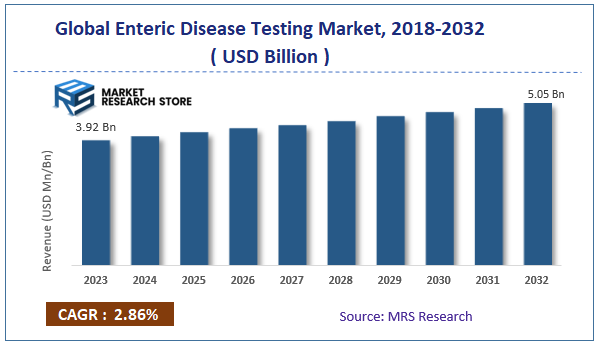
According to Market Research Store, the global enteric disease testing market size was valued at around USD 3.92 billion in 2023 and is estimated to reach USD 5.05 billion by 2032, to register a CAGR of approximately 2.86% in terms of revenue during the forecast period 2024-2032.
To Get more Insights, Request a Free Sample
The enteric disease testing report provides a comprehensive analysis of the market, including its size, share, growth trends, revenue details, and other crucial information regarding the target market. It also covers the drivers, restraints, opportunities, and challenges till 2032.
Global Enteric Disease Testing Market: Overview
The Enteric Disease Testing Market refers to the diagnostic sector focused on testing for infections caused by pathogens affecting the gastrointestinal tract, such as bacteria, viruses, and parasites. Common enteric diseases include salmonella, Escherichia coli (E. coli), rotavirus, and norovirus. These infections are often transmitted through contaminated food and water, leading to symptoms such as diarrhea, vomiting, and abdominal pain. The market includes diagnostic tests such as PCR-based tests, immunoassays, culture-based methods, and rapid diagnostic tests (RDTs).
The primary drivers of this market include the increasing prevalence of gastrointestinal infections globally, rising awareness about foodborne diseases, and advancements in diagnostic technologies. The growing demand for quick and accurate diagnostics, particularly in healthcare settings and among food safety organizations, is propelling the growth of this market. Additionally, the shift toward more sensitive and rapid testing methods, such as molecular diagnostics and immunoassays, helps healthcare providers to detect pathogens more efficiently, which is boosting the demand for enteric disease tests.
Key Highlights
- The enteric disease testing market is anticipated to grow at a CAGR of 2.86% during the forecast period.
- The global enteric disease testing market was estimated to be worth approximately USD 3.92 billion in 2023 and is projected to reach a value of USD 5.05 billion by 2032.
- The growth of the enteric disease testing market is being driven by the increasing prevalence of foodborne illnesses, rising healthcare expenditure, and technological advancements in diagnostic tools.
- Based on the product, the e.coli segment is growing at a high rate and is projected to dominate the market.
- On the basis of application, the hospitals segment is projected to swipe the largest market share.
- By region, North America is expected to dominate the global market during the forecast period.
Enteric Disease Testing Market: Dynamics
Key Growth Drivers
- Rising Prevalence of Foodborne Illnesses: Increasing incidents of foodborne illnesses caused by contaminated food and water are driving the demand for rapid and accurate diagnostic tests.
- Advancements in Diagnostic Technologies: The development of advanced diagnostic techniques, such as molecular diagnostics and rapid antigen tests, is improving the accuracy and speed of testing.
- Stricter Food Safety Regulations: Stringent food safety regulations are driving the adoption of robust testing procedures to ensure food safety.
- Increasing Healthcare Spending: Rising healthcare spending is enabling greater access to diagnostic testing services.
Restraints
- High Cost of Advanced Tests: Advanced diagnostic tests can be expensive, limiting their accessibility in certain regions.
- Complex Laboratory Procedures: Some tests require specialized laboratory equipment and skilled technicians.
- Time-Consuming Processes: Traditional culture-based methods can be time-consuming, delaying diagnosis and treatment.
- Lack of Awareness: Lack of awareness about the importance of early diagnosis and treatment can hinder the adoption of testing.
Opportunities
- Point-of-Care Testing: The development of rapid point-of-care tests can enable faster diagnosis and treatment.
- Molecular Diagnostics: Advanced molecular diagnostic techniques, such as PCR and DNA sequencing, can provide accurate and sensitive results.
- Telehealth and Remote Monitoring: Telehealth can facilitate remote sample collection and result reporting, improving access to testing.
- Emerging Markets: Expanding into emerging markets with growing healthcare infrastructure can drive market growth.
Challenges
- Regulatory Hurdles: Stringent regulatory requirements for diagnostic tests can delay market entry.
- Data Privacy and Security: Ensuring the privacy and security of patient data is crucial.
- Skill and Training Requirements: Skilled laboratory personnel are required to perform accurate and reliable tests.
- Supply Chain Disruptions: Disruptions in the supply chain of reagents and consumables can impact testing capacity.
Enteric Disease Testing Market: Report Scope
| Report Attributes | Report Details |
|---|---|
| Report Name | Enteric Disease Testing Market |
| Market Size in 2023 | USD 3.92 Billion |
| Market Forecast in 2032 | USD 5.05 Billion |
| Growth Rate | CAGR of 2.86% |
| Number of Pages | 215 |
| Key Companies Covered | Abbott, Becton, Dickinson, Bio Rad Laboratories, Biomerica, Cepheid, Coris BioConcept, DiaSorin, Meridian BioSceinces, Quest Diagnostics, bioMerieux, and others. |
| Segments Covered | By Product, By Application, and By Region |
| Regions Covered | North America, Europe, Asia Pacific (APAC), Latin America, Middle East, and Africa (MEA) |
| Base Year | 2023 |
| Historical Year | 2018 to 2022 |
| Forecast Year | 2024 - 2032 |
| Customization Scope | Avail customized purchase options to meet your exact research needs. Request For Customization |
Enteric Disease Testing Market: Segmentation Insights
The global enteric disease testing market is divided by product, application, and region.
Segmentation Insights by Product
Based on Product, the global enteric disease testing market is divided into e.coli, c. difficile, campylobacteriosis, cholera, h.pylori, salmonellosis, shigellosis, and others.
The E. coli segment dominates the enteric disease testing market, largely due to the high frequency of foodborne outbreaks and regulatory requirements for food safety testing. E. coli infections are one of the most commonly reported foodborne illnesses worldwide, driving continuous demand for testing solutions. E. coli is one of the largest segments in the enteric disease testing market due to the widespread nature of foodborne outbreaks and the regulatory requirements for testing food products.
The C. difficile segment holds a significant share of the enteric disease testing market, driven by the high prevalence of hospital-acquired infections and the rise in antimicrobial resistance (AMR). Clostridium difficile (C. difficile) infection is a leading cause of healthcare-associated gastrointestinal disease. It is commonly tested using stool samples to identify the bacteria responsible for the infection.
Campylobacteriosis accounts for a significant portion of enteric disease testing, particularly in developed countries, where foodborne infections are more frequently reported. Campylobacteriosis is caused by the Campylobacter bacteria, typically transmitted through contaminated food, especially undercooked poultry. The testing involves stool samples and various diagnostic methods, such as PCR, enzyme immunoassays, and culture.
Cholera testing is a critical part of enteric disease surveillance, especially in developing countries and regions with poor sanitation infrastructure. The market for cholera testing is highly dependent on geographical factors and the occurrence of outbreaks. Cholera is caused by Vibrio cholerae, a bacterium transmitted through contaminated water.
H. Pylori testing is a well-established market segment due to the chronic nature of the infection and its link to stomach cancer. It is one of the most common gastrointestinal infections worldwide. H. pylori) is a bacterium responsible for gastrointestinal infections, including peptic ulcers and gastritis. The testing methods for H. pylori include blood tests, breath tests, stool antigen tests, and biopsy samples.
Salmonellosis accounts for a significant portion of the enteric disease testing market, particularly in food safety and public health surveillance. It is one of the most commonly tested foodborne illnesses globally. Salmonellosis is caused by the Salmonella bacteria, often through consumption of contaminated food such as poultry, eggs, or unpasteurized milk.
Shigellosis testing is a growing market, especially in regions with limited access to sanitation and in healthcare settings that handle diarrheal diseases. Shigellosis is caused by Shigella bacteria and is transmitted through contaminated food, water, or direct contact with infected individuals. Testing involves stool cultures, PCR, and rapid antigen tests.
Segmentation Insights by Application
On the basis of Application, the global enteric disease testing market is bifurcated into hospitals, research centers, clinics, and others.
The Hospitals segment dominates the elastomeric closure components market due to the high volume of injectable drug use in hospital settings. Hospitals are the largest consumers of injectable medicines, vaccines, and biologics, making them the dominant application segment. The hospital segment holds a significant portion of the market due to the high demand for injectable drugs, vaccines, and biologics in clinical settings.
Research Centers use elastomeric closures in various pharmaceutical and biotech applications, including drug development, testing, and clinical trials. The research center segment holds a moderate share of the market. Although it is not as large as the hospital segment, it is growing due to the increasing investment in biomedical research, the development of new therapies, and clinical trials, particularly in the areas of personalized medicine, vaccines, and biologics.
Clinics, especially outpatient and specialty clinics, use elastomeric closures in syringes and cartridges for administering injectable medications and vaccines to patients. The clinic segment is a growing application area for elastomeric closures, particularly with the increasing use of injectable medications in outpatient care. The rise in chronic disease management, vaccinations, and aesthetic treatments in clinics is contributing to this growth.
Enteric Disease Testing Market: Regional Insights
- North America currently leads the global enteric disease testing market
North America holds a significant share of the enteric disease testing market, driven by high healthcare standards, advanced diagnostic infrastructure, and a rising focus on food safety. The United States, in particular, plays a crucial role in this market, with an emphasis on public health initiatives, including the detection of foodborne pathogens, which contribute to a high demand for enteric disease tests. Additionally, the increasing adoption of molecular diagnostic technologies such as PCR and next-generation sequencing is driving growth in the region.
Europe is another key region in the enteric disease testing market, with countries like Germany, the UK, and France leading the market. The region has a well-developed healthcare system and a high level of awareness about foodborne diseases. European countries are investing in advanced diagnostic tools to enhance the speed and accuracy of enteric disease detection. The rising focus on surveillance of enteric diseases, particularly in the wake of foodborne outbreaks, further fuels the demand for testing solutions.
The Asia Pacific region is expected to experience the fastest growth in the enteric disease testing market, driven by a large population base, increasing urbanization, and rising healthcare investments. Countries like China, India, and Japan are major contributors to the market growth. The increasing prevalence of gastrointestinal infections and foodborne diseases, coupled with the demand for rapid and accurate diagnostic tools, is boosting market expansion in this region. Additionally, the growing focus on improving healthcare infrastructure and diagnostic capabilities in emerging economies will likely enhance the market outlook.
The Latin American market for enteric disease testing is expanding, with Brazil and Mexico being the leading countries in the region. While there is a growing awareness of enteric diseases, challenges such as limited access to advanced diagnostic technologies and healthcare disparities in rural areas may hinder market growth. However, the increasing number of foodborne outbreaks and government initiatives to improve food safety standards are expected to drive the demand for enteric disease testing in the region.
The Middle East and Africa (MEA) region is witnessing gradual growth in the enteric disease testing market, with more focus on improving healthcare infrastructure and diagnostic capabilities in countries like Saudi Arabia, the UAE, and South Africa. In these regions, increasing investments in healthcare and rising awareness about gastrointestinal diseases are helping to propel market growth. However, challenges such as economic constraints and limited access to advanced diagnostic tools in certain African countries may limit market penetration.
Enteric Disease Testing Market: Competitive Landscape
The report provides an in-depth analysis of companies operating in the enteric disease testing market, including their geographic presence, business strategies, product offerings, market share, and recent developments. This analysis helps to understand market competition.
Some of the major players in the global enteric disease testing market include:
- Abbott
- Becton
- Dickinson
- Bio Rad Laboratories
- Biomerica
- Cepheid
- Coris BioConcept
- DiaSorin
- Meridian BioSceinces
- Quest Diagnostics
- bioMerieux
The global enteric disease testing market is segmented as follows:
By Product
- E.Coli
- C. difficile
- Campylobacteriosis
- Cholera
- H.Pylori
- Salmonellosis
- Shigellosis
By Application
- Hospitals
- Research Centers
- Clinics
By Region
- North America
- U.S.
- Canada
- Europe
- U.K.
- France
- Germany
- Rest of Europe
- Asia Pacific
- China
- Japan
- India
- South Korea
- Rest of Asia Pacific
- Latin America
- Brazil
- Rest of Latin America
- The Middle East and Africa
- GCC Countries
- South Africa
- Rest of Middle East Africa
Frequently Asked Questions
Based on statistics from the Market Research Store, the global enteric disease testing market size was projected at approximately US$ 3.92 billion in 2023. Projections indicate that the market is expected to reach around US$ 5.05 billion in revenue by 2032.
The global enteric disease testing market is expected to grow at a Compound Annual Growth Rate (CAGR) of around 2.86% during the forecast period from 2024 to 2032.
North America is expected to dominate the global enteric disease testing market.
The global enteric disease testing market is primarily driven by factors such as increasing prevalence of foodborne illnesses, rising healthcare expenditure, advancements in diagnostic technologies, and stringent regulatory standards for food safety.
Some of the prominent players operating in the global enteric disease testing market are; Abbott, Becton, Dickinson, Bio Rad Laboratories, Biomerica, Cepheid, Coris BioConcept, DiaSorin, Meridian BioSceinces, Quest Diagnostics, bioMerieux, and others.
Table Of Content
Inquiry For Buying
Enteric Disease Testing
Request Sample
Enteric Disease Testing
