Automotive Transmission Housing Market Size, Share, and Trends Analysis Report
CAGR :

| Market Size 2023 (Base Year) | USD 64.71 Billion |
| Market Size 2032 (Forecast Year) | USD 120.51 Billion |
| CAGR | 6.4% |
| Forecast Period | 2024 - 2032 |
| Historical Period | 2018 - 2023 |
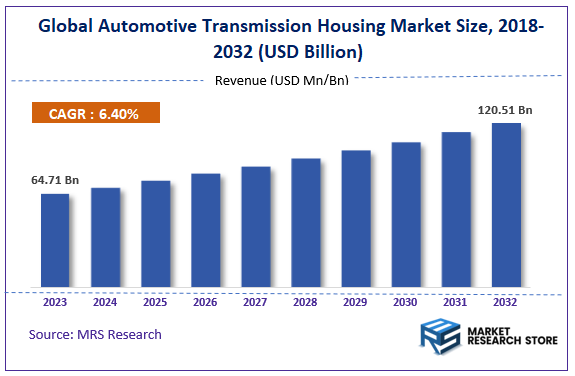
According to Market Research Store, the global automotive transmission housing market size was valued at around USD 64.71 billion in 2023 and is estimated to reach USD 120.51 billion by 2032, to register a CAGR of approximately 6.40% in terms of revenue during the forecast period 2024-2032.
To Get more Insights, Request a Free Sample
The automotive transmission housing report provides a comprehensive analysis of the market, including its size, share, growth trends, revenue details, and other crucial information regarding the target market. It also covers the drivers, restraints, opportunities, and challenges till 2032.
Global Automotive Transmission Housing Market: Overview
Automotive Transmission Housing is a critical component of a vehicle's transmission system, designed to encase and protect the transmission gears, shafts, and other internal parts. It serves as a structural support that holds the entire transmission assembly in place, preventing external contaminants like dirt and moisture from affecting the transmission's operation. Typically made from materials like aluminum or cast iron, transmission housing ensures the durability and heat dissipation necessary for the smooth functioning of the transmission system. Its design must withstand high levels of stress and vibration, as it is exposed to extreme conditions during vehicle operation.
Key Highlights
- The automotive transmission housing market is anticipated to grow at a CAGR of 6.40% during the forecast period.
- The global automotive transmission housing market was estimated to be worth approximately USD 64.71 billion in 2023 and is projected to reach a value of USD 120.51 billion by 2032.
- The growth of the automotive transmission housing market is being driven by the rising demand for vehicles, the shift towards lightweight materials, and advancements in transmission technology.
- Based on the type, the automatic transmission housing segment is growing at a high rate and is projected to dominate the market.
- On the basis of application, the passenger car segment is projected to swipe the largest market share.
- By region, Asia-Pacific is expected to dominate the global market during the forecast period.
Automotive Transmission Housing Market: Dynamics
Key Growth Drivers
- Increasing Vehicle Production: The global automotive industry is experiencing steady growth, driven by rising incomes and urbanization. This directly translates to increased demand for vehicles, which, in turn, boosts the need for automotive transmission housings.
- Advancements in Transmission Technology: The development of more efficient and sophisticated transmission systems, such as dual-clutch transmissions and continuously variable transmissions (CVTs), requires specialized housing designs. This drives innovation and growth in the market.
- Shift Towards Electric Vehicles: The transition to electric vehicles (EVs) is gaining momentum. While EVs have different transmission systems, they still require housings for components like gearboxes, inverters, and motors. This presents new opportunities for manufacturers.
Restraints
- Fluctuating Raw Material Prices: The automotive industry is sensitive to fluctuations in the prices of raw materials like steel, aluminum, and plastics used to manufacture transmission housings. Rising costs can impact profitability and hinder market growth.
- Stringent Emission Regulations: Government regulations aimed at reducing emissions have led to the development of more complex transmission systems. This can increase the cost and complexity of housing design and manufacturing.
- Economic Downturns: During economic downturns, consumers may reduce their spending on new vehicles, leading to a decline in demand for transmission housings.
Opportunities
- Lightweight Materials: The increasing focus on fuel efficiency and reducing vehicle weight presents opportunities for manufacturers to develop housings made from lightweight materials like magnesium and carbon fiber composites.
- Advanced Manufacturing Techniques: The adoption of advanced manufacturing techniques, such as 3D printing and additive manufacturing, can streamline production processes and enable the creation of complex housing designs.
- Customization and Personalization: As consumers seek more personalized vehicles, there is a growing demand for customized transmission housings to meet specific requirements or preferences.
Challenges
- Competition: The automotive transmission housing market is highly competitive, with numerous players vying for market share. This can make it challenging to differentiate products and maintain profitability.
- Supply Chain Disruptions: Global events like pandemics, natural disasters, and geopolitical tensions can disrupt supply chains, leading to delays in production and increased costs.
- Technological Advancements: Rapid advancements in technology can make it difficult for manufacturers to keep up with the latest trends and innovations, potentially hindering their competitiveness.
Automotive Transmission Housing Market: Segmentation Insights
The global automotive transmission housing market is divided by type, application, and region.
Segmentation Insights by Type
Based on type, the global automotive transmission housing market is divided into automatic transmission and manual transmission.
Automatic Transmission Housing segment is dominating due to the increasing preference for automatic transmissions, particularly in passenger cars. Consumers are favoring automatic transmissions for their convenience, ease of driving, and integration with advanced technologies such as ADAS (Advanced Driver Assistance Systems) and electric vehicles (EVs). The automatic transmission segment is experiencing a high CAGR, driven by the shift towards EVs and the rising demand for urban mobility solutions.
Manual transmission housing is designed for vehicles with manual gearboxes, where the driver manually shifts gears. These are traditionally popular in regions where cost-efficiency and control over the vehicle are prioritized. Manual transmissions are often associated with lower manufacturing costs and higher fuel efficiency, making them a preferred choice in commercial vehicles and certain markets where driving dynamics are emphasized.
While the CAGR of manual transmission housings might be lower compared to automatic transmission housings due to shifting consumer preferences, they remain significant in regions where manual transmissions are favored.
Segmentation Insights by Application
On the basis of application, the global automotive transmission housing market is bifurcated into passenger car and commercial vehicle.
In terms of application, the passenger car segment holds a dominant position in the market. The sheer volume of passenger car production globally, combined with the rising consumer preference for private vehicles with automatic transmissions, contributes to the dominance of this segment.
The increasing adoption of electric vehicles, which often feature automatic transmissions, further supports this segment's growth. The CAGR for this segment is expected to remain strong due to the growing trend toward urbanization and vehicle ownership.
Commercial vehicles, including trucks, buses, and heavy-duty vehicles, require durable and robust transmission housings. These vehicles are essential for logistics, public transport, and industrial applications, where reliability and efficiency are critical. Manual transmission housings are more prevalent in this segment due to their cost-efficiency and reliability, particularly in regions where commercial vehicles are expected to endure heavy loads and frequent gear changes.
However, as the market moves toward electric and hybrid commercial vehicles, automatic transmission housings are expected to grow at a significant CAGR. This segment's growth is also driven by increasing infrastructure development and the expansion of logistics industries worldwide.
Automotive Transmission Housing Market: Report Scope
| Report Attributes | Report Details |
|---|---|
| Report Name | Automotive Transmission Housing Market |
| USD 64.71 Billion | |
| USD 120.51 Billion | |
| Growth Rate | CAGR of 6.40% |
| Number of Pages | 220 |
| Key Companies Covered | ZF Friedrichshafen, Aisin Seiki, American Axle & Manufacturing, CIE Automotive, Eaton, Magna International, Schaeffler, Allison Transmission, Jatco, Magneti Marelli, Gibbons Transmission Systems, Weber Automotive, Matsumura Mold&Pattern, Punch Powertrain, Tremec, Avtec, Aichi Machine Industry, Hewland, Hunan Oil Pump, and others. |
| Segments Covered | By Type, By Application, and By Region |
| Regions Covered | North America, Europe, Asia Pacific (APAC), Latin America, Middle East, and Africa (MEA) |
| Base Year | 2023 |
| Historical Year | 2018 to 2022 |
| Forecast Year | 2024 - 2032 |
| Customization Scope | Avail customized purchase options to meet your exact research needs. Request For Customization |
Automotive Transmission Housing Market: Regional Insights
Asia-Pacific holds the dominant position. This region's growth is driven by stringent environmental regulations, increased vehicle production, and rising demand for fuel-efficient technologies. Countries like China, Japan, and India are major contributors, with China implementing Euro-4 equivalent emission standards. The region is also seeing increased adoption of automatic transmissions due to urbanization and traffic congestion.
Europe is a significant player due to its strong automotive R&D investments. This region is renowned for its innovation in electric vehicles (EVs) and high-quality multi-speed transmissions, contributing to its steady market growth. The European market is expected to benefit from increasing EV penetration, which demands advanced transmission systems for enhanced efficiency.
North America is the second-largest market, propelled by high demand for automatic transmissions and advanced technologies like automated manual transmissions (AMT). The region's sophisticated manufacturing infrastructure and a shift toward higher vehicle efficiency are driving growth.
Latin America and the Middle East & Africa are emerging markets with moderate growth. Latin America is witnessing gradual adoption of newer transmission technologies, while the Middle East and Africa have a relatively smaller share but are expected to experience steady growth due to increasing urbanization and vehicle demand in the region.
Automotive Transmission Housing Market: Competitive Landscape
The report provides an in-depth analysis of companies operating in the automotive transmission housing market, including their geographic presence, business strategies, product offerings, market share, and recent developments. This analysis helps to understand market competition.
Some of the major players in the global automotive transmission housing market include:
- ZF Friedrichshafen
- Aisin Seiki
- American Axle & Manufacturing
- CIE Automotive
- Eaton
- Magna International
- Schaeffler
- Allison Transmission
- Jatco
- Magneti Marelli
- Gibbons Transmission Systems
- Weber Automotive
- Matsumura Mold&Pattern
- Punch Powertrain
- Tremec
- Avtec
- Aichi Machine Industry
- Hewland
- Hunan Oil Pump
The global automotive transmission housing market is segmented as follows:
By Type
- Automatic Transmission
- Manual Transmission
By Application
- Passenger Car
- Commercial Vehicle
By Region
- North America
- U.S.
- Canada
- Europe
- U.K.
- France
- Germany
- Rest of Europe
- Asia Pacific
- China
- Japan
- India
- South Korea
- Rest of Asia Pacific
- Latin America
- Brazil
- Rest of Latin America
- The Middle East and Africa
- GCC Countries
- South Africa
- Rest of Middle East Africa
Frequently Asked Questions
Based on statistics from the Market Research Store, the global automotive transmission housing market size was projected at approximately US$ 64.71 billion in 2023. Projections indicate that the market is expected to reach around US$ 120.51 billion in revenue by 2032.
The global automotive transmission housing market is expected to grow at a Compound Annual Growth Rate (CAGR) of around 6.40% during the forecast period from 2024 to 2032.
Asia-Pacific is expected to dominate the global automotive transmission housing market.
The global automotive transmission housing market is experiencing steady growth, driven by the rising demand for vehicles, the shift towards lightweight materials, and advancements in transmission technology.
Who are the leading players functioning in the global automotive transmission housing market growth?
Some of the prominent players operating in the global automotive transmission housing market are; ZF Friedrichshafen, Aisin Seiki, American Axle & Manufacturing, CIE Automotive, Eaton, Magna International, Schaeffler, Allison Transmission, Jatco, Magneti Marelli, Gibbons Transmission Systems, Weber Automotive, Matsumura Mold&Pattern, Punch Powertrain, Tremec, Avtec, Aichi Machine Industry, Hewland, Hunan Oil Pump, and others.
Table Of Content
Inquiry For Buying
Automotive Transmission Housing
Request Sample
Automotive Transmission Housing
