Electronic Paper Screen in Education Market Size, Share, and Trends Analysis Report
CAGR :

| Market Size 2023 (Base Year) | USD 328.78 Million |
| Market Size 2032 (Forecast Year) | USD 744.11 Million |
| CAGR | 9.5% |
| Forecast Period | 2024 - 2032 |
| Historical Period | 2018 - 2023 |
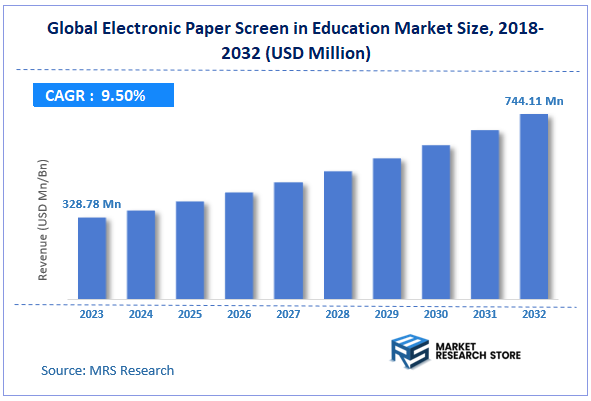
According to Market Research Store, the global electronic paper screen in education market size was valued at around USD 328.78 million in 2023 and is estimated to reach USD 744.11 million by 2032, to register a CAGR of approximately 9.5% in terms of revenue during the forecast period 2024-2032.
To Get more Insights, Request a Free Sample
The electronic paper screen in education report provides a comprehensive analysis of the market, including its size, share, growth trends, revenue details, and other crucial information regarding the target market. It also covers the drivers, restraints, opportunities, and challenges till 2032.
Global Electronic Paper Screen in Education Market: Overview
The Electronic Paper Screen in Education Market refers to the adoption of electronic paper (e-paper) display technology in educational settings, including schools, colleges, and universities. E-paper screens use technology that mimics the appearance of ink on paper, offering benefits such as reduced eye strain, energy efficiency, and readability in bright light conditions.
These screens are used in a variety of educational devices, including e-readers, digital notebooks, interactive displays, and smart textbooks. The technology is gaining traction as an alternative to traditional paper-based resources, providing an eco-friendly, cost-effective, and interactive solution for educational content delivery.
The market growth is driven by the increasing demand for digital learning tools, the shift towards paperless classrooms, and the growing preference for sustainable technologies.
E-paper displays are particularly suited for environments where prolonged reading or note-taking is common, such as in educational settings, due to their ability to provide a paper-like experience while reducing eye fatigue.
Additionally, e-paper technology is being integrated into digital textbooks, learning tablets, and whiteboards, supporting the digitalization of education. Governments' efforts to modernize educational infrastructure and promote technology-driven learning are also key factors fueling market expansion.
Key Highlights
- The electronic paper screen in education market is anticipated to grow at a CAGR of 9.5% during the forecast period.
- The global electronic paper screen in education market was estimated to be worth approximately USD 328.78 million in 2023 and is projected to reach a value of USD 744.11 million by 2032.
- The growth of the electronic paper screen in education market is being driven by the increasing demand for digital learning tools that offer a paper-like reading experience without the environmental impact.
- Based on the product, the rigid electronic paper screen segment is growing at a high rate and is projected to dominate the market.
- On the basis of application, the video walls segment is projected to swipe the largest market share.
- By region, North America is expected to dominate the global market during the forecast period.
Electronic Paper Screen in Education Market: Dynamics
Key Growth Drivers
- Reduced Eye Strain: E-paper screens reduce eye strain compared to traditional LCD or LED displays, promoting healthier learning environments.
- Paper-like Reading Experience: E-paper screens mimic the appearance of traditional paper, enhancing readability and reducing distractions.
- Energy Efficiency: E-paper displays consume significantly less power than traditional displays, making them environmentally friendly and cost-effective.
- Portability and Durability: E-paper devices are lightweight, durable, and suitable for use in various learning environments, both indoors and outdoors.
Restraints
- High Initial Cost: The initial cost of e-paper devices, especially large-format displays, can be higher than traditional display technologies.
- Limited Color Gamut: E-paper displays currently have limitations in terms of color gamut and refresh rates, which may not be suitable for all educational applications.
- Content Creation and Compatibility: Developing and adapting educational content for e-paper displays requires specific tools and formats.
- Technical Limitations: E-paper technology is still evolving, and there may be limitations in terms of screen size, resolution, and refresh rates.
Opportunities
- Interactive Learning: E-paper displays can be integrated with interactive features, such as touchscreens and stylus input, to enhance learning experiences.
- Digital Textbooks: E-paper devices can replace traditional textbooks, reducing the environmental impact and providing easy access to updated content.
- Accessibility: E-paper displays can be used to create accessible learning materials for students with visual impairments.
- Remote Learning: E-paper devices can facilitate remote learning by providing clear and easy-to-read digital content.
Challenges
- Standardization and Interoperability: Establishing industry standards for e-paper formats and content delivery is essential for widespread adoption.
- Content Development and Distribution: Creating high-quality educational content specifically designed for e-paper displays requires significant effort and resources.
- User Adoption: Encouraging teachers and students to adopt e-paper technology and change their learning habits may require training and support.
- Supply Chain and Manufacturing: Ensuring a reliable supply chain for e-paper displays and related components is crucial.
Electronic Paper Screen in Education Market: Segmentation Insights
The global electronic paper screen in education market is divided by product, application, and region.
Segmentation Insights by Product
Based on Product, the global electronic paper screen in education market is divided into rigid electronic paper screen, flexible electronic paper screen, and others.
While Rigid Electronic Paper Screens dominate, the Flexible Electronic Paper Screen segment is poised for significant growth due to the rise of portable and adaptable learning solutions. Flexible screens offer advantages in portability, user interaction, and flexibility, which are becoming more valuable in modern educational contexts. The Rigid Electronic Paper Screen segment holds a significant share of the electronic paper screen market in education, driven by the demand for stable, long-lasting, and clear displays in educational tools.
The Flexible Electronic Paper Screen segment is growing rapidly, driven by the increasing demand for portable, adaptable, and lightweight learning devices. Its potential for use in interactive learning tools, tablets, and wearable devices is a key growth driver. The Flexible Electronic Paper Screen segment involves electronic paper displays that can bend or fold, offering more versatility and adaptability for various applications.
Segmentation Insights by Application
On the basis of Application, the global electronic paper screen in education market is bifurcated into video walls, video screen, transparent LED screen, digital poster, kiosks, and others.
While Video Walls dominate, the Transparent LED Screen segment is emerging rapidly due to the innovative nature of these displays. Their ability to blend educational content with the physical environment makes them appealing for modern educational institutions looking to create cutting-edge learning spaces. The Video Walls segment holds a moderate to high share of the electronic paper screen market in education, driven by the increasing use of digital displays for large-scale information delivery and interactive learning environments in schools and universities.
The Video Screen segment is expected to hold a significant share in educational settings where video-based content delivery is crucial, especially in digital classrooms or virtual learning environments. The Video Screen segment involves electronic paper displays used for standard video playback, used in classrooms, auditoriums, and lecture halls.
The Transparent LED Screen segment is emerging in the educational market, with increasing interest in innovative, interactive, and aesthetically pleasing digital solutions for educational displays. The Transparent LED Screen segment includes transparent or see-through electronic paper screens that can display information while maintaining visibility of the background or environment.
The Digital Poster segment holds a growing share of the market due to the increasing use of digital signage for campus communication, advertisements, and student engagement in educational institutions. The Digital Poster segment includes small to medium-sized electronic paper screens used for displaying digital posters and advertisements.
The Kiosks segment is gaining popularity in educational environments, particularly in large institutions that require interactive, on-demand information access for students, faculty, and visitors. The Kiosks segment refers to self-service terminals that use electronic paper screens for various purposes, such as information retrieval, registration, campus navigation, and interactive learning.
Electronic Paper Screen in Education Market: Report Scope
| Report Attributes | Report Details |
|---|---|
| Report Name | Electronic Paper Screen in Education Market |
| Market Size in 2023 | USD 328.78 Million |
| USD 744.11 Million | |
| Growth Rate | CAGR of 9.5% |
| Number of Pages | 222 |
| Key Companies Covered | Intel, LG Electronics, Microsoft, NEC Display Solutions, Omnivex, Panasonic, Samsung Electronics, Scala, Winmate Communication, and others. |
| Segments Covered | By Product, By Application, and By Region |
| Regions Covered | North America, Europe, Asia Pacific (APAC), Latin America, Middle East, and Africa (MEA) |
| Base Year | 2023 |
| Historical Year | 2018 to 2022 |
| Forecast Year | 2024 - 2032 |
| Customization Scope | Avail customized purchase options to meet your exact research needs. Request For Customization |
Electronic Paper Screen in Education Market: Regional Insights
- North America currently leads the global electronic paper screen in education market
North America, particularly the United States and Canada, is a significant player in the electronic paper screen in education market due to the high level of technological adoption in schools and universities. The market is supported by substantial investments in educational technology, increasing demand for sustainable and energy-efficient learning tools, and the presence of major e-paper display manufacturers like E Ink Corporation.
Additionally, North America has a large base of ed-tech companies and educational institutions that are integrating e-paper technology into their digital learning environments. The adoption of digital textbooks and e-readers is widespread, with a focus on enhancing learning experiences, especially in K-12 and higher education.
Europe is another key market for electronic paper screens in education, with a high level of digital transformation in education. Countries like Germany, the UK, and France are investing in digital learning tools that incorporate e-paper technology. The demand for e-readers and digital learning devices in universities and schools is steadily increasing.
The European Union’s push for sustainability and digital education further supports the adoption of energy-efficient solutions like e-paper displays. Additionally, European educational institutions are increasingly adopting digital textbooks and e-paper-based smartboards for enhanced interactive learning.
The Asia Pacific region is one of the fastest-growing markets for electronic paper screens in education. Countries like China, India, Japan, and South Korea are at the forefront of adopting digital education technologies. E-paper displays are being used in e-readers, educational tablets, and digital signage in classrooms. In countries like Japan, where innovation in educational technology is highly prioritized, e-paper is being used for smart learning solutions and interactive educational tools.
In India, the government’s push for digital learning initiatives and affordable educational tools has contributed to the growth of e-paper technology in schools and higher education institutions. The region is seeing a rapid rise in mobile learning platforms that utilize e-paper displays for a seamless, sustainable educational experience.
In Latin America, the adoption of e-paper technology in education is slower compared to other regions, but it is steadily growing due to rising investments in digital education. Countries like Brazil and Mexico are exploring e-paper displays for digital textbooks and mobile learning devices.
The increasing availability of affordable e-paper-based educational products is expected to boost the market in the region. Governments in countries like Argentina are focusing on digital education policies that could further increase the demand for such sustainable learning solutions.
The Middle East and Africa region is seeing an increase in the adoption of e-paper displays in education, driven by the growing interest in smart education technologies and sustainable learning tools. Countries like the UAE, Saudi Arabia, and South Africa are investing in digital learning solutions, with schools and universities adopting e-paper-based devices for both textbooks and interactive learning.
As governments in the region continue to focus on improving education through technology, the demand for energy-efficient solutions like e-paper displays is expected to rise.
Electronic Paper Screen in Education Market: Competitive Landscape
The report provides an in-depth analysis of companies operating in the electronic paper screen in education market, including their geographic presence, business strategies, product offerings, market share, and recent developments. This analysis helps to understand market competition.
Some of the major players in the global electronic paper screen in education market include:
- Intel
- LG Electronics
- Microsoft
- NEC Display Solutions
- Omnivex
- Panasonic
- Samsung Electronics
- Scala
- Winmate Communication
The global electronic paper screen in education market is segmented as follows:
By Product
- Rigid Electronic Paper Screen
- Flexible Electronic Paper Screen
By Application
- Video Walls
- Video Screen
- Transparent LED Screen
- Digital Poster
- Kiosks
By Region
- North America
- U.S.
- Canada
- Europe
- U.K.
- France
- Germany
- Rest of Europe
- Asia Pacific
- China
- Japan
- India
- South Korea
- Rest of Asia Pacific
- Latin America
- Brazil
- Rest of Latin America
- The Middle East and Africa
- GCC Countries
- South Africa
- Rest of Middle East Africa
Frequently Asked Questions
Based on statistics from the Market Research Store, the global electronic paper screen in education market size was projected at approximately US$ 328.78 million in 2023. Projections indicate that the market is expected to reach around US$ 744.11 million in revenue by 2032.
The global electronic paper screen in education market is expected to grow at a Compound Annual Growth Rate (CAGR) of around 9.5% during the forecast period from 2024 to 2032.
North America is expected to dominate the global electronic paper screen in education market.
The global electronic paper screen in education market is primarily driven by factors such as the increasing adoption of digital learning tools, the growing need for paperless classrooms, and the rising demand for eye-friendly display technologies.
Some of the prominent players operating in the global electronic paper screen in education market are; Intel, LG Electronics, Microsoft, NEC Display Solutions, Omnivex, Panasonic, Samsung Electronics, Scala, Winmate Communication, and others.
The global electronic paper screen in education market report provides a comprehensive analysis of market definitions, growth factors, opportunities, challenges, geographic trends, and competitive dynamics.
Table Of Content
Inquiry For Buying
Electronic Paper Screen in Education
Request Sample
Electronic Paper Screen in Education
