Geriatric Software Market Size, Share, and Trends Analysis Report
CAGR :

| Market Size 2023 (Base Year) | USD 2.64 Billion |
| Market Size 2032 (Forecast Year) | USD 5.95 Billion |
| CAGR | 8.5% |
| Forecast Period | 2024 - 2032 |
| Historical Period | 2018 - 2023 |
Geriatric Software Market Insights
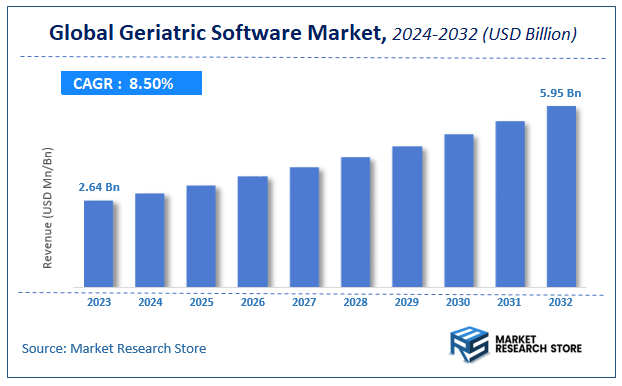
According to Market Research Store, the global geriatric software market size was valued at around USD 2.64 billion in 2023 and is estimated to reach USD 5.95 billion by 2032, to register a CAGR of approximately 8.5% in terms of revenue during the forecast period 2024-2032.
The geriatric software report provides a comprehensive analysis of the market, including its size, share, growth trends, revenue details, and other crucial information regarding the target market. It also covers the drivers, restraints, opportunities, and challenges till 2032.
To Get more Insights, Request a Free Sample
Global Geriatric Software Market: Overview
The Geriatric Software Market focuses on software solutions designed to meet the healthcare and lifestyle needs of the elderly population. These software applications include features such as patient management, telemedicine, medication tracking, health monitoring, and caregiver coordination. They are widely used by hospitals, nursing homes, assisted living facilities, and home care providers to streamline elder care, enhance efficiency, and improve patient outcomes.
The market is being driven by the increasing global aging population and the rising prevalence of chronic diseases among the elderly, such as diabetes, cardiovascular disorders, and Alzheimer’s disease. Advances in health IT, telehealth technologies, and wearable health devices are further propelling the adoption of geriatric software solutions. Additionally, the demand for personalized care, improved patient engagement, and efficient caregiver coordination are fueling market growth.
Key Highlights
- The geriatric software market is anticipated to grow at a CAGR of 8.5% during the forecast period.
- The global geriatric software market was estimated to be worth approximately USD 2.64 billion in 2023 and is projected to reach a value of USD 5.95 billion by 2032.
- The growth of the geriatric software market is being driven by several key factors, including the rapidly aging global population, increasing prevalence of chronic diseases among the elderly, rising healthcare costs, and advancements in technology.
- Based on the product, the cloud-based segment is growing at a high rate and is projected to dominate the market.
- On the basis of application, the home health segment is projected to swipe the largest market share.
- By region, North America is expected to dominate the global market during the forecast period.
Geriatric Software Market: Dynamics
Key Drivers
- Aging Population: The global population is aging rapidly, leading to a significant increase in the elderly population worldwide.
- Chronic Disease Management: Geriatric software plays a crucial role in managing chronic diseases like diabetes, hypertension, and dementia.
- Telehealth & Remote Monitoring: The rise of telehealth and remote patient monitoring enables continuous care for elderly individuals, facilitated by geriatric software solutions.
- Independent Living: Technologies like smart homes and wearable devices, integrated with geriatric software, empower older adults to live independently for longer.
- Government Initiatives: Government initiatives promoting aging-in-place and supporting elderly care are driving the adoption of geriatric software solutions.
Restraints
- Data Privacy & Security: Concerns about data privacy and security related to sensitive patient information are a significant restraint.
- Technological Literacy: Limited technological literacy among older adults can hinder the adoption and effective use of geriatric software.
- High Initial Investment: The initial investment in hardware, software, and infrastructure can be a significant barrier for some individuals and healthcare providers.
- Integration Challenges: Integrating geriatric software with existing healthcare systems and Electronic Health Records (EHRs) can be complex.
- Reimbursement Issues: Limited reimbursement coverage for geriatric technologies can limit their accessibility and affordability.
Opportunities
- AI & Machine Learning: Integrating AI and ML for predictive analytics, personalized care plans, and early detection of health issues.
- IoT Integration: Integrating geriatric software with IoT devices like wearables, smart home appliances, and medical devices.
- Virtual Reality & Augmented Reality: Utilizing VR/AR for remote care, cognitive training, and social interaction for elderly individuals.
- Accessibility & User-Friendliness: Developing user-friendly interfaces and intuitive designs that are easy for older adults to use.
- Expanding to Emerging Markets: Exploring emerging markets with rapidly aging populations and growing healthcare needs.
Challenges
- Maintaining Data Accuracy & Security: Ensuring the accuracy, integrity, and security of sensitive patient data.
- Addressing Ethical Concerns: Addressing ethical concerns related to data privacy, autonomy, and the potential for over-reliance on technology.
- Ensuring Interoperability: Ensuring interoperability between different geriatric software solutions and healthcare systems.
- Addressing Digital Divide: Bridging the digital divide and ensuring equitable access to geriatric technologies for all older adults.
Geriatric Software Market: Report Scope
| Report Attributes | Report Details |
|---|---|
| Report Name | Geriatric Software Market |
| Market Size in 2023 | USD 2.64 Billion |
| Market Forecast in 2032 | USD 5.95 Billion |
| Growth Rate | CAGR of 8.5% |
| Number of Pages | 140 |
| Key Companies Covered | Kareo Billing, Bizmatics, Azalea Health, NovoClinical, MDConnection, eClinicalWorks, Centricity, AllegianceMD, Practice, TotalMD, ChARM Health, CompuGroup Medical, Waystar, Advanced Data Systems, GEHRIMED, Doc-tor.com, Sevocity, UltraLinq |
| Segments Covered | By Product Type, By Application, and By Region |
| Regions Covered | North America, Europe, Asia Pacific (APAC), Latin America, Middle East, and Africa (MEA) |
| Base Year | 2023 |
| Historical Year | 2018 to 2023 |
| Forecast Year | 2024 to 2032 |
| Customization Scope | Avail customized purchase options to meet your exact research needs. Request For Customization |
Geriatric Software Market: Segmentation Insights
The global geriatric software market is divided by product, application, and region.
Segmentation Insights by Product
Based on Product, the global geriatric software market is divided into cloud-based, on-premise, and others.
The Cloud-Based Software segment is the dominant player in the geriatric software market and continues to outpace other solutions due to several key factors that cater to the evolving needs of healthcare providers and the aging population. Cloud-based software is hosted on remote servers and accessed via the internet, offering scalability, flexibility, and lower upfront costs. These solutions are ideal for healthcare providers of all sizes, especially those with limited IT resources.
On-premise Software is installed and operated within the healthcare facility, providing full control over data and system customization. This segment is favored by large institutions prioritizing data security and compliance, such as hospitals and long-term care facilities. However, its adoption is declining due to high costs and limited flexibility.
Segmentation Insights by Application
On the basis of Application, the global geriatric software market is bifurcated into home health, senior assisted-living communities, rehabilitation centers, skilled nursing settings, and others.
The Home Health segment has become the dominated segment in the geriatric software market. Software solutions in this segment are tailored for caregivers providing services at patients' homes. They assist with scheduling, monitoring, and delivering personalized care plans. Home health services provide medical and non-medical care to elderly individuals in their own homes, including nursing care, physical therapy, and home health aide services.
Senior Assisted-Living Communities this segment involves software designed to manage operations in senior living communities, focusing on resident care, scheduling, and compliance. These solutions support staff in improving efficiency and ensuring quality care for residents. With the growing elderly population and increasing demand for assisted-living facilities, this segment is witnessing steady growth. Enhanced features like resident monitoring and activity tracking are driving adoption.
Rehabilitation Centers use geriatric software to track patient recovery, manage therapy sessions, and coordinate care plans. The rising prevalence of conditions requiring rehabilitation, such as strokes and fractures, is fueling the demand for specialized software in this segment.
Skilled Nursing Settings this segment focuses on nursing facilities that provide comprehensive care to elderly patients requiring long-term medical supervision. The software aids in managing patient records, medication schedules, and compliance with healthcare regulations. The growing number of skilled nursing facilities and the increasing need for efficient care delivery systems are propelling demand in this segment.
Geriatric Software Market: Regional Insights
- North America currently leads the global geriatric software market
North America dominates the geriatric software market, driven by a well-established healthcare infrastructure, high adoption of advanced technologies, and government support for geriatric care. The United States leads the region, benefiting from a large elderly population and significant investments in digital health technologies. The integration of AI and machine learning in geriatric software for predictive analytics and personalized care is gaining traction. Canada is also contributing to market growth, particularly in telemedicine and remote patient monitoring solutions for elderly care.
Europe is a significant market for geriatric software, with countries like Germany, the UK, and France leading in adoption. The region's aging population, coupled with strong healthcare systems and government initiatives for elder care, drives demand for geriatric-focused digital solutions. For instance, telehealth platforms and home-based care solutions are widely used to address the challenges of an aging population. Moreover, the EU's focus on digital health and interoperability standards is fostering innovation in the geriatric software market.
Asia Pacific is the fastest-growing region in the geriatric software market, driven by rapid urbanization, rising healthcare expenditure, and a growing elderly population. Countries like Japan, China, South Korea, and India are key contributors. Japan, with one of the oldest populations globally, has a high demand for geriatric software solutions, including remote monitoring and robotic caregiving. China and India are witnessing increased adoption of digital healthcare solutions due to government initiatives and the rising prevalence of age-related diseases.
The geriatric software market in Latin America is growing steadily, with Brazil and Mexico being key contributors. The region’s aging population and increasing investments in healthcare infrastructure are driving the adoption of geriatric-focused digital solutions. Telemedicine platforms and EHRs are particularly gaining popularity to address the challenges of providing care in remote and underserved areas. However, limited technological infrastructure in certain parts of the region may hinder growth.
The Middle East and Africa (MEA) region is witnessing gradual growth in the geriatric software market. In the Middle East, countries like the UAE and Saudi Arabia are adopting advanced healthcare technologies for elder care as part of their broader digital transformation initiatives. In Africa, the market is still nascent but holds potential due to the increasing focus on improving healthcare access and the rising burden of chronic diseases among the elderly.
Geriatric Software Market: Competitive Landscape
The report provides an in-depth analysis of companies operating in the geriatric software market, including their geographic presence, business strategies, product offerings, market share, and recent developments. This analysis helps to understand market competition.
Some of the major players in the global geriatric software market include:
- Advanced Data Systems
- AllegianceMD
- Azalea Health
- Bizmatics
- Centricity
- ChARM Health
- CompuGroup Medical
- Doc-tor.com
- eClinicalWorks
- GEHRIMED
- Kareo Billing
- MDConnection
- NovoClinical
- Practice
- Sevocity
- TotalMD
- UltraLinq
- Waystar
The global geriatric software market is segmented as follows:
By Product
- Cloud-Based
- On-Premise
By Application
- Home Health
- Senior Assisted-living Communities
- Rehabilitation Centers
- Skilled Nursing Settings
By Region
- North America
- U.S.
- Canada
- Europe
- U.K.
- France
- Germany
- Rest of Europe
- Asia Pacific
- China
- Japan
- India
- South Korea
- Rest of Asia Pacific
- Latin America
- Brazil
- Rest of Latin America
- The Middle East and Africa
- GCC Countries
- South Africa
- Rest of Middle East Africa
Frequently Asked Questions
Based on statistics from the Market Research Store, the global geriatric software market size was projected at approximately US$ 2.64 billion in 2023. Projections indicate that the market is expected to reach around US$ 5.95 billion in revenue by 2032.
The global geriatric software market is expected to grow at a Compound Annual Growth Rate (CAGR) of around 8.5% during the forecast period from 2024 to 2032.
North America is expected to dominate the global geriatric software market.
The global geriatric software market is primarily driven by the aging population, increasing prevalence of chronic diseases, advancements in technology, and the growing demand for efficient and effective healthcare delivery.
Some of the prominent players operating in the global geriatric software market are; Advanced Data Systems, AllegianceMD, Azalea Health, Bizmatics, Centricity, ChARM Health, CompuGroup Medical, Doc-tor.com, eClinicalWorks, GEHRIMED, Kareo Billing, MDConnection, NovoClinical, Practice, Sevocity, TotalMD, UltraLinq, Waystar, and others.
Table Of Content
Inquiry For Buying
Geriatric Software
Request Sample
Geriatric Software
