Manure Spreaders Market Size, Share, and Trends Analysis Report
CAGR :

| Market Size 2023 (Base Year) | USD 1105.93 Million |
| Market Size 2032 (Forecast Year) | USD 1730.41 Million |
| CAGR | 5.1% |
| Forecast Period | 2024 - 2032 |
| Historical Period | 2018 - 2023 |
Manure Spreaders Market Insights
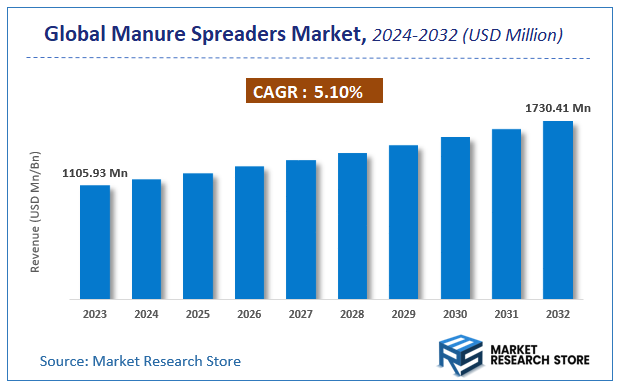
According to Market Research Store, the global manure spreaders market size was valued at around USD 1105.93 million in 2023 and is estimated to reach USD 1730.41 million by 2032, to register a CAGR of approximately 5.1% in terms of revenue during the forecast period 2024-2032.
The manure spreaders report provides a comprehensive analysis of the market, including its size, share, growth trends, revenue details, and other crucial information regarding the target market. It also covers the drivers, restraints, opportunities, and challenges till 2032.
To Get more Insights, Request a Free Sample
Global Manure Spreaders Market: Overview
The Manure Spreaders Market focuses on agricultural equipment designed to evenly distribute manure across fields to enhance soil fertility and improve crop yields. Manure spreaders are essential for modern farming, as they help in efficiently applying organic fertilizers, reducing manual labor, and promoting sustainable agricultural practices. These machines come in various types, including dry, liquid, and semi-liquid spreaders, catering to different farming needs and scales of operation.
The market is driven by the increasing adoption of precision farming techniques, the rising awareness of organic and sustainable agriculture, and the growing demand for high-efficiency farming equipment. As farmers seek to improve soil health and crop productivity while minimizing environmental impact, manure spreaders provide an effective solution for nutrient management. Additionally, technological advancements, such as GPS-guided spreaders and variable-rate application systems, are enhancing operational efficiency and reducing waste.
Key Highlights
- The manure spreaders market is anticipated to grow at a CAGR of 5.1% during the forecast period.
- The global manure spreaders market was estimated to be worth approximately USD 1105.93 million in 2023 and is projected to reach a value of USD 1730.41 million by 2032.
- The growth of the manure spreaders market is being driven by several factors, including the increasing demand for sustainable and efficient agricultural practices, the rising focus on organic farming, and the growing need to improve soil health and nutrient management.
- Based on the product, the above 2000L segment is growing at a high rate and is projected to dominate the market.
- On the basis of application, the farm segment is projected to swipe the largest market share.
- By region, North America is expected to dominate the global market during the forecast period.
Manure Spreaders Market: Dynamics
Key Drivers
- Sustainable Agriculture: Growing emphasis on sustainable agriculture practices, including organic farming and reduced reliance on chemical fertilizers, is driving demand for efficient manure spreading equipment.
- Improved Soil Health: Proper manure application improves soil fertility, enhances crop yields, and promotes soil health, making manure spreaders crucial for sustainable agricultural practices.
- Precision Agriculture: Advancements in precision agriculture technologies, such as GPS guidance and variable rate application, are increasing the demand for sophisticated manure spreaders that enable precise and efficient nutrient distribution.
- Environmental Regulations: Stricter environmental regulations aimed at minimizing nutrient runoff and mitigating environmental pollution are driving the adoption of more efficient and environmentally friendly manure spreading equipment.
Restraints
- High Initial Investment Costs: Modern manure spreaders can be expensive to purchase and maintain, representing a significant investment for farmers.
- Technological Complexity: Operating and maintaining advanced manure spreaders with integrated technologies like GPS and variable rate application can require specialized training and expertise.
- Environmental Concerns: Concerns about potential environmental impacts, such as nutrient runoff and air pollution, if manure is not spread properly.
- Competition from Other Fertilizers: Competition from other fertilizers, such as chemical fertilizers, can impact the demand for manure spreading equipment.
Opportunities
- Technological Advancements: Development of more advanced manure spreaders with features like GPS guidance, variable rate application, and real-time data analysis for improved efficiency and reduced environmental impact.
- Integration with Precision Agriculture Technologies: Integrating manure spreaders with other precision agriculture technologies, such as soil sensors and yield monitors, to optimize nutrient application and maximize crop yields.
- Focus on Sustainability: Developing more sustainable manure spreading technologies, such as those that minimize nutrient runoff and reduce greenhouse gas emissions.
- Exploring New Applications: Exploring new applications for manure spreading technology, such as in bioenergy production and biogas generation.
Challenges
- Maintaining Equipment Reliability and Durability: Ensuring the reliability and durability of manure spreaders under demanding farm conditions.
- Addressing Environmental Concerns: Mitigating the potential environmental impacts of manure spreading, such as nutrient runoff and air pollution.
- Staying Competitive: Remaining competitive in a dynamic market with evolving technologies and increasing competition from other agricultural equipment manufacturers.
- Meeting Regulatory Requirements: Complying with evolving environmental regulations and ensuring compliance with safety and emissions standards.
Manure Spreaders Market: Report Scope
| Report Attributes | Report Details |
|---|---|
| Report Name | Manure Spreaders Market |
| Market Size in 2023 | USD 1105.93 Million |
| Market Forecast in 2032 | USD 1730.41 Million |
| Growth Rate | CAGR of 5.1% |
| Number of Pages | 140 |
| Key Companies Covered | AGCO, Claas Agricultural Machinery, CNH Industrial, Tirth Agro Technology, Agrihire, Lely Holding, KUHN, Kubota, DELICA, Celikel, Degelman Industries |
| Segments Covered | By Product Type, By Application, and By Region |
| Regions Covered | North America, Europe, Asia Pacific (APAC), Latin America, Middle East, and Africa (MEA) |
| Base Year | 2023 |
| Historical Year | 2018 to 2023 |
| Forecast Year | 2024 to 2032 |
| Customization Scope | Avail customized purchase options to meet your exact research needs. Request For Customization |
Manure Spreaders Market: Segmentation Insights
The global manure spreaders market is divided by product, application, and region.
Segmentation Insights by Product
Based on Product, the global manure spreaders market is divided into above 2000L, below 1000L, and 1000-2000L.
The Above 2000L segment dominates the manure spreaders market due to its extensive use in large-scale farming, commercial agriculture, and livestock-intensive regions. These high-capacity spreaders are designed for efficiency, enabling farmers to cover vast areas with minimal downtime. They are commonly used in dairy farms, poultry farms, and industrial-scale crop production, where large volumes of manure need to be managed efficiently. Advanced technology integration, such as variable rate application and GPS-controlled spreading, further enhances their appeal among large-scale operators looking to maximize productivity while minimizing environmental impact. As precision agriculture continues to advance, high-capacity spreaders are increasingly being adopted to optimize manure management and improve soil health.
The Below 1000L segment in the manure spreaders market primarily caters to small-scale farms and agricultural operations with limited land area. These compact spreaders are ideal for small farms, horticulture, and specialized crop fields where precision spreading and maneuverability are essential. Due to their smaller capacity, they are generally more affordable, easier to maintain, and suitable for use with smaller tractors. Farmers who prioritize cost-efficiency and require a lightweight, easy-to-handle solution for organic fertilization often opt for these spreaders. The growing trend of organic farming and sustainable agriculture practices has also contributed to the demand for small-capacity manure spreaders.
The 1000-2000L segment represents medium-capacity manure spreaders that offer a balance between efficiency and affordability. These spreaders are widely used by mid-sized farms and livestock operations that require a moderate manure-handling capacity. They provide greater coverage than smaller models while remaining versatile enough for different types of terrain and field conditions. Equipped with advanced spreading mechanisms, these machines enhance nutrient distribution, ensuring uniform application to improve soil fertility. With the increasing adoption of precision farming and mechanized agriculture, demand for 1000-2000L manure spreaders is growing, especially in regions with mixed farming operations that integrate livestock and crop production.
Segmentation Insights by Application
On the basis of Application, the global manure spreaders market is bifurcated into farm, landscape garden, and others.
The Farm segment dominates the manure spreaders market, as efficient manure management is essential for agricultural productivity. Farmers use manure spreaders to enhance soil fertility by evenly distributing organic waste from livestock, thereby improving crop yields and reducing the need for chemical fertilizers. The adoption of mechanized farming and precision agriculture has led to increased demand for manure spreaders with advanced features, such as adjustable spreading rates and GPS-guided application. Large-scale dairy farms, poultry farms, and mixed farming operations particularly rely on high-capacity spreaders to handle significant volumes of manure efficiently. Additionally, as sustainable agriculture practices and organic farming gain traction, the demand for manure spreaders in farming applications continues to grow, particularly in regions with intensive livestock production.
The Landscape Garden segment in the manure spreaders market caters to parks, golf courses, nurseries, and ornamental gardens that require organic fertilization for soil enrichment and plant health. These spreaders are typically smaller in size and designed for precise application to prevent over-fertilization or uneven nutrient distribution. Landscape gardening professionals and municipal authorities use manure spreaders to improve soil structure, enhance plant growth, and maintain green spaces sustainably. As environmental concerns rise and organic fertilizers gain preference over synthetic alternatives, the demand for manure spreaders in landscape applications is steadily increasing. Additionally, advancements in compact and lightweight spreaders have made them more accessible for urban landscaping and small-scale horticultural projects.
Manure Spreaders Market: Regional Insights
- North America currently dominates the global manure spreaders market
North America is a key market for manure spreaders, driven by large-scale livestock farming and increasing adoption of precision agriculture. The United States, with its extensive dairy, poultry, and cattle industries, is a major contributor to market demand. The growing focus on sustainable farming and organic crop production is further fueling the adoption of advanced manure spreading equipment. Canada also plays a significant role, particularly in its grain and livestock sectors, where efficient nutrient management is essential.
Europe is another dominant region, with countries such as Germany, France, and the Netherlands leading the market. Strict environmental regulations regarding manure management and soil health are key factors driving the demand for advanced manure spreaders. The region’s focus on organic farming and sustainable agricultural practices has also increased the adoption of manure spreaders, particularly in France and Germany, where government incentives support eco-friendly farming solutions.
The Asia-Pacific region is experiencing significant growth in the manure spreaders market, led by China, India, and Australia. China and India, with their large agricultural sectors and increasing focus on sustainable farming practices, are witnessing growing demand for manure spreaders. The shift towards organic farming and the need for efficient nutrient recycling are key drivers in these countries. Australia, with its vast livestock farms, also contributes to market growth through the increasing adoption of mechanized manure management solutions.
Latin America is an emerging market for manure spreaders, with Brazil and Argentina being the primary contributors. These countries have strong agricultural sectors, with large livestock populations and extensive crop production areas. The growing demand for sustainable farming practices and organic fertilizers is driving the adoption of manure spreaders in the region. While the market is still developing, increasing investments in modern agricultural machinery are expected to support long-term growth.
The Middle East and Africa (MEA) region is witnessing steady growth, with demand primarily coming from South Africa and parts of North Africa. While arid conditions in the Middle East limit the market potential, countries with significant livestock farming, such as South Africa, are increasingly adopting manure spreaders to improve soil fertility and crop yields. The adoption of modern farming techniques and government initiatives to promote sustainable agriculture are expected to drive growth in the region.
Manure Spreaders Market: Competitive Landscape
The report provides an in-depth analysis of companies operating in the manure spreaders market, including their geographic presence, business strategies, product offerings, market share, and recent developments. This analysis helps to understand market competition.
Some of the major players in the global manure spreaders market include:
- AGCO
- Agrihire
- Celikel
- Claas Agricultural Machinery
- CNH Industrial
- Degelman Industries
- DELICA
- Kubota
- KUHN
- Lely Holding
- Tirth Agro Technology
The global manure spreaders market is segmented as follows:
By Product
- Above 2000L
- Below 1000L
- 1000-2000L
By Application
- Farm
- Landscape Garden
- Others
By Region
- North America
- U.S.
- Canada
- Europe
- U.K.
- France
- Germany
- Rest of Europe
- Asia Pacific
- China
- Japan
- India
- South Korea
- Rest of Asia Pacific
- Latin America
- Brazil
- Rest of Latin America
- The Middle East and Africa
- GCC Countries
- South Africa
- Rest of Middle East Africa
Frequently Asked Questions
Based on statistics from the Market Research Store, the global manure spreaders market size was projected at approximately US$ 1105.93 million in 2023. Projections indicate that the market is expected to reach around US$ 1730.41 million in revenue by 2032.
The global manure spreaders market is expected to grow at a Compound Annual Growth Rate (CAGR) of around 5.1% during the forecast period from 2024 to 2032.
North America is expected to dominate the global manure spreaders market.
The global manure spreaders market is primarily driven by the growing demand for sustainable and organic farming practices, increasing focus on soil health and nutrient management, and rising awareness about the environmental benefits of using organic fertilizers
Some of the prominent players operating in the global manure spreaders market are; AGCO, Agrihire, Celikel, Claas Agricultural Machinery, CNH Industrial, Degelman Industries, DELICA, Kubota, KUHN, Lely Holding, Tirth Agro Technology, and others.
Table Of Content
Inquiry For Buying
Manure Spreaders
Request Sample
Manure Spreaders
