Personal Car Leasing Market Size, Share, and Trends Analysis Report
CAGR :

| Market Size 2023 (Base Year) | USD 671.4 Million |
| Market Size 2032 (Forecast Year) | USD 1158.86 Million |
| CAGR | 5.6% |
| Forecast Period | 2024 - 2032 |
| Historical Period | 2018 - 2023 |
Personal Car Leasing Market Insights
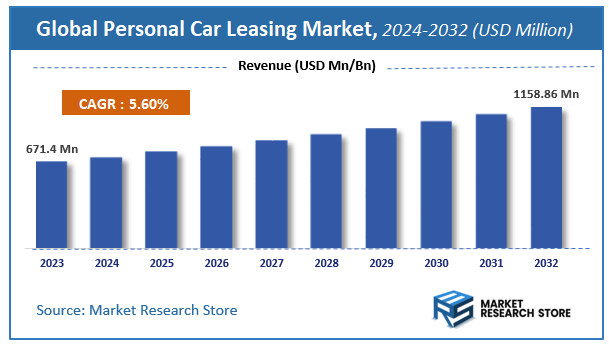
According to Market Research Store, the global personal car leasing market size was valued at around USD 671.4 million in 2023 and is estimated to reach USD 1158.86 million by 2032, to register a CAGR of approximately 5.6% in terms of revenue during the forecast period 2024-2032.
The personal car leasing report provides a comprehensive analysis of the market, including its size, share, growth trends, revenue details, and other crucial information regarding the target market. It also covers the drivers, restraints, opportunities, and challenges till 2032.
To Get more Insights, Request a Free Sample
Global Personal Car Leasing Market: Overview
Personal car leasing is a financial arrangement where individuals lease a vehicle for a fixed period, typically ranging from 24 to 48 months, by paying monthly installments instead of purchasing it outright. This option allows consumers to drive a new vehicle without the long-term commitment and financial burden of ownership. At the end of the lease term, lessees can return the car, renew the lease, or sometimes buy the vehicle at a predetermined price. Personal car leasing is gaining popularity due to lower upfront costs, tax benefits, and access to the latest car models with advanced features.
Key Highlights
- The personal car leasing market is anticipated to grow at a CAGR of 5.6% during the forecast period.
- The global personal car leasing market was estimated to be worth approximately USD 671.4 million in 2023 and is projected to reach a value of USD 1158.86 million by 2032.
- The growth of the personal car leasing market is being driven by changing consumer preferences, rising vehicle prices, and the increasing availability of attractive leasing options from automakers and financial institutions.
- Based on the lease type, the closed-end lease segment is growing at a high rate and is projected to dominate the market.
- On the basis of vehicle type, the SUVs segment is projected to swipe the largest market share.
- In terms of lease duration, the long-term lease segment is expected to dominate the market.
- Based on the end-user, the corporate segment is expected to dominate the market.
- By region, North America is expected to dominate the global market during the forecast period.
Personal Car Leasing Market: Dynamics
Key Growth Drivers
- Cost-Effective Alternative to Ownership: Leasing offers lower monthly payments compared to buying, making it attractive for budget-conscious consumers.
- Flexibility and Convenience: Leasing allows drivers to upgrade to newer models every few years without the hassle of selling or trading in a car.
- Rising Vehicle Costs: Increasing prices of new cars make leasing a more affordable option for many consumers.
- Urbanization and Mobility Trends: Growing urban populations and changing mobility preferences favor short-term leasing over long-term ownership.
- Corporate Leasing Programs: Employers offering car leasing as a benefit to employees drive market growth.
Restraints
- Mileage Restrictions: Leasing contracts often impose mileage limits, which can be a deterrent for high-mileage drivers.
- Long-Term Cost: Over time, leasing can be more expensive than owning a car outright, especially with additional fees.
- Lack of Ownership: Consumers who prefer to own assets may be reluctant to lease.
- Credit Requirements: Strict credit checks and eligibility criteria can limit access for some consumers.
Opportunities
- Electric and Hybrid Vehicles: Increasing demand for eco-friendly vehicles presents opportunities for leasing companies to offer green options.
- Subscription-Based Models: Flexible, short-term leasing or car subscription services cater to changing consumer preferences.
- Digital Platforms: Online leasing platforms simplify the process, making it more accessible and appealing to tech-savvy consumers.
- Emerging Markets: Expanding into developing regions with growing middle-class populations and increasing car ownership aspirations.
Challenges
- Economic Uncertainty: Fluctuations in the economy can impact consumer spending and leasing demand.
- Residual Value Risk: Accurate prediction of a car's residual value is critical for leasing companies and can be challenging.
- Regulatory Changes: Evolving regulations related to emissions, vehicle standards, and leasing terms can impact the market.
- Competition from Ride-Sharing: The rise of ride-sharing services may reduce the need for personal car leasing in urban areas.
Personal Car Leasing Market: Report Scope
| Report Attributes | Report Details |
|---|---|
| Report Name | Personal Car Leasing Market |
| Market Size in 2023 | USD 671.4 Million |
| Market Forecast in 2032 | USD 1158.86 Million |
| Growth Rate | CAGR of 5.6% |
| Number of Pages | 140 |
| Key Companies Covered | OuiCar, Getaround (Drivy), Allcarleasing, Conor Kennedy Ltd, BOLE Club, Hippo Vehicle Solutions, Leasing Options |
| Segments Covered | By Product Type, By Application, and By Region |
| Regions Covered | North America, Europe, Asia Pacific (APAC), Latin America, Middle East, and Africa (MEA) |
| Base Year | 2023 |
| Historical Year | 2018 to 2023 |
| Forecast Year | 2024 to 2032 |
| Customization Scope | Avail customized purchase options to meet your exact research needs. Request For Customization |
Personal Car Leasing Market: Segmentation Insights
The global personal car leasing market is divided by lease type, vehicle type, lease duration, end-user, and region.
Segmentation Insights by Lease Type
Based on lease type, the global personal car leasing market is divided into open-end lease and closed-end lease.
The Closed-End Lease segment dominates the personal car leasing market due to its predictable costs and lower financial risks for lessees. In a closed-end lease, the lessee returns the vehicle at the end of the lease term without any obligation to purchase it, making it a preferred choice for individuals who want fixed monthly payments and do not wish to deal with vehicle depreciation. This leasing option is particularly popular among consumers who seek convenience, as maintenance and residual value risks are typically covered by the leasing company. Additionally, closed-end leases often come with mileage limits, ensuring that vehicles remain in good condition, making them attractive to both consumers and leasing providers.
On the other hand, the Open-End Lease segment holds a smaller share of the market but remains relevant, especially for those who require flexibility in vehicle usage. Unlike closed-end leases, open-end leases do not have mileage restrictions, making them ideal for individuals who drive extensively. However, this lease type comes with greater financial responsibility, as the lessee is liable for the vehicle's residual value at the end of the lease term. If the car depreciates more than expected, the lessee must cover the difference, making it a less predictable option compared to closed-end leases. This characteristic makes open-end leases more suitable for high-mileage drivers and businesses rather than the average personal car lessee.
Segmentation Insights by Vehicle Type
On the basis of vehicle type, the global personal car leasing market is bifurcated into SUVs, sedans, hatchbacks, and others.
The SUVs segment dominates the personal car leasing market due to the growing consumer preference for spacious, comfortable, and versatile vehicles. Many lessees opt for SUVs because they offer better safety features, a higher driving position, and improved performance on various terrains. Additionally, the increasing popularity of compact and crossover SUVs has made them more accessible for leasing, with competitive monthly payments and attractive lease terms. Automakers and leasing companies often provide special lease deals on SUVs due to their high demand, making them the top choice for personal car leasing.
The Sedans segment follows closely, appealing to individuals seeking a balance between affordability, fuel efficiency, and comfort. Sedans are often leased by urban commuters and professionals who prioritize a smooth ride and lower fuel consumption. Their sleek design and advanced technology features make them an attractive option, especially in markets where fuel efficiency and driving dynamics are key factors. While sedans are still a strong choice, the growing shift toward SUVs has slightly impacted their dominance in the leasing market.
Hatchbacks come next, particularly popular among budget-conscious lessees and city dwellers who prefer compact vehicles for easy maneuverability and parking. Hatchbacks are known for their practicality, offering decent cargo space and fuel efficiency at a lower leasing cost than SUVs or sedans. They are a common choice for first-time lessees or those looking for an economical lease option. However, their lower demand compared to SUVs and sedans limits their overall share in the leasing market.
Segmentation Insights by Lease Duration
On the basis of lease duration, the global personal car leasing market is bifurcated into short-term and long-term.
The Long-Term Lease segment dominates the personal car leasing market as it offers lower monthly payments, making it a cost-effective option for individuals looking for a stable and predictable leasing arrangement. Typically lasting between 24 to 48 months, long-term leases provide benefits such as lower depreciation costs, extended warranty coverage, and manufacturer-backed maintenance programs. This lease type is particularly attractive to consumers who want a hassle-free driving experience with fixed expenses and no concerns about vehicle resale. Leasing companies and automakers also prefer long-term leases as they ensure a steady revenue stream and better fleet management, further strengthening this segment's dominance.
On the other hand, the Short-Term Lease segment, which includes lease durations ranging from a few months to a year, holds a smaller share of the market. Short-term leases are often chosen by individuals who need temporary mobility solutions, such as business professionals on short-term assignments or travelers. While they offer flexibility and the ability to switch vehicles frequently, they come with higher monthly costs compared to long-term leases. Additionally, the limited availability of short-term leasing options and higher depreciation risks for leasing companies contribute to this segment's lower market share. However, with the rising demand for subscription-based car leasing models and flexible ownership alternatives, the short-term lease segment is gradually gaining traction.
Segmentation Insights by End-User
On the basis of end-user, the global personal car leasing market is bifurcated into individual and corporate.
The Corporate segment dominates the personal car leasing market due to the high demand for leased vehicles by businesses for their employees and executives. Companies prefer leasing over purchasing because it allows them to manage fleet costs efficiently, benefit from tax advantages, and ensure their employees have access to well-maintained, up-to-date vehicles. Corporate leasing agreements often come with additional perks, such as maintenance packages, insurance coverage, and flexible mileage options, making them an attractive choice for businesses looking to optimize operational expenses. Moreover, multinational companies and startups alike utilize leasing to avoid the high upfront costs associated with vehicle ownership, further reinforcing the dominance of this segment.
The Individual segment, while smaller than corporate leasing, remains a significant part of the market. Personal leasing is popular among consumers who prefer driving a new car every few years without the financial burden of ownership. Individuals opt for leasing to enjoy lower monthly payments, minimal maintenance concerns, and access to newer vehicle models with advanced features. This segment is growing, especially with the rise of younger consumers and urban dwellers who prioritize financial flexibility over long-term ownership. However, since businesses lease vehicles in bulk and often on long-term contracts, the corporate segment continues to hold the largest share of the personal car leasing market.
Personal Car Leasing Market: Regional Insights
- North America is expected to dominates the global market
North America leads the global personal car leasing market, driven by a mature leasing industry, a strong consumer preference for flexible vehicle ownership options, and a well-established financial infrastructure that supports diverse leasing solutions. The region's technological advancements, such as the integration of digital platforms and telematics, have streamlined leasing processes, enhancing customer experience and operational efficiency. Additionally, the corporate sector's significant adoption of fleet leasing services has bolstered market growth, as businesses seek cost-effective and flexible mobility solutions.
Asia Pacific holds a substantial share of the personal car leasing market and is experiencing the fastest growth, driven by rapid urbanization, rising disposable incomes, and an increasing demand for flexible mobility solutions. Countries like China, Japan, and India are at the forefront, with consumers showing a growing preference for leasing over traditional vehicle ownership. Government incentives promoting electric vehicle adoption and investments in transportation infrastructure further support the expansion of the leasing market in this region.
Europe's market is characterized by a strong emphasis on environmental sustainability, leading to increased demand for electric and hybrid vehicle leasing options. Stringent emission regulations and government initiatives have encouraged both consumers and businesses to opt for eco-friendly vehicles through leasing. Additionally, the presence of leading car leasing companies and developed infrastructure supports the growth and accessibility of leasing services across European countries.
Latin America is gradually expanding in the personal car leasing market, influenced by improving economic conditions and a growing awareness of the benefits of vehicle leasing. Countries like Brazil and Argentina are witnessing increased adoption of leasing services, particularly among small and medium-sized enterprises seeking cost-effective fleet management solutions. However, market growth is moderated by economic volatility and limited consumer awareness in certain areas.
The Middle East and Africa are experiencing a gradual increase in the adoption of personal car leasing, supported by increasing urbanization, a rising expatriate population, and the expansion of corporate sectors requiring flexible transportation solutions. However, challenges such as limited infrastructure, economic disparities, and a traditional preference for vehicle ownership over leasing have tempered the market's expansion. Despite these challenges, there is a growing interest in leasing, particularly for luxury vehicles and among businesses aiming to optimize their operational costs.Bottom of Form
Personal Car Leasing Market: Competitive Landscape
The report provides an in-depth analysis of companies operating in the personal car leasing market, including their geographic presence, business strategies, product offerings, market share, and recent developments. This analysis helps to understand market competition.
Some of the major players in the global personal car leasing market include:
- Conor Kennedy Ltd
- BOLE Club
- Hippo Vehicle Solutions
- Leasing Options
- Europcar Mobility Group
- Daimler Fleet Management
- Volkswagen Leasing GmbH
- Alphabet Inc.
- LeasePlan Corporation N.V.
- ALD Automotive
- Toyota Financial Services
- Ford Credit
- General Motors Financial Company Inc.
- Hyundai Capital Services, Inc.
- Santander Consumer USA Holdings Inc.
- Wheels Inc.
- Arval BNP Paribas Group
- Hertz Global Holdings Inc.
- Enterprise Holdings Inc.
- Sixt SE
- Avis Budget Group Inc.
- Athlon Car Lease International B.V.
- Hitachi Capital Vehicle Solutions
The global personal car leasing market is segmented as follows:
By Lease Type
- Open-End Lease
- Closed-End Lease
By Vehicle Type
- SUVs
- Sedans
- Hatchbacks
- Others
By Lease Duration
- Short-Term
- Long-Term
By End-User
- Individual
- Corporate
By Region
- North America
- U.S.
- Canada
- Europe
- U.K.
- France
- Germany
- Rest of Europe
- Asia Pacific
- China
- Japan
- India
- South Korea
- Rest of Asia Pacific
- Latin America
- Brazil
- Rest of Latin America
- The Middle East and Africa
- GCC Countries
- South Africa
- Rest of Middle East Africa
Frequently Asked Questions
Based on statistics from the Market Research Store, the global personal car leasing market size was projected at approximately US$ 671.4 million in 2023. Projections indicate that the market is expected to reach around US$ 1158.86 million in revenue by 2032.
The global personal car leasing market is expected to grow at a Compound Annual Growth Rate (CAGR) of around 5.6% during the forecast period from 2024 to 2032.
North America is expected to dominate the global personal car leasing market.
The global personal car leasing market is driven by rising consumer preference for flexible vehicle ownership, increasing demand for cost-effective mobility solutions, and advancements in digital leasing platforms. Additionally, growing adoption of electric vehicles, government incentives, and corporate fleet leasing contribute to market expansion.
Some of the prominent players operating in the global personal car leasing market are; Conor Kennedy Ltd, BOLE Club, Hippo Vehicle Solutions, Leasing Options, Europcar Mobility Group, Daimler Fleet Management, Volkswagen Leasing GmbH, Alphabet Inc., LeasePlan Corporation N.V., ALD Automotive, Toyota Financial Services, Ford Credit, General Motors Financial Company Inc., Hyundai Capital Services, Inc., Santander Consumer USA Holdings Inc., Wheels Inc., Arval BNP Paribas Group, Hertz Global Holdings Inc., Enterprise Holdings Inc., Sixt SE, Avis Budget Group Inc., Athlon Car Lease International B.V., Hitachi Capital Vehicle Solutions, and others.
Table Of Content
Inquiry For Buying
Personal Car Leasing
Request Sample
Personal Car Leasing
