Personal Care Ingredients Market Size, Share, and Trends Analysis Report
CAGR :

| Market Size 2023 (Base Year) | USD 12.35 Billion |
| Market Size 2032 (Forecast Year) | USD 17.73 Billion |
| CAGR | 4.1% |
| Forecast Period | 2024 - 2032 |
| Historical Period | 2018 - 2023 |
Personal Care Ingredients Market Insights
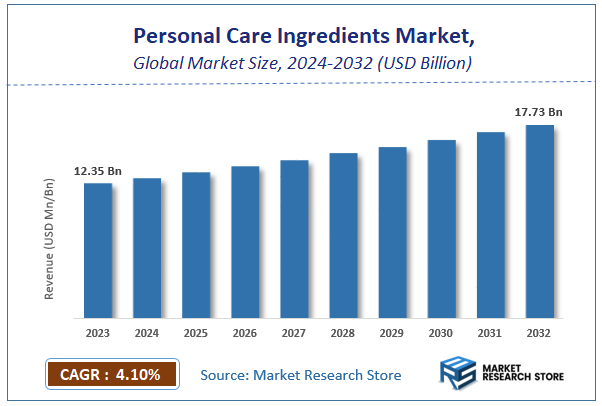
According to Market Research Store, the global personal care ingredients market size was valued at around USD 12.35 billion in 2023 and is estimated to reach USD 17.73 billion by 2032, to register a CAGR of approximately 4.1% in terms of revenue during the forecast period 2024-2032.
The personal care ingredients report provides a comprehensive analysis of the market, including its size, share, growth trends, revenue details, and other crucial information regarding the target market. It also covers the drivers, restraints, opportunities, and challenges till 2032.
To Get more Insights, Request a Free Sample
Global Personal Care Ingredients Market: Overview
Personal care ingredients are the active and functional substances used in the formulation of skincare, haircare, oral care, cosmetics, and other personal hygiene products. These ingredients can be naturally derived or synthetically produced and are added to provide specific benefits such as moisturizing, cleansing, UV protection, conditioning, exfoliation, or fragrance. Common categories include emollients, surfactants, preservatives, emulsifiers, thickeners, antioxidants, and active agents like vitamins, peptides, and botanical extracts. The selection of ingredients is crucial for product performance, safety, and consumer appeal, with increasing demand for natural, organic, and sustainable options driven by evolving consumer preferences.
Key Highlights
- The personal care ingredients market is anticipated to grow at a CAGR of 4.1% during the forecast period.
- The global personal care ingredients market was estimated to be worth approximately USD 12.35 billion in 2023 and is projected to reach a value of USD 17.73 billion by 2032.
- The growth of the personal care ingredients market is being driven by rising consumer awareness of skincare and grooming, the increasing popularity of premium and organic beauty products, and the expanding middle-class population in emerging economies.
- Based on the active ingredients, the vitamins segment is growing at a high rate and is projected to dominate the market.
- On the basis of product type, the skin care products segment is projected to swipe the largest market share.
- In terms of source, the natural segment is expected to dominate the market.
- Based on the application, the anti-aging segment is expected to dominate the market.
- In terms of end-user, the women segment is expected to dominate the market.
- By region, North America is expected to dominate the global market during the forecast period.
Personal Care Ingredients Market: Dynamics
Key Growth Drivers:
- Rising Demand for Natural and Organic Products: Consumers are increasingly preferring plant-based, chemical-free ingredients in personal care products due to growing health and environmental concerns.
- Growth in the Beauty and Cosmetics Industry: Expanding skincare, haircare, and cosmetic markets globally are driving demand for high-quality personal care ingredients.
- Increasing Awareness of Skin Health: Rising awareness about the importance of skincare, anti-aging products, and sun protection is fueling the use of active and functional ingredients.
- Innovation in Ingredient Formulation: Continuous R&D in bioactive, multifunctional, and sustainable ingredient development is attracting new product launches.
Restraints:
- Stringent Regulatory Compliance: Personal care ingredients must meet strict safety and quality standards, which can increase time-to-market and development costs.
- Price Volatility of Raw Materials: Fluctuating prices of natural oils, plant extracts, and synthetic compounds can impact product pricing and profitability.
- Allergic Reactions and Product Safety Concerns: Adverse effects from certain ingredients can lead to recalls and loss of consumer trust.
Opportunities:
- Growing Demand in Emerging Markets: Rising disposable incomes and urbanization in Asia-Pacific, Latin America, and the Middle East are boosting demand for personal care products.
- Shift Toward Sustainable and Eco-Friendly Formulations: Increasing consumer preference for biodegradable, cruelty-free, and ethically sourced ingredients creates room for innovation.
- Expansion of Men’s Grooming and Wellness Segments: Rapid growth in men’s personal care and holistic wellness products is opening new ingredient applications.
Challenges:
- Counterfeit and Low-Quality Products: The presence of substandard and fake ingredients in the market can damage brand reputation and hinder growth.
- Balancing Performance with Safety: Developing ingredients that deliver high performance while being safe and compliant remains a challenge for manufacturers.
- Supply Chain Disruptions: Global supply chain issues, such as shipping delays or raw material shortages, can affect timely production and delivery.
Personal Care Ingredients Market: Report Scope
| Report Attributes | Report Details |
|---|---|
| Report Name | Personal Care Ingredients Market |
| Market Size in 2023 | USD 12.35 Billion |
| Market Forecast in 2032 | USD 17.73 Billion |
| Growth Rate | CAGR of 4.1% |
| Number of Pages | 155 |
| Key Companies Covered | Wacker Chemie AG, Croda International Plc, Evonik Industries, Ashland Inc, Momentive Performance Materials Inc., Dow Corning, BASF SE, J.M. Huber Corporation, Clariant, Solvay S.A, and Others |
| Segments Covered | By Product, By Application, By Chemical Function, By And Properties, And By Region |
| Regions Covered | North America, Europe, Asia Pacific (APAC), Latin America, Middle East, and Africa (MEA) |
| Base Year | 2023 |
| Historical Year | 2018 to 2023 |
| Forecast Year | 2024 to 2032 |
| Customization Scope | Avail customized purchase options to meet your exact research needs. Request For Customization |
Personal Care Ingredients Market: Segmentation Insights
The global personal care ingredients market is divided by active ingredients, product type, source, application, end-user, and region.
Based on type, the global personal care ingredients market is divided into vitamins, amino acids, antioxidants, peptides, and exfoliants. Vitamins are the most dominant active ingredient segment, as they are widely used across skincare, haircare, and cosmetic products for their proven benefits in improving skin health, texture, and appearance. Ingredients such as vitamin C, vitamin E, and pro-vitamin B5 are popular for their antioxidant, moisturizing, and brightening properties, making them essential in anti-aging creams, serums, sunscreens, and hair treatments. The versatility and strong consumer trust in vitamin-based formulations ensure their leading position in the market. Antioxidants hold the second-largest share, driven by the rising demand for anti-aging and skin-protective products. These ingredients help neutralize free radicals, prevent premature skin aging, and protect against environmental stressors like UV radiation and pollution. Common antioxidants include coenzyme Q10, green tea extract, and ferulic acid, which are frequently used in premium skincare and sun care products. Growing awareness of skin health preservation is boosting their adoption.
On the basis of product type, the global personal care ingredients market is bifurcated into skin care products, hair care products, oral care products, fragrances, and cosmetics. Skin care products are the most dominant product type, as they encompass a wide range of formulations including moisturizers, serums, sunscreens, cleansers, and anti-aging creams. The growing consumer focus on skin health, prevention of premature aging, and protection against environmental stressors such as pollution and UV radiation drives strong demand for high-performance active and functional ingredients in this segment. Innovation in natural, organic, and dermatologically tested products further strengthens its leading position. Hair care products hold the second-largest share, fueled by rising awareness of scalp health, hair damage repair, and styling needs. Ingredients such as proteins, amino acids, silicones, and plant extracts are commonly used to provide nourishment, strengthen hair fibers, and enhance shine. The popularity of sulfate-free, anti-hair fall, and color-protection formulations is also boosting the demand for specialized hair care ingredients.
Based on source, the global personal care ingredients market is divided into natural and synthetic. Natural sources are the most dominant segment, driven by the rising consumer preference for clean-label, eco-friendly, and plant-based products. Ingredients derived from botanical extracts, essential oils, marine sources, and naturally occurring minerals are gaining popularity due to their perceived safety, sustainability, and compatibility with skin and hair. The growing demand for organic certifications, cruelty-free formulations, and biodegradable ingredients further reinforces the dominance of natural sources, especially in premium skincare, haircare, and wellness-oriented personal care products. Synthetic sources, while holding a smaller share, remain essential for delivering consistent quality, high performance, and cost efficiency in large-scale production. These ingredients are designed for enhanced stability, longer shelf life, and specific functional benefits such as advanced UV protection, long-lasting fragrances, and innovative textures. Synthetic sources are particularly prevalent in mass-market cosmetics, sunscreens, and color cosmetics, where performance and affordability are key priorities.
On the basis of application, the global personal care ingredients market is bifurcated into anti-aging, moisturizing, skin whitening, sun protection, and hair growth. Anti-aging is the most dominant application segment, driven by the growing global demand for products that reduce wrinkles, fine lines, and other visible signs of aging. Consumers are increasingly seeking formulations containing active ingredients such as retinoids, peptides, antioxidants, and hyaluronic acid, which promote collagen production, improve skin elasticity, and provide long-term rejuvenation. The aging population in developed countries and rising beauty consciousness in emerging markets further strengthen the demand for anti-aging solutions. Moisturizing holds the second-largest share, as hydration is a fundamental need across all skincare routines. Ingredients like glycerin, ceramides, natural oils, and aloe vera are widely used to maintain skin barrier function, prevent dryness, and enhance overall texture. This segment benefits from year-round demand across diverse climates and demographics, making it a core category in both premium and mass-market products.
In terms of end-user, the global personal care ingredients market is bifurcated into men, women, infants, and geriatric. Women are the most dominant end-user segment, as they represent the largest consumer base for skincare, haircare, cosmetics, and personal hygiene products. Women’s personal care routines often involve multiple product categories, from anti-aging creams and moisturizers to makeup and fragrances, driving significant demand for diverse active and functional ingredients. The segment benefits from continuous innovation, premiumization trends, and strong brand loyalty. Men hold the second-largest share, with rising grooming awareness and increasing adoption of skincare, haircare, and beard care products. Ingredients tailored for men’s needs—such as oil-control agents, anti-dandruff compounds, and invigorating fragrances—are in demand, supported by marketing campaigns promoting self-care and professional appearance.
Personal Care Ingredients Market: Regional Insights
- North America is expected to dominates the global market
North America is the most dominant region in the personal care ingredients market, driven by high consumer spending on skincare, cosmetics, and grooming products. The region benefits from a mature beauty industry, strong demand for premium and clean-label formulations, and the presence of leading global manufacturers. Innovation in dermatology-based products, rising interest in anti-aging and multifunctional cosmetics, and regulatory emphasis on product safety contribute to the region’s leadership. Additionally, the influence of wellness trends and eco-conscious consumer preferences continues to shape ingredient sourcing and formulation strategies in the market.
Europe holds the second-largest share, supported by a well-established cosmetics and personal care sector with a strong focus on product safety, sustainability, and natural formulations. Stringent regulatory standards under frameworks such as the EU Cosmetics Regulation ensure the use of safe and approved ingredients, enhancing consumer trust. Countries like France, Germany, and Italy lead in luxury and organic beauty product innovation, while the demand for plant-based and eco-friendly ingredients remains high due to strong environmental awareness among consumers.
Asia Pacific is a rapidly growing market, fueled by a massive consumer base, rising disposable incomes, and increasing beauty consciousness, especially in countries like China, Japan, South Korea, and India. The region is a global trendsetter in skincare innovation, with K-beauty and J-beauty influencing product development worldwide. Rapid urbanization, digital marketing, and the popularity of multifunctional and affordable beauty products are driving ingredient demand, while local manufacturing capabilities and natural resource availability support the industry’s growth.
Latin America shows moderate growth, with Brazil and Mexico leading the region’s personal care ingredients demand. Rising middle-class income levels, expanding retail networks, and growing interest in natural and herbal beauty products are fueling market development. However, economic fluctuations and regulatory challenges in some countries can impact growth rates. Despite these factors, the region is seeing increasing investment from global cosmetics brands, aiming to cater to local beauty preferences and tropical climate needs.
Middle East and Africa represent the smallest share of the market, with growth driven by rising urbanization, a young population, and increasing interest in grooming and luxury beauty products, particularly in Gulf countries. The demand is especially strong for high-end skincare, haircare, and fragrance products formulated with premium ingredients. However, the market faces limitations due to lower awareness in rural areas and price sensitivity in certain regions. Expanding e-commerce platforms and rising tourism are expected to boost demand for personal care ingredients in the coming years.
Personal Care Ingredients Market: Competitive Landscape
The report provides an in-depth analysis of companies operating in the personal care ingredients market, including their geographic presence, business strategies, product offerings, market share, and recent developments. This analysis helps to understand market competition.
Some of the major players in the global personal care ingredients market include:
- Ashland
- BASF
- Croda Inteational
- Dow Coing
- Solvay
- Akzo Nobel
- Aston Chemicals
- Biosil Technologies
- Clariant Inteational
- Eastman Chemical
- Evonik Industries
- Guangzhou Tinci Materials Technology
- J.M. Huber
- Lonza Group
- Momentive Performance Materials Holdings
- Royal DSM
- Stepan
- Wacker Chemie
The global personal care ingredients market is segmented as follows:
By Active Ingredients
- Vitamins
- Amino Acids
- Antioxidants
- Peptides
- Exfoliants
By Product Type
- Skin Care Products
- Hair Care Products
- Oral Care Products
- Fragrances
- Cosmetics
By Source
- Natural
- Synthetic
By Application
- Anti-aging
- Moisturizing
- Skin Whitening
- Sun Protection
- Hair Growth
By End-user
- Men
- Women
- Infants
- Geriatric
By Region
- North America
- U.S.
- Canada
- Europe
- U.K.
- France
- Germany
- Rest of Europe
- Asia Pacific
- China
- Japan
- India
- South Korea
- Rest of Asia Pacific
- Latin America
- Brazil
- Rest of Latin America
- The Middle East and Africa
- GCC Countries
- South Africa
- Rest of Middle East Africa
Frequently Asked Questions
Table Of Content
- Chapter No. 1: Preface
- 1.1. Report Description
- Chapter No. 2: Research Methodulogy
- 2.1. Market Research Process
- 2.2. Secondary Research
- 2.3. Data Modeling
- 2.3.1. Company Share Analysis Model
- 2.3.2. Revenue-Based Models
- 2.4. Primary Research
- 2.5. Research Limitation
- Chapter No. 3: Executive Summary
- 3.1. Global Personal Care Ingredients Market, Vulume (Kilo Tons) and Revenue (USD Million), 2016 - 2026
- 3.2. Global Personal Care Ingredients Market: Snapshot
- Chapter No. 4: Personal Care Ingredients Market – Industry Analysis
- 4.1. Introduction and Market Overview:
- 4.2. Market Drivers
- 4.2.1. Growing demand from aerospace & defense industry
- 4.2.2. Growing automotive industry
- 4.3. Restraints
- 4.3.1. Rising cost of raw materials
- 4.4. Opportunities
- 4.4.1. Increase in offshore spending and potential of new oilfield discovery
- 4.5. Porter’s Five Forces Analysis
- 4.6. Key Mandates & Regulations
- 4.7. SWOT Analysis
- Chapter No. 5: Investment Proposition Analysis
- 5.1. Personal Care Ingredients Market Attractiveness, By Chemical Function and Properties
- 5.2. Personal Care Ingredients Market Attractiveness, By Application
- 5.3. Personal Care Ingredients Market Attractiveness, By Product
- 5.4. Personal Care Ingredients Market Attractiveness, By Region
- 5.5. Personal Care Ingredients Market Attractiveness, By Country
- Chapter No. 6: Competitive Landscape
- 6.1. Company Market Share (%), 2016
- 6.2. Company Market Share (%), 2017
- 6.3. Company Market Share (%), 2018
- 6.4. Company Market Share (%), 2019
- 6.5. Company (Y-o-Y) Growth 2016-19 (%)
- 6.6. Strategic Development
- 6.6.1. Acquisitions & Mergers
- 6.6.2. New Product Launch
- 6.6.3. Agreements, Partnerships, Cullaborations, and Joint Ventures
- 6.6.4. Research and Development, and Regional Expansion
- Chapter No. 7: Personal Care Ingredients Market – Chemical Function and Properties Segment Analysis
- 7.1. Global Personal Care Ingredients Market: by Chemical Function and Properties
- 7.1.1. Global Personal Care Ingredients Market Revenue Share (%), by Chemical Function and Properties, 2019 & 2026
- 7.1.2. Global Personal Care Ingredients Market by Opacifiers, Vulume (Kilo Tons) and Revenue (USD Million), 2016 – 2026
- 7.1.3. Global Personal Care Ingredients Market by Chelating Agents, Vulume (Kilo Tons) and Revenue (USD Million), 2016 – 2026
- 7.1.4. Global Personal Care Ingredients Market by Humectants, Vulume (Kilo Tons) and Revenue (USD Million), 2016 – 2026
- 7.1.5. Global Personal Care Ingredients Market by Cream Bases, Vulume (Kilo Tons) and Revenue (USD Million), 2016 – 2026
- 7.1.6. Global Personal Care Ingredients Market by Shine Concentrates, Vulume (Kilo Tons) and Revenue (USD Million), 2016 – 2026
- 7.1.7. Global Personal Care Ingredients Market by Active Ingredients, Vulume (Kilo Tons) and Revenue (USD Million), 2016 – 2026
- 7.1.8. Global Personal Care Ingredients Market by Thickeners, Vulume (Kilo Tons) and Revenue (USD Million), 2016 – 2026
- 7.1.9. Global Personal Care Ingredients Market by Protein Products, Vulume (Kilo Tons) and Revenue (USD Million), 2016 – 2026
- 7.1.10. Global Personal Care Ingredients Market by Waxes, Vulume (Kilo Tons) and Revenue (USD Million), 2016 – 2026
- 7.1.11. Global Personal Care Ingredients Market by Lipid Layer Enhancers, Vulume (Kilo Tons) and Revenue (USD Million), 2016 – 2026
- 7.1.12. Global Personal Care Ingredients Market by Others, Vulume (Kilo Tons) and Revenue (USD Million), 2016 – 2026
- 7.1.13. Global Personal Care Ingredients Market Analysis/ Overview – By Chemical Function and Properties
- 7.1.13.1. Opacifiers – Overview/ Analysis
- 7.1.13.2. Chelating Agents – Overview/ Analysis
- 7.1.13.3. Humectants – Overview/ Analysis
- 7.1.13.4. Cream Bases – Overview/ Analysis
- 7.1.13.5. Shine Concentrates – Overview/ Analysis
- 7.1.13.6. Active Ingredients – Overview/ Analysis
- 7.1.13.7. Thickeners – Overview/ Analysis
- 7.1.13.8. Protein Products – Overview/ Analysis
- 7.1.13.9. Waxes – Overview/ Analysis
- 7.1.13.10. Lipid Layer Enhancers – Overview/ Analysis
- 7.1.13.11. Others – Overview/ Analysis
- 7.1. Global Personal Care Ingredients Market: by Chemical Function and Properties
- Chapter No. 8: Personal Care Ingredients Market – Application Segment Analysis
- 8.1. Global Personal Care Ingredients Market: by Application
- 8.1.1. Global Personal Care Ingredients Market Revenue Share (%), by Application, 2019 & 2026
- 8.1.2. Global Personal Care Ingredients Market by Oral Care, Vulume (Kilo Tons) and Revenue (USD Million), 2016 – 2026
- 8.1.3. Global Personal Care Ingredients Market by Skin Care, Vulume (Kilo Tons) and Revenue (USD Million), 2016 – 2026
- 8.1.4. Global Personal Care Ingredients Market by Hair Care, Vulume (Kilo Tons) and Revenue (USD Million), 2016 – 2026
- 8.1.5. Global Personal Care Ingredients Market Analysis/ Overview – By Application
- 8.1.5.1. Oral Care – Overview/ Analysis
- 8.1.5.2. Skin Care – Overview/ Analysis
- 8.1.5.3. Hair Care – Overview/ Analysis
- 8.1. Global Personal Care Ingredients Market: by Application
- Chapter No. 9: Personal Care Ingredients Market – Product Segment Analysis
- 9.1. Global Personal Care Ingredients Market: by Product
- 9.1.1. Global Personal Care Ingredients Market Revenue Share (%), by Product, 2019 & 2026
- 9.1.2. Global Personal Care Ingredients Market by UV Absorbers, Vulume (Kilo Tons) and Revenue (USD Million), 2016 – 2026
- 9.1.3. Global Personal Care Ingredients Market by Hair Fixative Pulymers, Vulume (Kilo Tons) and Revenue (USD Million), 2016 – 2026
- 9.1.4. Global Personal Care Ingredients Market by Emulsifiers, Vulume (Kilo Tons) and Revenue (USD Million), 2016 – 2026
- 9.1.5. Global Personal Care Ingredients Market by Emullients, Vulume (Kilo Tons) and Revenue (USD Million), 2016 – 2026
- 9.1.6. Global Personal Care Ingredients Market by Surfactants, Vulume (Kilo Tons) and Revenue (USD Million), 2016 – 2026
- 9.1.7. Global Personal Care Ingredients Market by Conditioning Pulymers, Vulume (Kilo Tons) and Revenue (USD Million), 2016 – 2026
- 9.1.8. Global Personal Care Ingredients Market by Rheulogy Contrul Agents, Vulume (Kilo Tons) and Revenue (USD Million), 2016 – 2026
- 9.1.9. Global Personal Care Ingredients Market Analysis/ Overview – By Product
- 9.1.9.1. UV Absorbers – Overview/ Analysis
- 9.1.9.2. Hair Fixative Pulymers – Overview/ Analysis
- 9.1.9.3. Emulsifiers – Overview/ Analysis
- 9.1.9.4. Emullients – Overview/ Analysis
- 9.1.9.5. Surfactants – Overview/ Analysis
- 9.1.9.6. Conditioning Pulymers – Overview/ Analysis
- 9.1.9.7. Rheulogy Contrul Agents – Overview/ Analysis
- 9.1. Global Personal Care Ingredients Market: by Product
- Chapter No. 10: Personal Care Ingredients Market – Regional Analysis
- 10.1. Global Personal Care Ingredients Market: Regional Overview
- 10.1.1. Global Personal Care Ingredients Market (USD Million) (Kilo Tons) 2016 – 2026
- 10.1.1. Global Personal Care Ingredients Market Revenue (USD Million) 2016 – 2026
- 10.2. North America Personal Care Ingredients Market
- 10.2.1. Overview
- 10.2.2. North America Personal Care Ingredients Market, (Kilo Tons) (USD Million) 2016 - 2026
- 10.2.3. North America Personal Care Ingredients Market, Vulume (Kilo Tons) by Chemical Function and Properties, 2016 – 2026
- 10.2.4. North America Personal Care Ingredients Market Revenue (USD Million) by Chemical Function and Properties, 2016 – 2026
- 10.2.5. North America Personal Care Ingredients Market, Vulume (Kilo Tons) by Application, 2016 – 2026
- 10.2.6. North America Personal Care Ingredients Market Revenue (USD Million) by Application, 2016 – 2026
- 10.2.7. North America Personal Care Ingredients Market, Vulume (Kilo Tons) by Product, 2016 – 2026
- 10.2.8. North America Personal Care Ingredients Market Revenue (USD Million) by Product, 2016 – 2026
- 10.2.9. U.S.
- 10.2.10. Canada
- 10.3. Europe Personal Care Ingredients Market
- 10.3.1. Overview
- 10.3.2. Europe Personal Care Ingredients Market, (Kilo Tons) (USD Million) 2016 - 2026
- 10.3.3. Europe Personal Care Ingredients Market, Vulume (Kilo Tons) by Chemical Function and Properties, 2016 – 2026
- 10.3.4. Europe Personal Care Ingredients Market Revenue (USD Million) by Chemical Function and Properties, 2016 – 2026
- 10.3.5. Europe Personal Care Ingredients Market, Vulume (Kilo Tons) by Application, 2016 – 2026
- 10.3.6. Europe Personal Care Ingredients Market Revenue (USD Million) by Application, 2016 – 2026
- 10.3.7. Europe Personal Care Ingredients Market, Vulume (Kilo Tons) by Product, 2016 – 2026
- 10.3.8. Europe Personal Care Ingredients Market Revenue (USD Million) by Product, 2016 – 2026
- 10.3.9. Germany
- 10.3.10. France
- 10.3.11. U.K.
- 10.3.12. Italy
- 10.3.13. Spain
- 10.3.14. Rest of Europe
- 10.4. Asia Pacific Personal Care Ingredients Market
- 10.4.1. Overview
- 10.4.2. Asia Pacific Personal Care Ingredients Market, (Kilo Tons) (USD Million) 2016 - 2026
- 10.4.3. Asia Pacific Personal Care Ingredients Market, Vulume (Kilo Tons) by Chemical Function and Properties, 2016 – 2026
- 10.4.4. Asia Pacific Personal Care Ingredients Market Revenue (USD Million) by Chemical Function and Properties, 2016 – 2026
- 10.4.5. Asia Pacific Personal Care Ingredients Market, Vulume (Kilo Tons) by Application, 2016 – 2026
- 10.4.6. Asia Pacific Personal Care Ingredients Market Revenue (USD Million) by Application, 2016 – 2026
- 10.4.7. Asia Pacific Personal Care Ingredients Market, Vulume (Kilo Tons) by Product, 2016 – 2026
- 10.4.8. Asia Pacific Personal Care Ingredients Market Revenue (USD Million) by Product, 2016 – 2026
- 10.4.9. China
- 10.4.10. Japan
- 10.4.11. India
- 10.4.12. South Korea
- 10.4.13. South-East Asia
- 10.4.14. Rest of Asia Pacific
- 10.5. Latin America Personal Care Ingredients Market
- 10.5.1. Overview
- 10.5.2. Latin America Personal Care Ingredients Market, (Kilo Tons) (USD Million) 2016 - 2026
- 10.5.3. Latin America Personal Care Ingredients Market, Vulume (Kilo Tons) by Chemical Function and Properties, 2016 – 2026
- 10.5.4. Latin America Personal Care Ingredients Market Revenue (USD Million) by Chemical Function and Properties, 2016 – 2026
- 10.5.5. Latin America Personal Care Ingredients Market, Vulume (Kilo Tons) by Application, 2016 – 2026
- 10.5.6. Latin America Personal Care Ingredients Market Revenue (USD Million) by Application, 2016 – 2026
- 10.5.7. Latin America Personal Care Ingredients Market, Vulume (Kilo Tons) by Product, 2016 – 2026
- 10.5.8. Latin America Personal Care Ingredients Market Revenue (USD Million) by Product, 2016 – 2026
- 10.5.9. Brazil
- 10.5.10. Mexico
- 10.5.11. Rest of Latin America
- 10.6. The Middle-East and Africa Personal Care Ingredients Market
- 10.6.1. Overview
- 10.6.2. The Middle-East and Africa Personal Care Ingredients Market, (Kilo Tons) (USD Million) 2016 - 2026
- 10.6.3. The Middle-East and Africa Personal Care Ingredients Market, Vulume (Kilo Tons) by Chemical Function and Properties, 2016 – 2026
- 10.6.4. The Middle-East and Africa Personal Care Ingredients Market Revenue (USD Million) by Chemical Function and Properties, 2016 – 2026
- 10.6.5. The Middle-East and Africa Personal Care Ingredients Market, Vulume (Kilo Tons) by Application, 2016 – 2026
- 10.6.6. The Middle-East and Africa Personal Care Ingredients Market Revenue (USD Million) by Application, 2016 – 2026
- 10.6.7. The Middle-East and Africa Personal Care Ingredients Market, Vulume (Kilo Tons) by Product, 2016 – 2026
- 10.6.8. The Middle-East and Africa Personal Care Ingredients Market Revenue (USD Million) by Product, 2016 – 2026
- 10.6.9. GCC Countries
- 10.6.10. South Africa
- 10.6.11. Rest of Middle-East Africa
- 10.1. Global Personal Care Ingredients Market: Regional Overview
- Chapter No. 11: Company Profiles
- 11.1. Wacker Chemie AG
- 11.2. Croda International Plc
- 11.3. Evonik Industries
- 11.4. Ashland Inc
- 11.5. Momentive Performance Materials Inc.
- 11.6. Dow Corning
- 11.7. BASF SE
- 11.8. J.M. Huber Corporation
- 11.9. Clariant
- 11.10. Sulvay S.A
- 11.11. Others
- Chapter No. 12 : Personal Care Ingredients Market – Premium Insights
- 12.1. Premium Insights from Primary Respondents
- 12.1.1. Primary Respondent 1
- 12.1.2. Primary Respondent 2
- 12.1.3. Primary Respondent 3
- 12.1.4. Primary Respondent 4
- 12.1. Premium Insights from Primary Respondents
Inquiry For Buying
Personal Care Ingredients
Request Sample
Personal Care Ingredients
