Portable Electronic Nose Market Size, Share, and Trends Analysis Report
CAGR :

| Market Size 2023 (Base Year) | USD 37.2 Million |
| Market Size 2032 (Forecast Year) | USD 100.31 Million |
| CAGR | 10.4% |
| Forecast Period | 2024 - 2032 |
| Historical Period | 2018 - 2023 |
Portable Electronic Nose Market Insights
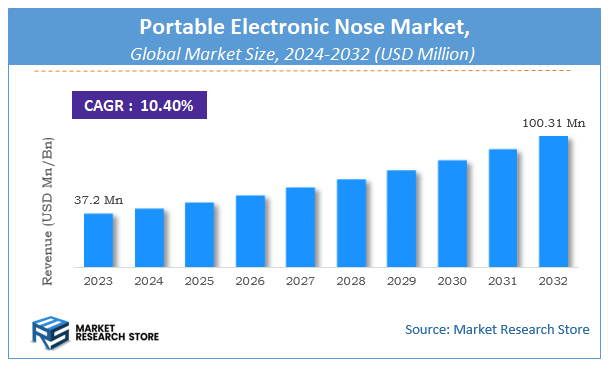
According to Market Research Store, the global portable electronic nose market size was valued at around USD 37.2 million in 2023 and is estimated to reach USD 100.31 million by 2032, to register a CAGR of approximately 10.4% in terms of revenue during the forecast period 2024-2032.
The portable electronic nose report provides a comprehensive analysis of the market, including its size, share, growth trends, revenue details, and other crucial information regarding the target market. It also covers the drivers, restraints, opportunities, and challenges till 2032.
To Get more Insights, Request a Free Sample
Global Portable Electronic Nose Market: Overview
A Portable Electronic Nose is a compact, handheld device that detects and identifies odors or volatile organic compounds (VOCs) in the environment. It works by mimicking the human sense of smell, using an array of sensors to detect specific chemical substances in the air. The device captures a "fingerprint" or pattern of the odor, which is then analyzed and compared using advanced algorithms, often powered by artificial intelligence (AI) or machine learning (ML), to identify the compound or mixture of odors.
Portable electronic noses are used in various industries for real-time monitoring and analysis. The sensors within these devices typically include technologies like metal oxide semiconductors (MOS), conductive polymers (CP), or piezoelectric sensors, each sensitive to different molecules. When exposed to an odor, the sensors react by producing electrical signals that are interpreted by the device's software to determine the source and concentration of the odor.
Key Highlights
- The portable electronic nose market is anticipated to grow at a CAGR of 10.4% during the forecast period.
- The global portable electronic nose market was estimated to be worth approximately USD 37.2 million in 2023 and is projected to reach a value of USD 100.31 million by 2032.
- The growth of the portable electronic nose market is being driven by the increasing demand for real-time and on-site detection of volatile organic compounds (VOCs) across various industries.
- Based on the product type, the chemical sensors segment is growing at a high rate and is projected to dominate the market.
- On the basis of application, the food & beverage segment is projected to swipe the largest market share.
- In terms of technology, the metal oxide semiconductor segment is expected to dominate the market.
- Based on the end-user, the industrial segment is expected to dominate the market.
- By region, North America is expected to dominate the global market during the forecast period.
Portable Electronic Nose Market: Dynamics
Key Growth Drivers
- Increasing Demand for Rapid and On-Site Gas Analysis: Many applications require immediate and field-based analysis of gases and odors, where traditional lab-based methods are time-consuming and impractical. Portable e-noses offer a quick and convenient solution.
- Growing Focus on Food Safety and Quality Control: Portable e-noses can be used for rapid assessment of food spoilage, freshness, and quality throughout the supply chain, from farm to consumer.
- Rising Environmental Monitoring Concerns: Portable devices enable real-time monitoring of air and water quality, detection of pollutants, and identification of odor sources in various environments.
- Advancements in Sensor Technology and Miniaturization: Progress in developing smaller, more sensitive, and energy-efficient chemical sensors is crucial for creating practical portable e-noses.
- Improved Pattern Recognition Algorithms and Machine Learning: Sophisticated algorithms enhance the accuracy and reliability of odor and gas identification by portable e-noses, even in complex mixtures.
- Increasing Applications in Healthcare Diagnostics: Portable e-noses are being explored for non-invasive disease detection through breath analysis and identification of infection markers.
- Demand for Occupational Health and Safety Monitoring: Portable devices can be used to detect hazardous gases and VOCs in workplaces, ensuring worker safety and compliance with regulations.
- Growing Interest in Security and Public Safety Applications: Portable e-noses can be deployed for detecting explosives, narcotics, and other hazardous substances in security checkpoints and public spaces.
Restraints
- Accuracy and Selectivity Limitations: While improving, portable e-noses can still face challenges in accurately identifying specific gases in complex mixtures and differentiating between similar odors.
- Sensor Drift and Calibration Issues: The sensitivity and response of chemical sensors in portable e-noses can drift over time, requiring frequent calibration and maintenance.
- Influence of Environmental Factors: Temperature, humidity, and other environmental conditions can affect the performance and reliability of portable e-nose sensors.
- Limited Battery Life and Portability Constraints: While designed to be portable, battery life can still be a limitation for extended field use, and the size and weight need to be optimized for true portability.
- Cost of Advanced Sensor Arrays and Algorithms: High-performance portable e-noses with sophisticated sensor arrays and advanced algorithms can be expensive, limiting their widespread adoption.
- Lack of Standardization and Regulatory Frameworks: The absence of standardized testing protocols and regulatory guidelines can hinder the commercialization and adoption of portable e-noses in certain sectors.
- User Training and Data Interpretation: Effective use of portable e-noses often requires user training in sample collection, device operation, and interpretation of the generated data.
- Competition from Traditional Gas Detection Methods: Established gas detection technologies, such as gas chromatography and mass spectrometry, offer higher accuracy and sensitivity for specific applications, posing competition.
Opportunities
- Development of Highly Selective and Stable Nanosensors: Advancements in nanotechnology are paving the way for the development of highly selective and stable sensors with improved sensitivity and reduced drift for portable e-noses.
- Integration with IoT and Cloud Platforms: Connecting portable e-noses to the Internet of Things (IoT) and cloud platforms enables real-time data sharing, remote monitoring, and centralized analysis.
- Miniaturization and Integration into Wearable Devices: Integrating e-nose technology into wearable devices could enable personal health monitoring and environmental exposure tracking.
- Development of User-Friendly Software and Mobile Applications: Intuitive software interfaces and mobile apps can simplify device operation, data visualization, and result interpretation for non-expert users.
- Customized Sensor Arrays for Specific Applications: Tailoring sensor arrays and algorithms to the specific odor and gas profiles relevant to particular industries or applications (e.g., specific food types, pollutants).
- Advancements in Power Management and Battery Technology: Longer-lasting and more efficient batteries will enhance the portability and usability of e-noses for extended field deployments.
- Integration with Other Analytical Techniques: Combining portable e-nose data with information from other sensors or analytical methods can provide a more comprehensive analysis.
- Expansion into Consumer Applications: Developing affordable and user-friendly portable e-noses for home use in areas like food freshness detection, indoor air quality monitoring, and even personal health tracking.
Challenges
- Achieving High Accuracy and Reliability in Complex Environments: Ensuring the accuracy and reliability of portable e-nose readings in real-world scenarios with fluctuating environmental conditions and complex gas mixtures.
- Reducing Sensor Drift and Improving Long-Term Stability: Developing sensor technologies that exhibit minimal drift over time and maintain stable performance without frequent calibration.
- Standardizing Sensor Responses and Data Formats: Establishing industry-wide standards for sensor responses and data formats to facilitate data comparison and interoperability.
- Developing Robust and Ruggedized Devices for Field Use: Designing portable e-noses that can withstand harsh environmental conditions and physical handling in various field applications.
- Making the Technology More Affordable and Accessible: Reducing the cost of advanced sensor arrays and processing units to enable wider adoption across different user segments.
- Building User Trust and Acceptance: Demonstrating the reliability and accuracy of portable e-noses through rigorous testing and validation studies.
- Addressing the Need for Comprehensive Odor Libraries and Databases: Creating and maintaining extensive databases of odor and gas signatures for accurate identification.
- Navigating Regulatory Hurdles for Different Applications: Obtaining necessary approvals and certifications for the use of portable e-noses in regulated industries like food safety and healthcare.
Portable Electronic Nose Market: Report Scope
This report thoroughly analyzes the Portable Electronic Nose Market, exploring its historical trends, current state, and future projections. The market estimates presented result from a robust research methodology, incorporating primary research, secondary sources, and expert opinions. These estimates are influenced by the prevailing market dynamics as well as key economic, social, and political factors. Furthermore, the report considers the impact of regulations, government expenditures, and advancements in research and development on the market. Both positive and negative shifts are evaluated to ensure a comprehensive and accurate market outlook.
| Report Attributes | Report Details |
|---|---|
| Report Name | Portable Electronic Nose Market |
| Market Size in 2023 | USD 37.2 Million |
| Market Forecast in 2032 | USD 100.31 Million |
| Growth Rate | CAGR of 10.4% |
| Number of Pages | 184 |
| Key Companies Covered | Alpha MOS, AIRSENSE Analytics GmbH, The eNose Company, Odotech Inc., Electronic Sensor Technology, Sensigent, RoboScientific Ltd., AIRSENSE OY, Scensive Technologies Ltd., Plasmion GmbH, Aryballe Technologies, Osmetech plc, Smiths Detection Group Ltd., Brechbuehler AG, Sensory Analytics, Scentroid, OdorLab, NoseKnows Consulting, Enose Co., Nanoscent Ltd. |
| Segments Covered | By Product Type, By Application, By Technology, By End-User, and By Region |
| Regions Covered | North America, Europe, Asia Pacific (APAC), Latin America, Middle East, and Africa (MEA) |
| Base Year | 2023 |
| Historical Year | 2018 to 2023 |
| Forecast Year | 2024 to 2032 |
| Customization Scope | Avail customized purchase options to meet your exact research needs. Request For Customization |
Portable Electronic Nose Market: Segmentation Insights
The global portable electronic nose market is divided by product type, application, technology, end-user, and region.
Segmentation Insights by Product Type
Based on product type, the global portable electronic nose market is divided into chemical sensors, biosensors, and optical sensors.
Chemical Sensors continue to dominate the portable electronic nose market due to their versatility, cost-effectiveness, and high sensitivity. They are particularly favored in food and beverage production, pharmaceuticals, environmental monitoring, and safety applications. Their ability to detect a wide range of gases and chemicals makes them essential for ensuring quality and compliance with industry regulations. Chemical sensors play a critical role in detecting hazardous gases like carbon monoxide or methane, ensuring safety in environments like factories, mining sites, and homes. Additionally, they are used for air quality monitoring and food safety, contributing to improved public health and environmental standards.
Biosensors are gaining traction but are more specialized in their application. These sensors can detect biological substances, such as pathogens, bacteria, or proteins, making them ideal for use in healthcare, medical diagnostics, and food safety. In the healthcare sector, biosensors are essential for non-invasive diagnostics, providing real-time analysis of biological samples. While their market presence is growing, Biosensors generally account for a smaller share of the portable electronic nose market compared to Chemical Sensors due to the higher cost and specialized nature of their applications.
Optical Sensors, utilizing technologies like infrared spectroscopy, are seeing increased adoption, especially in industries like environmental monitoring, petrochemicals, and industrial safety. These sensors are valued for their ability to perform real-time, non-invasive analyses. They are particularly useful in detecting gases and chemicals in hazardous environments, where direct contact with substances should be avoided. However, while Optical Sensors offer several advantages in specialized applications, they are not as widely used across industries as Chemical Sensors due to the higher initial investment and maintenance costs.
Segmentation Insights by Application
On the basis of application, the global portable electronic nose market is bifurcated into food & beverage, healthcare, environmental monitoring, military & defense, and others.
Food & Beverage is the dominant sector in the Portable Electronic Nose Market, holding the largest market share due to the growing demand for quality control and food safety. These devices are widely used in food production to detect spoilage, contamination, and ensure consistent product quality. The sector’s growth is driven by rising consumer demand for high-quality, safe food products and stringent regulatory requirements for food safety. Technological advancements have further bolstered this dominance by enabling more precise and efficient detection of odors and contaminants. As food safety standards continue to tighten globally, the Food & Beverage sector remains a key driver of the market.
Healthcare sector, while not yet the largest, is rapidly gaining traction and is expected to become a dominant force in the future. Portable electronic noses are being increasingly used in medical diagnostics for detecting diseases like diabetes, lung cancer, and infections by analyzing volatile organic compounds (VOCs). The non-invasive nature of these devices, combined with their ability to provide early disease detection, positions them as a valuable tool in healthcare. As research progresses and the applications for disease-specific biomarkers expand, the demand for portable electronic noses in this sector is expected to grow significantly.
Environmental Monitoring segment is also witnessing rapid growth, although it currently holds a smaller share of the market. With increasing concerns about air pollution and environmental degradation, portable electronic noses are being adopted for continuous air quality monitoring in urban and industrial settings. Stringent environmental regulations and sustainability initiatives are driving the demand for such technologies, and their application in monitoring pollution levels and detecting hazardous gases is expected to expand in the coming years.
Military & Defense sector, while essential, represents a smaller yet critical segment. Portable electronic noses are used for detecting chemical warfare agents, explosives, and other hazardous substances in the field. The sector’s growth is fueled by evolving security threats and the need for advanced, field-deployable detection technologies. Although this segment does not dominate the market, its importance in ensuring safety and preparedness in defense operations ensures its steady growth.
Segmentation Insights by Technology
On the basis of technology, the global portable electronic nose market is bifurcated into metal oxide semiconductor, conducting polymer, quartz crystal microbalance, and others.
Metal Oxide Semiconductor technology dominates the Portable Electronic Nose Market due to its cost-effectiveness, versatility, and wide range of applications, with Conducting Polymer and QCM technologies playing important but smaller roles in specialized applications. MOS sensors are known for their ability to detect a wide range of volatile organic compounds (VOCs) and gases, making them suitable for various applications such as food safety, environmental monitoring, and healthcare. The technology’s high sensitivity and low production costs make it the most adopted solution in the market, especially in industries that require reliable, real-time gas detection at an affordable price point.
Conducting Polymer technology, while growing in popularity, holds a smaller share of the market compared to MOS. These sensors offer high sensitivity and are particularly favored in applications that require detection at low concentrations, such as healthcare diagnostics and environmental monitoring. The flexibility, lightweight nature, and ability to integrate easily into portable devices are key advantages that drive adoption in sectors where portability and on-site detection are crucial. However, it is still overshadowed by MOS technology in terms of overall market dominance.
Quartz Crystal Microbalance (QCM), while valued for its precision and accuracy, is the least dominant technology in the Portable Electronic Nose Market. QCM sensors are typically used in specialized, high-precision applications, such as medical diagnostics and environmental monitoring, where minute changes in gas concentrations need to be detected. Despite their high sensitivity and accuracy, QCM sensors are more expensive than MOS and conducting polymer sensors, limiting their adoption to niche markets that require top-tier performance and precision.
Segmentation Insights by End-User
On the basis of end-user, the global portable electronic nose market is bifurcated into industrial, commercial, residential, and others.
Industrial sector is the dominant end-user of portable electronic noses, driven by the need for safety, quality control, and environmental monitoring. These devices are widely used in industries such as food and beverage manufacturing, chemicals, pharmaceuticals, and oil and gas. In industrial settings, portable electronic noses are used to detect hazardous gases, monitor air quality, ensure product consistency, and maintain compliance with environmental regulations. The high demand for reliable and real-time detection of gas leaks and pollutants in industrial environments makes this sector the largest end-user of portable electronic noses.
Commercial sector represents a growing portion of the market, with applications spanning retail, hospitality, and commercial food services. Portable electronic noses in this sector are used primarily for quality control in food services, such as detecting spoilage, contamination, or inconsistencies in food products. Additionally, commercial applications include air quality monitoring in hotels, restaurants, and office buildings, where maintaining a clean and safe environment is critical. The rise in awareness regarding environmental concerns and the need for businesses to comply with health and safety standards is driving the growth of portable electronic noses in the commercial sector.
Residential sector, while currently smaller compared to industrial and commercial uses, is expected to grow as consumers become more aware of the benefits of air quality monitoring and the potential health risks associated with poor air quality or undetected food spoilage. In residential applications, portable electronic noses are used for monitoring indoor air quality, detecting cooking odors, and ensuring the safety of stored food. This sector is expected to expand as more individuals adopt health-conscious lifestyles and seek devices to improve their living environments, although it remains a niche market at present.
Portable Electronic Nose Market: Regional Insights
- North America is expected to dominate the global market.
North America is a dominate region in the Portable Electronic Nose Market due to the high adoption of advanced technologies and an established healthcare and environmental monitoring infrastructure. In the U.S. and Canada, the demand for portable electronic noses is driven by their application in detecting diseases (e.g., early cancer detection, diabetes monitoring), environmental monitoring (such as air quality and pollution control), and food safety. The increasing prevalence of chronic diseases and the rising focus on non-invasive diagnostic tools are key factors propelling market growth. North American healthcare institutions and research organizations are at the forefront of developing and commercializing electronic nose technologies, making the region a dominant player. Additionally, advancements in IoT and AI integration in these devices further enhance their utility, contributing to the market's expansion.
Europe is experiencing steady growth in the Portable Electronic Nose Market, driven by the region's emphasis on healthcare innovation, environmental sustainability, and stringent regulatory standards. Countries like Germany, France, and the UK are investing in technologies that support early detection of diseases and promote environmental protection. European institutions are utilizing portable electronic noses for applications such as detecting volatile organic compounds (VOCs) in healthcare, monitoring air pollution in urban areas, and ensuring food safety standards. The European Union’s focus on health and environmental regulations has accelerated the development and adoption of these devices. Moreover, collaborations between universities, research institutes, and private companies have led to advancements in the technology, making it more accurate and affordable, thereby broadening its application across various industries.
Asia-Pacific is rapidly emerging as a high-growth region for the Portable Electronic Nose Market. This region's expansion is largely driven by increasing healthcare investments, growing awareness of environmental issues, and technological advancements in countries such as China, Japan, India, and South Korea. China’s healthcare sector, in particular, is experiencing a boom, with an increasing focus on disease detection and preventive healthcare, which is driving demand for portable diagnostic tools like electronic noses. Additionally, environmental concerns, such as air pollution in major cities, are encouraging the adoption of these devices for real-time monitoring of air quality. Japan, known for its advancements in robotics and electronics, is a key player in this space, investing heavily in R&D to enhance the capabilities of portable electronic noses for various applications. As these countries continue to modernize their healthcare systems and address environmental challenges, the market for portable electronic noses in Asia-Pacific is expected to grow substantially.
Latin America presents an emerging market for portable electronic noses, with significant growth potential. Countries like Brazil, Mexico, and Argentina are increasingly focusing on improving healthcare infrastructure and addressing environmental challenges, which creates a favorable environment for the adoption of electronic nose technologies. In the healthcare sector, portable electronic noses are gaining attention for their potential in non-invasive disease detection and monitoring, particularly in rural and underserved regions. Additionally, environmental concerns like air pollution and food safety regulations in Latin America are driving interest in electronic noses for air quality monitoring and detecting contaminants in food products. However, the adoption rate in this region is still relatively low compared to more developed markets, though it is steadily increasing due to government and private sector investments aimed at expanding access to healthcare technology and improving environmental standards.
Middle East & Africa are gradually adopting portable electronic nose technologies, with varying degrees of development across the regions. In the Middle East, countries such as the UAE, Saudi Arabia, and Qatar are investing heavily in healthcare innovation as part of their broader efforts to improve public health and diversify their economies. These countries are using portable electronic noses to enhance disease diagnostics, particularly in detecting respiratory conditions, and to monitor environmental pollution in urban areas. The push for smart cities and healthcare modernization initiatives has created a conducive environment for deploying these technologies. In Africa, the adoption is slower but gaining momentum as countries like South Africa and Kenya focus on improving healthcare systems and addressing environmental issues like air quality and water contamination. The region’s growing healthcare infrastructure, coupled with international collaborations and funding for healthcare technologies, is expected to support the adoption of portable electronic noses in the coming years.
Portable Electronic Nose Market: Competitive Landscape
The report provides an in-depth analysis of companies operating in the portable electronic nose market, including their geographic presence, business strategies, product offerings, market share, and recent developments. This analysis helps to understand market competition.
Some of the major players in the global portable electronic nose market include:
- Alpha MOS
- AIRSENSE Analytics GmbH
- The eNose Company
- Odotech Inc.
- Electronic Sensor Technology
- Sensigent
- RoboScientific Ltd.
- AIRSENSE OY
- Scensive Technologies Ltd.
- Plasmion GmbH
- Aryballe Technologies
- Osmetech plc
- Smiths Detection Group Ltd.
- Brechbuehler AG
- Sensory Analytics
- Scentroid
- OdorLab
- NoseKnows Consulting
- Enose Co.
- Nanoscent Ltd.
The global portable electronic nose market is segmented as follows:
By Product Type
- Chemical Sensors
- Biosensors
- Optical Sensors
- Others
By Application
- Food & Beverage
- Healthcare
- Environmental Monitoring
- Military & Defense
- Others
By Technology
- Metal Oxide Semiconductor
- Conducting Polymer
- Quartz Crystal Microbalance
- Others
By End-User
- Industrial
- Commercial
- Residential
- Others
By Region
- North America
- U.S.
- Canada
- Europe
- U.K.
- France
- Germany
- Rest of Europe
- Asia Pacific
- China
- Japan
- India
- South Korea
- Rest of Asia Pacific
- Latin America
- Brazil
- Rest of Latin America
- The Middle East and Africa
- GCC Countries
- South Africa
- Rest of Middle East Africa
Frequently Asked Questions
Table Of Content
Inquiry For Buying
Portable Electronic Nose
Request Sample
Portable Electronic Nose
