Semi-automatic Mini Washing Machine Market Size, Share, and Trends Analysis Report
CAGR :

| Market Size 2023 (Base Year) | USD 3.72 Billion |
| Market Size 2032 (Forecast Year) | USD 5.97 Billion |
| CAGR | 5.4% |
| Forecast Period | 2024 - 2032 |
| Historical Period | 2018 - 2023 |
Semi-automatic Mini Washing Machine Market Insights
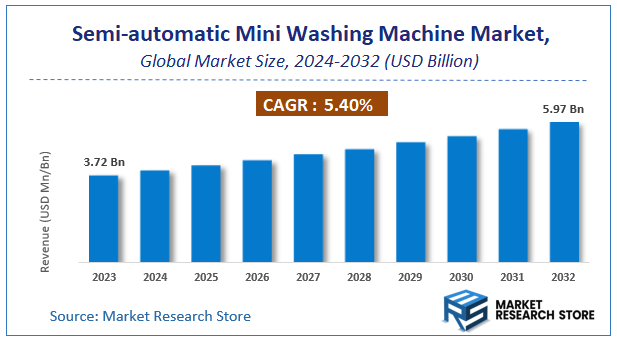
According to Market Research Store, the global semi-automatic mini washing machine market size was valued at around USD 3.72 billion in 2023 and is estimated to reach USD 5.97 billion by 2032, to register a CAGR of approximately 5.4% in terms of revenue during the forecast period 2024-2032.
The semi-automatic mini washing machine report provides a comprehensive analysis of the market, including its size, share, growth trends, revenue details, and other crucial information regarding the target market. It also covers the drivers, restraints, opportunities, and challenges till 2032.
To Get more Insights, Request a Free Sample
Global Semi-automatic Mini Washing Machine Market: Overview
A semi-automatic mini washing machine is a compact and portable laundry solution designed for small-scale washing needs, offering a balance between manual control and automated functions. These space-saving appliances, typically with 2kg to 6kg capacity, feature either single-tub or twin-tub designs that automate the washing and spinning processes while requiring user involvement for water filling, draining, and sometimes transferring clothes between compartments. Their affordable price point, energy efficiency, and low water consumption make them particularly popular among urban dwellers in small apartments, college students in dormitories, and households in areas with unreliable water or electricity supply. While lacking the full automation of premium washing machines, these mini versions provide an economical alternative for basic laundry needs, combining essential cleaning functions with portability that suits mobile lifestyles, temporary living situations, and budget-conscious consumers.
The Semi-automatic Mini Washing Machine Market is experiencing robust growth, driven by increasing urbanization, rising disposable incomes, and a growing preference for compact, economical appliances among consumers with limited living space. These machines, which require manual intervention to move clothes between washing and rinsing cycles, are particularly popular in densely populated urban areas where space is at a premium. Their affordability and efficiency make them an attractive option for budget-conscious consumers seeking practical laundry solutions.
Key Highlights
- The semi-automatic mini washing machine market is anticipated to grow at a CAGR of 5.4% during the forecast period.
- The global semi-automatic mini washing machine market was estimated to be worth approximately USD 3.72 billion in 2023 and is projected to reach a value of USD 5.97 billion by 2032.
- The growth of the semi-automatic mini washing machine market is being driven by increasing urbanization and smaller living spaces, which drive demand for compact appliances.
- Based on the type, the top loader type segment is growing at a high rate and is projected to dominate the market.
- On the basis of application, the commercial segment is projected to swipe the largest market share.
- By region, North America is expected to dominate the global market during the forecast period.
Semi-automatic Mini Washing Machine Market: Dynamics
Key Growth Drivers
- Affordability and Lower Initial Cost: Semi-automatic mini washing machines are generally significantly cheaper than fully automatic models, making them accessible to budget-conscious consumers and those with limited financial resources.
- Suitability for Small Households and Limited Space: Their compact size makes them ideal for individuals living alone, students, small families in cramped apartments, or those with space constraints.
- Lower Water and Electricity Consumption: Compared to larger, fully automatic machines, mini semi-automatic washers typically use less water and electricity per wash cycle, appealing to environmentally conscious consumers and those looking to reduce utility bills.
- Portability and Ease of Movement: Their lightweight and small size often make them easily portable, allowing users to move them around as needed, especially beneficial in rented accommodations or homes without dedicated laundry areas.
- Manual Control and Customization: Some users prefer the manual control offered by semi-automatic machines, allowing them to adjust wash times, water levels, and the intensity of agitation based on their specific laundry needs.
- Durability and Simplicity of Design: Often featuring simpler mechanical designs with fewer electronic components, these machines can be more durable and less prone to breakdowns compared to complex automatic models.
- Ideal for Delicates and Small Loads: They can be suitable for washing delicate items or small loads of laundry without wasting the water and energy required by a larger machine.
- Demand in Areas with Unreliable Water Supply: In regions with inconsistent water supply, the manual water filling feature offers greater flexibility as users can collect and use water as available.
Restraints
- Manual Effort and Time Required: The primary drawback is the need for manual intervention in filling water, transferring clothes between wash and spin tubs, and draining, making the process more time-consuming and labor-intensive than using a fully automatic machine.
- Lower Washing Efficiency Compared to Automatic Machines: Due to simpler agitation mechanisms and less sophisticated wash cycles, the cleaning efficiency might be lower compared to fully automatic models, especially for heavily soiled clothes.
- Inconvenience of Water Filling and Draining: Manually filling and draining water can be inconvenient, especially for users with mobility issues or those living in multi-story buildings.
- Limited Features and Functionality: Semi-automatic mini washers typically lack advanced features like pre-soak cycles, multiple wash programs, temperature control, and automatic dispensing of detergent and softener.
- Lower Spin Drying Efficiency: The spin drying in separate tubs of semi-automatic machines is often less efficient than the high-speed spin cycles of fully automatic washers, resulting in clothes with higher residual moisture content and longer drying times.
- Perception as a Basic or Entry-Level Appliance: In developed markets, these machines might be perceived as a basic or entry-level option, with consumers often preferring the convenience of fully automatic models as their income levels rise.
- Potential for Water Spillage During Transfer: Manually transferring wet clothes between the wash and spin tubs can lead to water spillage and mess.
- Limited Capacity: Their small size inherently limits the amount of laundry that can be washed in a single cycle, making them unsuitable for large families or bulky items.
Opportunities
- Innovation in Design for Enhanced Convenience: Developing features that minimize manual effort, such as improved water pouring mechanisms, easier transfer systems, and more efficient spin cycles within the compact form factor.
- Integration of Basic Smart Features: Incorporating simple smart features like cycle timers with automatic shut-off or basic connectivity for remote monitoring could enhance user convenience.
- Development of Energy-Efficient Models: Focusing on designing highly energy-efficient mini semi-automatic washers to appeal to environmentally conscious consumers.
- Targeting Specific Niche Markets: Catering to specific needs, such as portable models for RVs or boats, or specialized machines for delicate fabrics.
- Expansion in Developing Economies: The affordability and low running costs make these machines attractive in developing economies with a large base of price-sensitive consumers.
- Marketing Towards Students and Single Individuals in Urban Areas: Highlighting the space-saving and cost-effective benefits for students and single professionals living in small urban apartments.
- Offering Models with Improved Aesthetics: Designing more visually appealing mini semi-automatic washers to overcome the perception of them being basic appliances.
- Creating Hybrid Models: Exploring the possibility of combining some automation features (like automatic water draining) while retaining the affordability and compactness.
Challenges
- Overcoming the Perception of Lower Efficiency and Convenience: Addressing consumer perceptions about the limitations of semi-automatic machines compared to fully automatic models.
- Balancing Affordability with Durability and Performance: Ensuring that the low price point does not compromise the durability and basic cleaning performance of the machines.
- Competing with the Increasing Affordability of Entry-Level Fully Automatic Machines: As the prices of basic fully automatic washing machines decrease, semi-automatic models face increased competition.
- Meeting Evolving Consumer Expectations: Consumers are increasingly accustomed to the convenience and features of automatic appliances, making it challenging for semi-automatic machines to remain appealing.
- Addressing Water Scarcity Concerns in Some Regions: While manual filling offers flexibility, the overall water usage still needs to be considered in water-scarce areas.
- Ensuring Safety Standards: Maintaining safety standards, especially related to electrical components and moving parts, in these often lower-priced appliances.
- Building Brand Loyalty and Differentiation: Creating a strong brand identity and differentiating products in a market often perceived as commoditized.
- Adapting to Changing Lifestyles and Housing Trends: Understanding and catering to the evolving needs of increasingly urbanized and smaller households.
Semi-automatic Mini Washing Machine Market: Report Scope
This report thoroughly analyzes the Semi-automatic Mini Washing Machine Market, exploring its historical trends, current state, and future projections. The market estimates presented result from a robust research methodology, incorporating primary research, secondary sources, and expert opinions. These estimates are influenced by the prevailing market dynamics as well as key economic, social, and political factors. Furthermore, the report considers the impact of regulations, government expenditures, and advancements in research and development on the market. Both positive and negative shifts are evaluated to ensure a comprehensive and accurate market outlook.
| Report Attributes | Report Details |
|---|---|
| Report Name | Semi-automatic Mini Washing Machine Market |
| Market Size in 2023 | USD 3.72 Billion |
| Market Forecast in 2032 | USD 5.97 Billion |
| Growth Rate | CAGR of 5.4% |
| Number of Pages | 168 |
| Key Companies Covered | LG, Midea, Daewoo Electronics, Haier, Panasonic, Xiaojie Internet, Electrolux, Smad Electric, Hisense, Qishuai, Little Duck, TCL |
| Segments Covered | By Type, By Application, and By Region |
| Regions Covered | North America, Europe, Asia Pacific (APAC), Latin America, Middle East, and Africa (MEA) |
| Base Year | 2023 |
| Historical Year | 2018 to 2023 |
| Forecast Year | 2024 to 2032 |
| Customization Scope | Avail customized purchase options to meet your exact research needs. Request For Customization |
Semi-automatic Mini Washing Machine Market: Segmentation Insights
The global semi-automatic mini washing machine market is divided by type, application, and region.
Segmentation Insights by Type
Based on type, the global semi-automatic mini washing machine market is divided into top loader type and front loader type.
Top Loader Type dominates the semi-automatic mini washing machine market due to its user-friendly design, affordability, and widespread consumer preference. These models are especially popular in regions with limited space and lower water pressure, as they are more adaptable to varying infrastructure conditions. Their ease of loading and unloading, shorter wash cycles, and relatively lower price points make them highly favored in both urban and rural households, especially among students, bachelors, and small families. Additionally, the compact size and portability of top loader mini machines align well with the needs of temporary housing and rental accommodations.
Front Loader Type machines, while less dominant, are gradually gaining traction among consumers looking for better energy and water efficiency. These models are generally considered gentler on clothes and offer more effective washing with less detergent usage. Although they tend to be slightly more expensive, front loader mini machines are often chosen by environmentally conscious users and those with specific fabric care requirements. Technological enhancements such as digital controls and customized washing modes are increasingly being integrated into this segment to boost appeal.
Segmentation Insights by Application
On the basis of application, the global semi-automatic mini washing machine market is bifurcated into commercial and residential.
Commercial application dominates the semi-automatic mini washing machine market, while a smaller segment, and is experiencing gradual growth, particularly in niche markets such as dormitories, salons, hostels, and small service-based businesses. The demand here is driven by the need for cost-effective and compact laundry solutions for limited-scale or supplemental operations. However, the scale of usage in commercial settings remains limited compared to residential demand.
Residential application the Semi-Automatic Mini Washing Machine Market, accounting for the largest market share due to widespread adoption in small households, apartments, and rental accommodations, especially in emerging economies. The affordability, portability, and energy efficiency of these machines make them an ideal choice for individuals and families with limited space or budget constraints. Additionally, their ease of use and lower maintenance requirements contribute significantly to their popularity in the residential segment.
Semi-automatic Mini Washing Machine Market: Regional Insights
- North America is expected to dominate the global market.
North America is the dominant region in the Semi-automatic Mini Washing Machine Market, driven by consumer preferences for compact and energy-efficient appliances. Factors such as busy lifestyles, limited living spaces, and a preference for space-saving appliances have driven market growth in this region. The market in North America is also influenced by an increasing trend toward sustainability, with consumers opting for energy-efficient and water-saving washing machines. The U.S. is the dominating region here, experiencing growth due to technological advancements in appliance design, as well as strong retail networks that facilitate the adoption of mini washing machines.
Asia-Pacific region is by far the largest and fastest-growing market for semi-automatic mini washing machines. This region is characterized by high population density, rapid urbanization, and rising disposable income, particularly in countries like China, India, Japan, and South Korea. The semi-automatic models are highly popular in emerging economies due to their affordability and compact size, which is ideal for small apartments and homes in urban areas. India and China, with their large population base, are the dominating regions, contributing significantly to the market share. In addition, these regions have seen a surge in e-commerce and online retail, which makes it easier for consumers to access these products.
Europe is another key market for semi-automatic mini washing machines, primarily driven by countries like Germany, the United Kingdom, and France. European consumers have become more inclined towards compact home appliances due to the rising number of small households and a growing urban population. Additionally, the region's high level of environmental awareness has spurred demand for energy-efficient washing machines, a key feature of mini washing machines. The market is also supported by increasing disposable income, which allows consumers to purchase high-quality, technologically advanced washing machines.
Latin America the demand for semi-automatic mini washing machines is growing due to the increasing adoption of compact and portable home appliances. Countries like Brazil and Mexico are the leading markets in this region. The rising middle class, coupled with an increasing trend towards smaller living spaces and higher awareness of energy-efficient appliances, is driving the market. However, the growth rate is slower compared to regions like Asia-Pacific due to relatively lower disposable income in certain parts of the region.
Middle East and Africa market is relatively smaller in comparison, but it is gradually gaining traction due to the increasing number of small households and the high demand for portable appliances in urban areas. Countries like Saudi Arabia, UAE, and South Africa are leading in the demand for these machines. The market is growing steadily as consumers look for energy-efficient and space-saving appliances to match their modern lifestyles.
Semi-automatic Mini Washing Machine Market: Competitive Landscape
The report provides an in-depth analysis of companies operating in the semi-automatic mini washing machine market, including their geographic presence, business strategies, product offerings, market share, and recent developments. This analysis helps to understand market competition.
Some of the major players in the global semi-automatic mini washing machine market include:
- LG
- Midea
- Daewoo Electronics
- Haier
- Panasonic
- Xiaojie Internet
- Electrolux
- Smad Electric
- Hisense
- Qishuai
- Little Duck
- TCL
The global semi-automatic mini washing machine market is segmented as follows:
By Type
- Top Loader Type
- Front Loader Type
By Application
- Commercial
- Residential
By Region
- North America
- U.S.
- Canada
- Europe
- U.K.
- France
- Germany
- Rest of Europe
- Asia Pacific
- China
- Japan
- India
- South Korea
- Rest of Asia Pacific
- Latin America
- Brazil
- Rest of Latin America
- The Middle East and Africa
- GCC Countries
- South Africa
- Rest of Middle East Africa
Frequently Asked Questions
Table Of Content
Inquiry For Buying
Semi-automatic Mini Washing Machine
Request Sample
Semi-automatic Mini Washing Machine
