Switchboard Market Size, Share, and Trends Analysis Report
CAGR :

| Market Size 2023 (Base Year) | USD 92.35 Billion |
| Market Size 2032 (Forecast Year) | USD 128.96 Billion |
| CAGR | 3.78% |
| Forecast Period | 2024 - 2032 |
| Historical Period | 2018 - 2023 |
Switchboard Market Insights
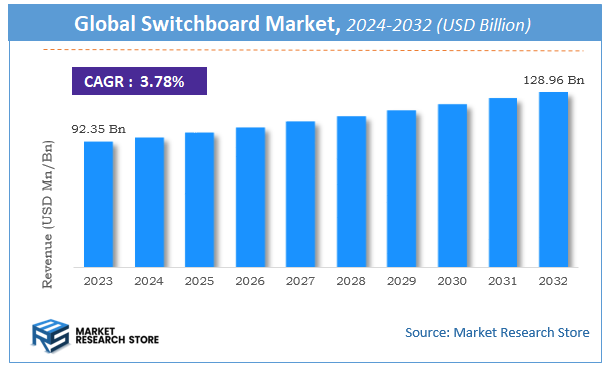
According to Market Research Store, the global switchboard market size was valued at around USD 92.35 billion in 2023 and is estimated to reach USD 128.96 billion by 2032, to register a CAGR of approximately 3.78% in terms of revenue during the forecast period 2024-2032.
The switchboard report provides a comprehensive analysis of the market, including its size, share, growth trends, revenue details, and other crucial information regarding the target market. It also covers the drivers, restraints, opportunities, and challenges till 2032.
To Get more Insights, Request a Free Sample
Global Switchboard Market: Overview
Switchboard is a crucial component in electrical systems used to manage, control, and protect electrical circuits. It is essentially a large panel or cabinet containing various electrical switches, fuses, circuit breakers, and other devices that allow the distribution of electrical power throughout a building or industrial facility. The main function of a switchboard is to route electricity from a power source to different parts of the electrical system, ensuring proper functioning and safety.
Switchboards are commonly used in residential, commercial, and industrial settings. In residential buildings, they are often found as electrical panels where power is distributed to various circuits, such as lighting and appliances. In industrial applications, switchboards can handle higher voltage levels and more complex electrical requirements, protecting equipment from faults, overloads, or short circuits
Key Highlights
- The switchboard market is anticipated to grow at a CAGR of 3.78% during the forecast period.
- The global switchboard market was estimated to be worth approximately USD 92.35 billion in 2023 and is projected to reach a value of USD 128.96 billion by 2032.
- The growth of the switchboard market is being driven by increasing demand from the ceramics industry, its role as a precursor for various zirconium compounds, and expanding applications in water treatment and specialty papers
- Based on the type, the low-voltage segment is growing at a high rate and is projected to dominate the market.
- On the basis of product standard, the IEC standard segment is projected to swipe the largest market share.
- In terms of end users, the industrial segment is expected to dominate the market.
- By region, North America is expected to dominate the global market during the forecast period.
Switchboard Market: Dynamics
Key Growth Drivers:
- Increasing Construction Activities Globally: The growth in residential, commercial, and industrial construction projects worldwide, driven by urbanization and economic development, directly fuels the demand for switchboards for power distribution within these facilities.
- Rising Investments in Infrastructure Development: Government initiatives and private investments in infrastructure projects, such as transportation networks, power grids, and water treatment plants, necessitate the installation of robust switchboard systems for reliable power management.
- Growing Adoption of Industrial Automation: The increasing automation of industrial processes across various sectors requires sophisticated electrical control and distribution systems, leading to higher demand for advanced switchboards with integrated control functionalities.
- Stringent Electrical Safety Regulations and Standards: Governments and regulatory bodies are enforcing stricter electrical safety standards to prevent accidents and ensure the protection of electrical systems. This drives the demand for high-quality, compliant switchboards with advanced safety features.
- Focus on Energy Efficiency and Smart Buildings: The growing emphasis on energy conservation and the development of smart buildings, equipped with intelligent power management systems, is increasing the demand for energy-efficient and smart switchboards capable of monitoring and controlling power consumption.
- Replacement and Modernization of Aging Electrical Infrastructure: A significant portion of existing electrical infrastructure is aging and requires replacement or modernization. This presents a substantial market for new and more efficient switchboard systems.
Restraints:
- High Initial Investment Costs: Advanced switchboards with sophisticated features and high safety standards can involve significant upfront investment costs, which might be a deterrent for budget-conscious end-users, particularly smaller businesses or residential projects.
- Slowdown in Construction and Industrial Sectors in Certain Regions: Economic downturns or slower growth in the construction and industrial sectors in specific geographic areas can lead to a temporary decrease in the demand for switchboards.
- Availability and Cost of Raw Materials and Components: Fluctuations in the prices and availability of raw materials like steel, copper, and electronic components used in switchboard manufacturing can impact production costs and potentially restrain market growth.
- Competition from Unorganized and Local Players: In some regions, the presence of numerous unorganized and local switchboard manufacturers offering lower-priced products can create intense price competition and impact the market share of established players.
- Complexity of Installation and Maintenance: Installing and maintaining complex switchboard systems often requires skilled technicians and specialized knowledge, which can add to the overall project costs and potentially delay adoption.
- Standardization and Interoperability Issues: Lack of complete standardization in switchboard designs and communication protocols can sometimes create challenges in terms of integration with other electrical systems and future upgrades.
Opportunities:
- Development of Smart and IoT-Enabled Switchboards: Integrating Internet of Things (IoT) capabilities into switchboards allows for real-time monitoring, remote control, predictive maintenance, and energy management, creating opportunities for value-added services and enhanced efficiency.
- Focus on Compact and Modular Designs: The demand for space-saving and easily scalable electrical distribution solutions is driving the development of compact and modular switchboard designs that offer flexibility and ease of installation.
- Increasing Demand for Arc Flash Mitigation Technologies: Growing awareness of the dangers of arc flash incidents is driving the demand for switchboards equipped with advanced arc flash protection and mitigation technologies, enhancing safety.
- Growth in Renewable Energy Integration: As the adoption of renewable energy sources like solar and wind power increases, there is a growing need for switchboards that can effectively integrate and manage power from these distributed generation sources.
- Customization and Application-Specific Solutions: Tailoring switchboard designs and features to meet the specific requirements of different applications (e.g., data centers, hospitals, industrial plants) offers opportunities for manufacturers to differentiate their products and cater to niche markets.
- Expansion in Emerging Economies with Rapid Urbanization: The rapid urbanization and industrialization in emerging economies present significant growth opportunities for the switchboard market as these regions invest in building and upgrading their electrical infrastructure.
Challenges:
- Ensuring Reliability and Safety in Critical Applications: Switchboards are crucial for the reliable and safe operation of various critical facilities. Maintaining high standards of reliability and safety is a paramount challenge for manufacturers.
- Meeting Stringent Regulatory Requirements and Certifications: Compliance with diverse and often complex electrical safety standards and certification requirements across different regions is a significant challenge for global switchboard manufacturers.
- Managing the Thermal Performance of High-Density Switchboards: As switchboards become more compact and handle higher power loads, managing heat dissipation effectively to prevent overheating and ensure longevity is a critical engineering challenge.
- Protecting Against Cyber Threats in Smart Switchboard Systems: With the increasing connectivity of smart switchboards, ensuring cybersecurity and protecting these systems from cyber threats is a growing concern and challenge.
- Addressing the Skills Gap in Installation, Operation, and Maintenance of Advanced Switchboards: The increasing sophistication of modern switchboard systems requires skilled personnel for installation, operation, and maintenance. Addressing the skills gap in this area is crucial.
- Balancing Cost Competitiveness with Quality and Innovation: Manufacturers face the ongoing challenge of offering cost-competitive switchboards while maintaining high quality standards and investing in innovation to meet evolving market needs.
Switchboard Market: Report Scope
This report thoroughly analyzes the Switchboard Market, exploring its historical trends, current state, and future projections. The market estimates presented result from a robust research methodology, incorporating primary research, secondary sources, and expert opinions. These estimates are influenced by the prevailing market dynamics as well as key economic, social, and political factors. Furthermore, the report considers the impact of regulations, government expenditures, and advancements in research and development on the market. Both positive and negative shifts are evaluated to ensure a comprehensive and accurate market outlook.
| Report Attributes | Report Details |
|---|---|
| Report Name | Switchboard Market |
| Market Size in 2023 | USD 92.35 Billion |
| Market Forecast in 2032 | USD 128.96 Billion |
| Growth Rate | CAGR of 3.78% |
| Number of Pages | 175 |
| Key Companies Covered | ABB Ltd, Mitsubishi Electric, Schneider Electric, Emerson Process Management, Rockwell Automation, Eaton, Siemens, Powerwell, Kounis, Gedac Electric |
| Segments Covered | By Type, By Product Standard, By End Users, and By Region |
| Regions Covered | North America, Europe, Asia Pacific (APAC), Latin America, Middle East, and Africa (MEA) |
| Base Year | 2023 |
| Historical Year | 2018 to 2023 |
| Forecast Year | 2024 to 2032 |
| Customization Scope | Avail customized purchase options to meet your exact research needs. Request For Customization |
Switchboard Market: Segmentation Insights
The global switchboard market is divided by type, product standard, end users, and region.
Segmentation Insights by Type
Based on type, the global switchboard market is divided into low-voltage, middle-voltage, and high-voltage.
Low-Voltage Switchboards dominate the switchboard market due to their extensive use across residential, commercial, and light industrial sectors. These switchboards are essential for distributing electricity at safer, lower voltages, making them ideal for buildings, office complexes, data centers, and manufacturing units with modest power demands. Their dominance is supported by the global rise in construction activities, rapid urbanization, and the increasing adoption of energy-efficient building technologies. Additionally, advancements in smart grid infrastructure and renewable energy integration continue to reinforce their widespread deployment, further solidifying their leading market position.
Middle-Voltage Switchboards play a critical role in medium-scale electrical systems, often used in industrial settings, utility substations, and large commercial infrastructures. These switchboards help manage higher power loads safely and are essential in applications where reliability and safety are paramount. Their market presence is expanding steadily, driven by industrial growth and infrastructure development in emerging economies.
High-Voltage Switchboards are crucial in heavy-duty industrial and utility applications, including power generation plants, mining operations, and high-capacity transmission systems. They ensure stable power distribution over long distances and are pivotal in national grid networks. Although vital, their market share remains smaller compared to low-voltage systems, primarily due to their specialized applications and higher installation costs. However, increasing investments in grid modernization and renewable energy projects are gradually boosting their adoption.
Segmentation Insights by Product Standard
On the basis of product standard, the global switchboard market is bifurcated into IEC standard and ANSI standard.
IEC Standard switchboards hold a dominant position in the global market, primarily due to their widespread acceptance and adaptability across numerous international regions. Developed by the International Electrotechnical Commission, IEC standards are recognized globally for ensuring uniformity, safety, and performance in electrical equipment. These standards are extensively adopted in Europe, Asia, the Middle East, and other international markets, making IEC-compliant switchboards the preferred choice for multinational construction projects and infrastructure developments. Their compatibility with global power distribution frameworks and consistent updates to meet evolving technology trends contribute significantly to their dominance.
ANSI Standard switchboards are primarily utilized in North America, particularly in the United States and Canada, where the American National Standards Institute governs compliance and performance criteria. These switchboards are engineered to meet the specific voltage, frequency, and safety requirements of North American electrical systems. While they are highly trusted and essential for regional applications, their adoption is more geographically concentrated compared to IEC standards. However, their robust design and high reliability continue to support steady demand within domestic markets.
Segmentation Insights by End Users
On the basis of end users, the global switchboard market is bifurcated into industrial, residential, and commercial.
Industrial end users represent the dominant segment in the switchboard market, primarily due to the high and consistent demand for reliable power distribution systems in manufacturing facilities, processing plants, utility stations, and heavy machinery operations. Industrial applications often involve complex electrical networks that require durable, high-capacity switchboards capable of handling large power loads and ensuring uninterrupted power flow. The ongoing trend of industrial automation, smart factories, and infrastructure expansion in both developed and emerging economies continues to drive the growth of this segment. Moreover, the emphasis on energy efficiency and regulatory compliance further supports the demand for advanced industrial-grade switchboards.
Residential end users typically require low-voltage switchboards for basic power distribution and safety within homes and apartment complexes. While this segment contributes significantly to overall market volume due to the high number of individual units, the value share remains smaller compared to industrial applications. However, the increasing development of smart homes and urban housing projects, along with growing awareness of electrical safety, is gradually enhancing the demand for modern residential switchboards.
Commercial end users include offices, retail spaces, educational institutions, healthcare facilities, and hospitality establishments. These environments demand efficient and secure power distribution to support lighting, HVAC systems, elevators, and electronic equipment. The segment is experiencing growth with the rising construction of commercial buildings, especially in urban and suburban areas. Additionally, the integration of energy management systems and green building standards is pushing for the adoption of technologically advanced and space-efficient switchboards in commercial settings.
Switchboard Market: Regional Insights
- North America is expected to dominate the global market.
North America region dominates the Switchboard Market and stands as the most mature and technologically advanced landscape for switchboard deployment. This dominance is supported by extensive investments in upgrading aging electrical infrastructure, the modernization of utility grids, and the integration of smart technologies. The United States, in particular, has been actively modernizing its power transmission and distribution networks, which fuels the demand for high-performance, intelligent switchboard systems. The presence of key industry players such as Schneider Electric, Siemens USA, and Eaton Corporation provides strong technical expertise, innovation, and wide product availability across low, medium, and high-voltage segments. Moreover, the rising deployment of electric vehicle charging infrastructure and the rapid expansion of renewable energy installations, such as wind and solar farms, are accelerating the need for customized and energy-efficient switchboard solutions. Additionally, North America's industrial automation trend and data center boom are generating sustained demand for intelligent switchboards with high operational reliability, advanced monitoring capabilities, and flexible configuration features.
Asia-Pacific region is emerging as the fastest-growing market for switchboards, driven by rapid industrialization, urbanization, and massive infrastructure development across developing countries. China and India, in particular, are making large-scale investments in smart cities, commercial complexes, and manufacturing zones. These projects require efficient electrical distribution networks, where modern switchboards provide centralized control and protection capabilities. In Japan and South Korea, high-tech industries and automation-intensive factories are propelling demand for intelligent, space-saving switchboards that align with Industry 4.0 trends. The expansion of renewable energy projects and electrification of remote areas further supports switchboard deployment in Asia-Pacific. However, challenges such as price sensitivity and limited access to advanced components in rural regions may impact full-scale penetration.
Europe region maintains a significant position in the switchboard market, driven by strong regulatory mandates, energy efficiency initiatives, and modernization efforts in industrial and commercial infrastructure. Countries like Germany, the United Kingdom, and France are leading the transition to digital substations and smart grid systems, where modern switchboards serve as key enablers of real-time control and monitoring. Europe's commitment to environmental sustainability and green building certifications like BREEAM and LEED further strengthens demand for compact, modular, and eco-friendly switchboards. The region also benefits from technological collaboration among utility providers, engineering firms, and global equipment manufacturers. Ongoing renovations in transportation systems, such as railway electrification and metro expansions, further contribute to the market's positive outlook in Western Europe.
Latin America region is showing steady market expansion, particularly in Brazil, Mexico, and Chile, where economic recovery and infrastructure revitalization projects are underway. The switchboard market in this region is benefitting from improved access to electrical infrastructure in urban areas and the development of commercial buildings and industrial parks. Renewable energy development—especially solar and wind—is gaining momentum, creating demand for medium-voltage switchboards with enhanced safety and performance standards. Despite progress, market growth in Latin America is sometimes hindered by regulatory uncertainties, economic volatility, and delays in public-private partnership projects.
Middle East & Africa region is an emerging switchboard market with long-term growth prospects fueled by government-led megaprojects, urbanization, and investment in diversified energy sources. In the Middle East, countries such as the UAE, Saudi Arabia, and Qatar are actively pursuing smart city developments, commercial skyscrapers, and expansive transport infrastructure. These projects require scalable and modular switchboards that offer high reliability and integration with advanced monitoring systems. In Africa, the focus is primarily on rural electrification, grid expansion, and building basic power distribution infrastructure. Limited technical expertise and dependency on imported equipment are challenges, but growing foreign investments and increasing demand for reliable electricity access support gradual market advancement.
Switchboard Market: Competitive Landscape
The report provides an in-depth analysis of companies operating in the switchboard market, including their geographic presence, business strategies, product offerings, market share, and recent developments. This analysis helps to understand market competition.
Some of the major players in the global switchboard market include:
- ABB Ltd
- Mitsubishi Electric
- Schneider Electric
- Emerson Process Management
- Rockwell Automation
- Eaton
- Siemens
- Powerwell
- Kounis
- Gedac Electric
The global switchboard market is segmented as follows:
By Type
- Low-Voltage
- Middle-Voltage
- High-Voltage
By Product Standard
- IEC Standard
- ANSI Standard
By End Users
- Industrial
- Residential
- Commercial
By Region
- North America
- U.S.
- Canada
- Europe
- U.K.
- France
- Germany
- Rest of Europe
- Asia Pacific
- China
- Japan
- India
- South Korea
- Rest of Asia Pacific
- Latin America
- Brazil
- Rest of Latin America
- The Middle East and Africa
- GCC Countries
- South Africa
- Rest of Middle East Africa
Frequently Asked Questions
Table Of Content
Inquiry For Buying
Switchboard
Request Sample
Switchboard
