19-Jun-2025 | Market Research Store
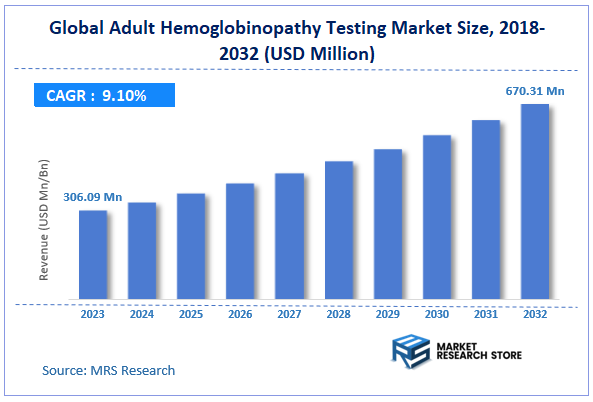
According Market Research Store the Adult Hemoglobinopathy Testing Market report, the market is expected to grow significantly from USD 306.09 million in 2023 to around USD 670.31 million by 2032. This growth represents a strong Compound Annual Growth Rate (CAGR) of 9.10% over the forecast period from 2024 to 2032.
This pivotal report is designed to serve as an indispensable resource for diagnostic companies, pharmaceutical firms, healthcare providers, public health organizations, and investors seeking to understand and contribute to the evolving landscape of genetic screening and inherited blood disorder management. Hemoglobinopathies, such as Sickle Cell Disease and Thalassemia, represent a significant global health burden. Adult testing plays a crucial role in carrier identification, family planning, diagnosis confirmation, and disease monitoring, driving demand for advanced and accessible testing solutions. This report provides a detailed, step-by-step understanding of the market's dynamics and its promising future trajectory.
For detailed insights, visit the complete report here: https://www.marketresearchstore.com/market-insights/adult-hemoglobinopathy-testing-market-829760
Market Definition
The Global Adult Hemoglobinopathy Testing Market encompasses diagnostic assays and methodologies used to identify and characterize hemoglobin disorders in adult populations. Hemoglobinopathies are inherited genetic conditions that affect the structure or production of hemoglobin, the protein in red blood cells responsible for oxygen transport. Key conditions include Sickle Cell Disease (SCD) and various forms of Thalassemia. Adult testing is crucial for:
- Carrier Screening: Identifying individuals who carry a defective gene but may not show symptoms, which is vital for genetic counseling and family planning.
- Diagnosis Confirmation: Confirming the presence and type of hemoglobinopathy in symptomatic individuals or those with abnormal initial blood test results.
- Disease Monitoring: Assessing disease progression and treatment effectiveness in diagnosed patients. The market includes a range of techniques from initial screening to definitive molecular diagnostics.
Key Highlights
This comprehensive research report offers a multi-faceted analysis of the Global Adult Hemoglobinopathy Testing Market, providing critical insights into its key aspects. Some of the prominent highlights include:
Market Size and Growth: The report meticulously tracks the historical market size from 2018 to 2022, establishing a robust baseline for future projections. The analysis indicates a strong growth trajectory, with the market poised for significant expansion from USD 306.09 Million in 2023 to USD 670.31 Million by 2032, registering an impressive CAGR of 9.10% during the forecast period (2024-2032). This growth is primarily fueled by the increasing global prevalence of hemoglobinopathies, rising awareness campaigns, growing government initiatives for genetic screening programs, and advancements in diagnostic technologies that offer higher accuracy and efficiency.
Consumer Preferences: The report analyzes evolving preferences among healthcare providers and patients. Key preferences include high accuracy and reliability of test results, especially for carrier screening and definitive diagnosis. There is a growing demand for rapid turnaround times for test results to enable timely clinical decisions and genetic counseling. Cost-effectiveness and ease of use for laboratory personnel are also crucial factors. Furthermore, non-invasive or minimally invasive sample collection methods, where feasible, are gaining preference among patients. The integration of comprehensive interpretive reports that aid clinicians in diagnosis and management is also highly valued.
Technological Innovations: The report highlights significant technological innovations shaping the adult hemoglobinopathy testing market. These include the widespread adoption of High-Performance Liquid Chromatography (HPLC) and Capillary Electrophoresis (CE) as gold standards for initial screening and quantification of hemoglobin variants. Advancements in molecular diagnostic techniques like Polymerase Chain Reaction (PCR), DNA sequencing (including Next-Generation Sequencing - NGS), and array analysis are enabling definitive genetic diagnosis, carrier identification, and detection of rare or complex variants. Innovations also focus on increased automation, higher throughput, improved data analysis software, and miniaturization of devices for point-of-care testing in resource-limited settings.
Market Segmentation: The report provides a detailed segmentation of the Global Adult Hemoglobinopathy Testing Market based on various parameters:
- By Type: This segment primarily includes the different methodologies used for testing, such as HPLC, Capillary Electrophoresis (CE), Electrophoresis (e.g., agarose gel electrophoresis), Isoelectric Focusing (IEF), Molecular Diagnostics (e.g., PCR, DNA sequencing), and Mass Spectrometry. Each method offers unique advantages in terms of sensitivity, specificity, throughput, and cost, catering to different stages of diagnosis and screening.
- By Application: This segment covers the primary uses of adult hemoglobinopathy testing, including Screening (premarital, prenatal, newborn, population-based), Diagnostic Confirmation, and Disease Monitoring (e.g., evaluating treatment efficacy, managing complications). The screening application is a significant driver, especially in high-prevalence regions.
Regional Analysis: The report provides an in-depth regional analysis, covering North America, Europe, Asia Pacific (APAC), Latin America, and the Middle East, and Africa (MEA). Each region is meticulously analyzed based on market size, growth drivers, healthcare infrastructure, prevalence rates, and key trends. North America is identified as a dominant region, characterized by advanced healthcare infrastructure, high awareness, and significant investments in genetic testing. However, Asia Pacific (APAC) and the Middle East & Africa (MEA) are expected to witness the highest growth rates due to the high prevalence of hemoglobinopathies, increasing government support for screening programs, and improving healthcare access in these regions.
Competitive Landscape: The report features an in-depth analysis of the competitive landscape, profiling key players operating in the Global Adult Hemoglobinopathy Testing Market. These prominent companies include: Bio-Rad Laboratories, Thermo Fisher Scientific, PerkinElmer, Chromsystems Instruments & Chemicals GmbH, BioMedomics, CapitalBio Technology, Trinity Biotech, Streck, and others. The competitive landscape is characterized by continuous innovation, strategic collaborations (e.g., with public health programs), product portfolio expansion, and a focus on developing integrated solutions that combine instruments, reagents, and software for comprehensive testing.
Sustainability Trends: The report highlights the growing emphasis on sustainability within the clinical diagnostics manufacturing sector, which impacts the hemoglobinopathy testing market. This includes efforts to reduce the environmental footprint of laboratory operations by minimizing waste generation (e.g., single-use plastics), optimizing energy and water consumption of instruments, and implementing responsible chemical management practices. Manufacturers are increasingly focused on developing eco-friendly reagents (e.g., animal-free components) and adopting circular economy principles to extend product lifecycles and promote recycling of instrument components. The move towards more efficient and less resource-intensive diagnostic workflows is also a key sustainability driver.
Challenges and Opportunities
While the Global Adult Hemoglobinopathy Testing Market presents significant growth potential, it also faces specific challenges that require strategic navigation. Concurrently, numerous opportunities are emerging that can be leveraged for future expansion.
Challenges
- High Cost of Advanced Tests: The initial investment and recurring costs associated with advanced molecular diagnostic platforms and specialized reagents can be a barrier to widespread adoption, especially in low-income settings.
- Lack of Awareness and Screening Infrastructure: In some regions, particularly in remote or underserved areas, there is still limited awareness about hemoglobinopathies and insufficient infrastructure for comprehensive screening programs.
- Need for Skilled Personnel: Performing and interpreting complex hemoglobinopathy tests requires highly trained laboratory technicians and genetic counselors, which can be a limiting factor.
- Complex Regulatory Pathways: Navigating diverse and evolving regulatory landscapes for diagnostic devices and assays across different countries can pose a challenge for market entry and product commercialization.
- Ethical Considerations: Genetic testing raises ethical considerations related to data privacy, informed consent, and the potential for discrimination based on genetic status.
Opportunities
- Increasing Prevalence of Hemoglobinopathies: The high and rising global prevalence, particularly in endemic regions, creates a consistent and growing demand for testing.
- Government and Public Health Initiatives: Growing support from governments and international health organizations for national screening programs (e.g., newborn screening, premarital screening) presents a significant growth opportunity.
- Technological Advancements: Continuous innovation in diagnostic technologies, leading to more accurate, faster, and potentially more affordable tests (e.g., miniaturization, automation, AI-powered analysis), will drive market expansion.
- Expansion into Underserved Regions: There is a vast untapped market in developing countries with high prevalence rates but limited access to advanced diagnostic services.
- Integration with Personalized Medicine: Hemoglobinopathy testing fits well into the paradigm of personalized medicine, offering opportunities for tailored treatment strategies based on specific genetic profiles.
- Telemedicine and Digital Health Integration: Leveraging digital platforms for genetic counseling and remote interpretation of results can improve accessibility and efficiency of testing services.
Future Outlook
The Global Adult Hemoglobinopathy Testing Market is poised for dynamic growth, driven by a convergence of increasing disease burden, advancing diagnostic technologies, and strengthening public health initiatives. The future outlook points towards greater accessibility of testing, particularly through point-of-care solutions and expanded screening programs in high-prevalence regions. Integration of multi-omics approaches and AI-driven data analysis is expected to enhance diagnostic precision and clinical utility. As awareness continues to grow and healthcare infrastructure improves globally, the market will play an increasingly vital role in early diagnosis, effective management, and ultimately, improving the quality of life for millions affected by hemoglobinopathies worldwide.
About Us
Market Research Store is a single destination for all types of industries, global, and regional reports. We feature large repository of latest industry reports and market statistics published by reputed private publishers and public organizations. Market Research Store is the comprehensive collection of market intelligence products and services available. Our vast database of reports enables our clients to benefit from expert insights on global industries, products, and market trends.
Contact Us
Market Research Store
244 Fifth Avenue, Suite N202
New York, 10001, United States
Tel: +1-302-444-0166
USA/Canada Toll Free No.+1 (855) 465-4651
Email: sales@marketresearchstore.com
Website: www.marketresearchstore.com