10-Jun-2025 | Market Research Store
The global barcode scanner market, which includes both hardware and software, was valued at approximately USD 8.12 billion in 2023 and is projected to reach an estimated USD 15.78 billion by 2032, growing at a Compound Annual Growth Rate (CAGR) of 6.9% during the forecast period (2024-2032). This substantial growth underscores the indispensable role of advanced software in enabling efficient and accurate barcode data capture across various enterprises.
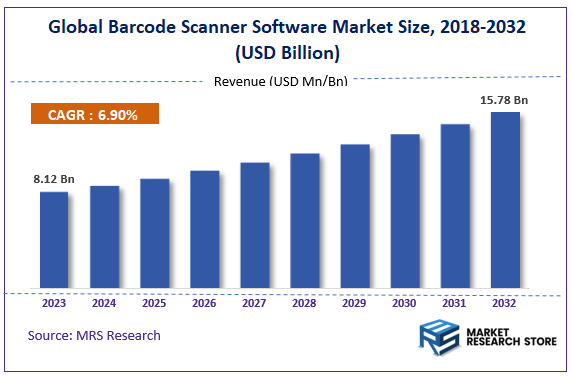
The global Barcode Scanner Software market is experiencing dynamic growth, driven by the increasing need for efficient data capture, streamlined operations, and enhanced inventory management across a multitude of industries. Far beyond simple data entry, modern barcode scanner software solutions are pivotal to digital transformation initiatives, enabling businesses to achieve greater accuracy, speed, and visibility throughout their supply chains, retail operations, healthcare systems, and manufacturing processes. As businesses increasingly embrace automation and seek real-time insights, the demand for sophisticated, integrated, and intelligent barcode scanning software is escalating. A new, comprehensive market research report provides a detailed, step-by-step analysis of this critical sector, offering invaluable insights for software developers, hardware manufacturers, system integrators, and businesses seeking to optimize their data capture strategies.
For more information about the report or to inquire about purchasing, please visit: https://www.marketresearchstore.com/market-insights/barcode-scanner-software-market-829309
Market Definition
The Barcode Scanner Software market encompasses the software applications and development kits (SDKs) that enable devices to read, interpret, and process barcode data. This includes decoding algorithms and integration software. The core technology that translates the optical patterns of 1D (linear) and 2D (matrix, like QR codes) barcodes into usable digital information. Applications and APIs (Application Programming Interfaces) that allow barcode scanners (whether dedicated handheld devices, stationary scanners, or smartphone cameras) to seamlessly communicate with enterprise systems such as Inventory Management Systems (IMS), Point-of-Sale (POS) systems, Enterprise Resource Planning (ERP) systems, Warehouse Management Systems (WMS), and Electronic Health Records (EHR).
Software that can manipulate, validate, and format scanned data according to specific business rules and trigger automated workflows (e.g., updating inventory, initiating a shipping order, verifying patient information). Software development kits that allow businesses to embed barcode scanning capabilities into their mobile applications, transforming smartphones and tablets into powerful scanning tools. Software for deploying, configuring, managing, and troubleshooting barcode scanner hardware and software across an organization. This market is critical for ensuring accuracy, speed, and efficiency in data collection, thereby enhancing productivity and reducing errors in diverse operational environments.
Key Highlights from the Report
Market Size and Growth: The Barcode Scanner Software market is experiencing significant expansion, primarily driven by the escalating demand for automation and digital transformation across industries. The rapid growth of e-commerce and logistics necessitates faster and more accurate inventory tracking and order fulfillment, directly fueling the adoption of advanced scanning software. Furthermore, the increasing adoption of barcode technology in healthcare for patient safety and medication tracking, and in manufacturing for production efficiency and quality control, are key growth drivers. The rise of smartphone-based scanning solutions, leveraging existing mobile devices, is also contributing to market accessibility and growth.
Consumer Preferences: For businesses and enterprises in the barcode scanning market, operational efficiency, cost-effectiveness, and adaptability are key drivers of purchasing decisions. Accuracy and reliability are critical, as these solutions must decode even damaged, poorly printed, or hard-to-scan barcodes with high precision. Speed and efficiency are equally vital, especially in high-volume settings like retail checkouts and warehouses, where fast scanning directly impacts productivity. Companies prioritize seamless integration, favoring software that effortlessly connects with existing IT ecosystems—such as ERP, WMS, and POS systems—without requiring extensive customization.
Versatility is another major factor, with demand for scanners capable of reading multiple barcode types (1D, 2D, QR, Data Matrix) and performing reliably under varying lighting and environmental conditions. The rise of mobile workflows has also increased the need for mobile-compatible SDKs, enabling dependable barcode scanning on smartphones and tablets while reducing hardware costs. A user-friendly interface is essential to minimize training time and operational errors, while advanced data management and analytics capabilities—including real-time processing and integration with business intelligence tools—help enterprises derive actionable insights.
Finally, scalability and security are non-negotiable, as businesses require solutions that can grow with their operations while ensuring robust data protection. Together, these factors define the expectations of enterprise consumers in this technology-driven market.
Technological Innovations: The barcode scanner software market is undergoing a transformative shift, leveraging cutting-edge technologies to evolve from basic decoding tools into intelligent data capture platforms. AI and machine learning (AI/ML) are revolutionizing the space, with advanced algorithms improving accuracy for damaged or low-quality barcodes while enabling predictive maintenance and workflow optimization. Computer vision extends functionality beyond traditional barcodes, allowing for automated visual inspections and data extraction from complex labels.
Augmented reality (AR) integration is enhancing operational efficiency by overlaying digital product information in real-time via smart glasses, streamlining tasks like inventory management and order picking. For high-throughput environments, multi-code reading capabilities enable simultaneous scanning of multiple barcodes in a single capture, dramatically boosting productivity. The industry is also embracing cloud-based solutions for their scalability, remote management features, and cost efficiencies, while GS1 Digital Link support modernizes traditional barcodes by connecting them to dynamic web resources for richer product data.
Developers benefit from increasingly sophisticated SDKs that simplify embedding enterprise-grade scanning into custom applications across all major platforms. Finally, edge computing is reducing latency by processing data locally, enabling faster decision-making in time-sensitive operations. Together, these innovations are redefining barcode scanning as a gateway to smarter, more connected enterprise workflows.
Market Segmentation: The global barcode scanner software market is divided by product, application, and region. Based on Product, the global barcode scanner software market is divided into cloud-based, on-premise, and others. The On-Premise segment currently holds a larger share due to established enterprise infrastructures and security preferences for sensitive data. However, the Cloud-Based segment is projected to achieve the highest CAGR due to its flexibility, scalability, and lower upfront costs. On the basis of Application, the global barcode scanner software market is bifurcated into commercial users, private users, and others. The Commercial Users segment dominates the Barcode Scanner Software Market due to the high demand for barcode scanning in retail, logistics, and other large-scale operations.
Regional Analysis: North America currently holds the largest market share in the barcode scanner software market. This is attributed to the early adoption of advanced technologies, the presence of major technology providers, robust infrastructure in retail, logistics, and healthcare sectors, and a strong emphasis on automation and operational efficiency. Asia Pacific region is projected to exhibit the fastest CAGR during the forecast period. Driven by rapid industrialization, the booming e-commerce sector, increasing investments in supply chain modernization, and rising adoption of digital technologies in countries like China, India, and Japan. Governments' push for digital transformation also contributes significantly.
Europe is a significant market, characterized by strong manufacturing and logistics sectors, high automation rates, and an increasing focus on smart factory initiatives and Industry 4.0. Latin America and the Middle East & Africa regions are showing steady growth, fueled by improving economic conditions, increasing industrialization, rising internet penetration, and a growing awareness of the benefits of digital data capture solutions.
Competitive Landscape: The global Barcode Scanner Software market is highly competitive, featuring a mix of established hardware manufacturers with robust software offerings, specialized software developers, and nimble insurtech startups. Key players in the market include AngleTech, ASAP Systems, EZ to Use, IHandy, NM, Scan, Scanbuy, Shop Savvy, TWMobile, WordPress, and others. These companies are focusing on continuous innovation in decoding algorithms, enhancing integration capabilities, developing user-friendly mobile SDKs, and forming strategic partnerships to expand their market reach and provide comprehensive solutions.
Sustainability Trends: While not as direct as in other industries, sustainability is influencing the barcode scanner software market in several ways:
- Reduced Paper Consumption: Digitalization of processes through barcode scanning reduces the reliance on paper-based records, contributing to environmental sustainability.
- Optimized Logistics: Efficient inventory and supply chain management enabled by barcode software can reduce waste (e.g., spoilage, overstocking) and optimize transportation routes, lowering carbon emissions.
- Extended Device Lifespan: Software updates and compatibility with various hardware can extend the usable life of scanning devices, reducing electronic waste.
- Resource Efficiency: Real-time data provided by scanning software can help businesses manage resources more efficiently, from energy consumption in warehouses to material usage in manufacturing.
- Circular Economy: Barcodes and associated software can facilitate tracking and recycling initiatives for products throughout their lifecycle.
Challenges and Opportunities
The Barcode Scanner Software market faces certain challenges:
- Integration Complexity: Integrating barcode scanning software with diverse and often legacy enterprise systems can be a significant technical and financial challenge.
- Data Security and Privacy: Ensuring the secure transmission and storage of sensitive data captured via barcode scanning, especially in healthcare and finance, is paramount.
- Barcode Quality and Standards: Issues with poorly printed, damaged, or non-standardized barcodes can hinder scanning accuracy and efficiency, requiring advanced software algorithms to compensate.
- Cost of Implementation: While long-term ROI is clear, the initial investment in hardware, software licenses, and training can be a barrier for smaller businesses.
- Technological Obsolescence: The rapid pace of technological change requires continuous software updates and compatibility with new barcode symbologies and scanning hardware.
- Lack of Skilled Workforce: A shortage of IT professionals with expertise in deploying and managing advanced data capture solutions can be a constraint.
Despite these challenges, the market presents significant opportunities:
- Proliferation of E-commerce and Logistics: The continuous growth of online retail and global supply chains demands highly efficient and accurate data capture solutions.
- Industry 4.0 and Automation: The push towards smart factories, automated warehouses, and connected enterprises creates immense opportunities for integrated barcode software.
- Growth of Mobile Computing: The widespread adoption of smartphones and tablets as business tools drives demand for robust and user-friendly mobile scanning SDKs.
- Increasing Adoption in Healthcare: The imperative for patient safety, medication tracking, and asset management in healthcare facilities is fueling market expansion.
- Demand for Real-Time Analytics: Businesses increasingly rely on real-time data from scanning operations for immediate decision-making and operational optimization.
- Emergence of 2D Barcodes and QR Codes: The versatility and data capacity of 2D codes open up new applications in marketing, consumer engagement, and advanced traceability.
- Cloud-Based Solutions for SMEs: The scalability and affordability of cloud-based software are making advanced barcode scanning accessible to a wider range of small and medium-sized enterprises.
- Innovation in AI and AR: Further development in AI and AR will unlock new levels of efficiency and capability in barcode scanning workflows.
Future Outlook
The global Barcode Scanner Software market is set for sustained and robust growth, solidifying its role as a fundamental enabler of digital efficiency. The future will see an even deeper integration of scanning software with enterprise systems, driven by AI and machine learning for predictive insights and automated decision-making. As the physical and digital worlds continue to converge, barcode scanner software will evolve into intelligent data capture platforms, supporting advanced traceability, personalized consumer experiences, and highly optimized operational workflows across every sector imaginable.
About Us
Market Research Store is a single destination for all types of industries, global, and regional reports. We feature large repository of latest industry reports and market statistics published by reputed private publishers and public organizations. Market Research Store is the comprehensive collection of market intelligence products and services available. Our vast database of reports enables our clients to benefit from expert insights on global industries, products, and market trends.
Contact Us
Market Research Store
244 Fifth Avenue, Suite N202
New York, 10001, United States
Tel: +1-302-444-0166
USA/Canada Toll Free No.+1 (855) 465-4651
Email: sales@marketresearchstore.com
Website: www.marketresearchstore.com