16-Jul-2025 | Market Research Store
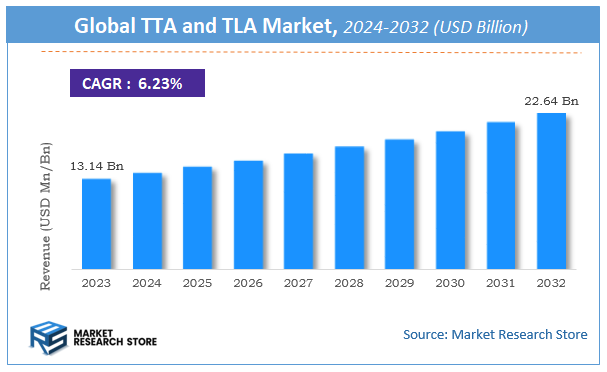
Market Research Store, a leading global provider of comprehensive market intelligence and consulting services, today announced the publication of its latest in-depth research report, titled "TTA and TLA Market." This meticulously researched report offers an exhaustive analysis of the current market dynamics, key growth drivers, cutting-edge technological innovations, evolving laboratory demands, challenges, opportunities, and the strategic future outlook within the global total laboratory automation and total testing automation industry. The TTA and TLA Market report forecasts a substantial expansion of the market, from USD 13.14 Billion in 2023 to a remarkable USD 22.64 Billion by 2032, demonstrating a Compound Annual Growth Rate (CAGR) of 6.23% during the forecast period (2024-2032).
This pivotal report is designed to serve as an indispensable resource for clinical diagnostic laboratories, pharmaceutical and biotechnology companies, research institutions, academic centers, and investors seeking to understand and capitalize on the accelerating trend of automating complex laboratory workflows. Total Laboratory Automation (TLA) and Total Testing Automation (TTA) are revolutionizing scientific and diagnostic processes by enhancing efficiency, reproducibility, throughput, and safety, while significantly reducing human error and operational costs. Their growing adoption is critical for laboratories navigating increasing test volumes, labor shortages, and the imperative for rapid, accurate, and standardized results. This report provides a detailed, step-by-step understanding of the market's dynamics and its promising future trajectory.
Access the Full Report Overview Here: https://www.marketresearchstore.com/market-insights/tta-and-tla-market-830556
Market Definition
The Global Total Laboratory Automation (TLA) and Total Testing Automation (TTA) Market encompasses integrated systems and solutions designed to automate a wide range of laboratory processes, from pre-analytical (sample handling, preparation) and analytical (testing, analysis) to post-analytical (data management, storage, archiving) phases.
- Total Laboratory Automation (TLA) refers to the comprehensive, end-to-end automation of an entire laboratory workflow, typically involving robotic systems, automated instruments, and sophisticated software that connect various analytical modules. The goal of TLA is to create a seamless, hands-off process for high-volume testing, minimizing manual intervention and maximizing efficiency, standardization, and turnaround time. This is particularly prevalent in large clinical diagnostic laboratories.
- Total Testing Automation (TTA), often considered a subset or a specific focus within TLA, refers to the automation of specific testing methodologies or analytical platforms within a laboratory. While TLA aims for holistic automation across departments, TTA focuses on optimizing the automation within a particular testing area (e.g., chemistry, immunoassay, hematology) to achieve high throughput and consistent results for specific types of tests.
Together, TLA and TTA solutions leverage robotics, advanced instrumentation, and intelligent software to improve data quality, reduce human error, enhance safety, and significantly boost laboratory throughput and operational efficiency across clinical diagnostics, drug discovery, genomics, proteomics, and other life science applications.
Key Highlights
This comprehensive research report offers a multi-faceted analysis of the Global TTA and TLA Market, providing critical insights into its key aspects. Some of the prominent highlights include:
Market Size and Growth: The report meticulously tracks the historical market size from 2018 to 2023, establishing a robust baseline for future projections. The analysis indicates a consistent growth trajectory, with the market poised for significant expansion from USD 13.14 Billion in 2023 to USD 22.64 Billion by 2032, registering a steady CAGR of 6.23% during the forecast period (2024-2032). This robust growth is primarily fueled by the increasing global demand for diagnostic testing, the rising volume of samples in clinical and research laboratories, the imperative to reduce labor costs and address skilled personnel shortages, and the continuous need for improved accuracy, reproducibility, and faster turnaround times in laboratory results.
Consumer Preferences: The report identifies evolving preferences among laboratory managers, researchers, and clinicians for TTA and TLA systems. Buyers prioritize reliability and robustness of automated platforms to ensure continuous operation and minimize downtime. Scalability and modularity are crucial, allowing systems to be customized for diverse applications and easily expanded as needs evolve. Seamless integration with existing laboratory information management systems (LIMS), hospital information systems (HIS), and various analytical instruments is highly valued. Furthermore, there's a strong demand for user-friendly software interfaces, comprehensive data management and analysis capabilities, and solutions that offer a clear Return on Investment (ROI) through enhanced efficiency, reduced errors, and optimized resource utilization.
Technological Innovations: The report highlights cutting-edge technological innovations shaping the TTA and TLA market. These include advancements in robotics, with more agile, collaborative, and precise robotic arms capable of handling a wider range of complex laboratory tasks. The integration of Artificial Intelligence (AI) and Machine Learning (ML) algorithms is transforming data analysis, enabling automated interpretation, predictive analytics for instrument maintenance, and optimization of workflow protocols. Miniaturization of assays (e.g., microfluidics) allows for reduced sample and reagent consumption while increasing throughput. Innovations in sensor technology and real-time monitoring enhance process control and ensure sample integrity. Furthermore, the development of cloud-based platforms for data storage, sharing, and remote operation is enhancing collaboration, accessibility, and enabling centralized management of distributed lab networks.
Market Segmentation: The report provides a detailed segmentation of the Global TTA and TLA Market, offering a granular understanding of its diverse components:
- By Product Type: This segment includes Automated Liquid Handlers, Robotic Systems, Automated Plate Readers, LIMS (Laboratory Information Management Systems), and Integrated Workstations. Integrated Workstations and LIMS are crucial for comprehensive automation.
- By Application: This covers the primary uses of TTA and TLA systems, such as Clinical Diagnostics (e.g., Immunoassays, Clinical Chemistry, Hematology, Microbiology), Drug Discovery & Development (e.g., High-Throughput Screening, Compound Management), Genomics & Proteomics Research, and Biobanking. Clinical Diagnostics and Drug Discovery & Development are the largest and fastest-growing application areas.
- By End User: This segment categorizes the primary consumers of these systems, including Hospitals & Diagnostic Laboratories, Pharmaceutical & Biotechnology Companies, Research & Academic Institutions, and Contract Research Organizations (CROs). Hospitals & Diagnostic Laboratories are the largest end-user segment.
- By Workflow: This differentiates based on the stage of automation, such as Pre-Analytical Automation, Analytical Automation, and Post-Analytical Automation. Analytical Automation is currently the most mature, with increasing focus on pre- and post-analytical.
- By Automation Type: This includes Modular Automation (flexible, customizable systems) and Total Laboratory Automation (TLA) Systems (fully integrated, high-throughput solutions). Modular Automation is gaining traction due to its adaptability, while TLA Systems are essential for large-scale operations.
Dominating Region in Segmentation: The Application segment, particularly Clinical Diagnostics, consistently drives the highest demand. Geographically, North America is expected to dominate across most segments due to its advanced healthcare and research infrastructure.
Regional Analysis: The report provides an in-depth regional analysis, covering North America, Europe, Asia Pacific (APAC), Latin America, the Middle East, and Africa (MEA). Each region is meticulously analyzed based on market size, R&D expenditure, healthcare infrastructure, and the adoption rates of advanced laboratory technologies.
North America is identified as the dominating region in the Global TTA and TLA Market. This leadership is attributed to its robust healthcare spending, significant investments in pharmaceutical and biotechnology R&D, the presence of numerous large clinical diagnostic laboratories, and early adoption of advanced automation technologies. Europe also holds a substantial market share, driven by similar factors and a strong focus on laboratory efficiency.
Asia Pacific (APAC) is projected to exhibit the highest growth rates, fueled by rapidly expanding healthcare infrastructure, increasing government and private investments in life sciences, a growing patient population, and the rising demand for high-throughput diagnostic and research capabilities in countries like China, India, and Japan.
Competitive Landscape: The report features an in-depth analysis of the competitive landscape, profiling key players operating in the Global TTA and TLA Market. These prominent companies include: Thermo Fisher Scientific Inc., Beckman Coulter, Inc., PerkinElmer, Inc., Tecan Group Ltd., Agilent Technologies, Inc., Danaher Corporation, Bio-Rad Laboratories, Inc., Hamilton Company, Roche Holding AG, QIAGEN N.V., Siemens Healthineers AG, Eppendorf AG, Promega Corporation, Abbott Laboratories, Analytik Jena AG, Dade, OCD, Abbot, Autobio, Mindry, Hitachi, and Tomtec. The competitive landscape is characterized by major diversified healthcare and life science companies offering comprehensive automation solutions, alongside specialized firms providing niche automation components or software. Companies are focusing on strategic partnerships, product innovation (especially in AI, modularity, and integration), expanding their global footprint, and providing integrated solutions that cater to the evolving needs of modern laboratories.
Sustainability Trends: The TTA and TLA market contributes to broader sustainability goals in laboratories through several key trends. By enabling more efficient and optimized workflows, automation can lead to reduced consumption of reagents and consumables by minimizing manual errors and optimizing assay volumes. Improved efficiency and throughput can also contribute to lower energy consumption per test compared to manual processes. The reduction of biological and chemical waste through precise liquid handling and optimized workflows is another significant sustainability benefit. Furthermore, the ability to collect and manage data digitally reduces the reliance on paper, aligning with broader paperless initiatives in laboratories. Manufacturers are also focusing on designing automated systems with longer lifespans and modular components for easier upgrades and repairs, promoting resource efficiency.
Challenges & Opportunities
While the Global TTA and TLA Market demonstrates robust growth, it also faces specific challenges that require strategic navigation. Concurrently, numerous opportunities are emerging that can be leveraged for future expansion.
Challenges
- High Initial Investment: The significant capital expenditure required for purchasing and installing comprehensive TLA/TTA systems can be a major barrier, especially for smaller laboratories or those with limited budgets.
- Complexity of Integration: Integrating new automation systems with existing laboratory information management systems (LIMS), analytical instruments, and diverse workflows can be technically complex and time-consuming.
- Need for Skilled Personnel: Operating, programming, and maintaining sophisticated automation systems requires specialized technical expertise, leading to a demand for skilled personnel and potential training costs.
- Resistance to Change: Laboratory personnel accustomed to manual workflows may exhibit resistance to adopting new automated systems, necessitating effective change management strategies.
- Maintenance and Downtime: While designed for reliability, complex automated systems can experience technical issues, and any downtime can significantly impact laboratory throughput and operations.
Opportunities
- Increasing Demand for High-Throughput Testing: The accelerating pace of drug discovery, diagnostic testing, and genomics research drives a strong demand for high-throughput automation.
- Rising Volume of Diagnostic Tests: The global increase in chronic and infectious diseases, coupled with a growing emphasis on preventive healthcare, leads to a surge in diagnostic testing volumes, necessitating automation.
- Focus on Reproducibility and Quality: Automation significantly reduces human error and variability, leading to improved data quality, reproducibility of results, and enhanced regulatory compliance, which are critical for research and clinical applications.
- Labor Shortages and Cost Reduction: Automation offers a compelling solution to address labor shortages in laboratories and reduce long-term operational costs by optimizing human resource allocation.
- Emergence of AI and Machine Learning: The integration of AI and ML can further enhance automation capabilities, enabling intelligent workflow optimization, predictive maintenance, and advanced data analysis.
- Modular and Flexible Solutions: The trend towards modular automation systems allows laboratories to scale their automation capabilities gradually, making it more accessible and adaptable to evolving needs.
- Growth in Biobanking and Sample Management: Automation is crucial for efficient and reliable management of large biological sample collections, supporting research and diagnostic efforts.
Future Outlook
The Global TTA and TLA Market is poised for a transformative future, becoming an indispensable backbone of modern scientific and clinical laboratories. The future outlook points towards highly intelligent, interconnected, and adaptive automation platforms that leverage AI and machine learning for predictive capabilities and autonomous decision-making in workflows. We anticipate a deeper convergence of TTA/TLA with digital health ecosystems, enabling seamless data flow from patient to diagnosis and treatment. The market will see continued innovation in miniaturization and microfluidics, enabling more efficient use of precious samples and reagents. Ultimately, Total Laboratory Automation and Total Testing Automation will drive unprecedented levels of efficiency, precision, and discovery, accelerating scientific breakthroughs and improving healthcare outcomes worldwide.
About Us
Market Research Store is a single destination for all types of industries, global, and regional reports. We feature large repository of latest industry reports and market statistics published by reputed private publishers and public organizations. Market Research Store is the comprehensive collection of market intelligence products and services available. Our vast database of reports enables our clients to benefit from expert insights on global industries, products, and market trends.
Contact Us
Market Research Store
244 Fifth Avenue, Suite N202
New York, 10001, United States
Tel: +1-302-444-0166
USA/Canada Toll Free No.+1 (855) 465-4651
Email: sales@marketresearchstore.com
Website: www.marketresearchstore.com