15-Jul-2025 | Market Research Store
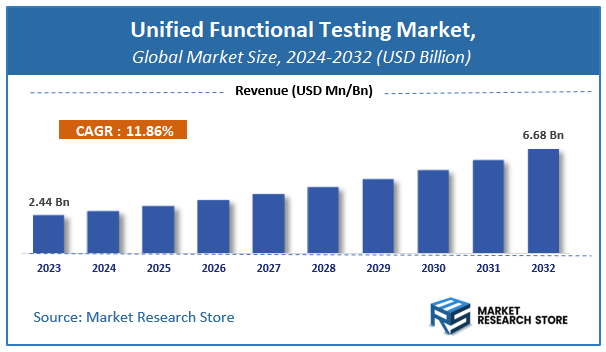
Market Research Store, a leading global provider of comprehensive market intelligence and consulting services, today announced the publication of its latest in-depth research report, titled "Unified Functional Testing Market." This meticulously researched report offers an exhaustive analysis of the current market dynamics, key growth drivers, cutting-edge technological innovations, evolving software development demands, challenges, opportunities, and the strategic future outlook within the global unified functional testing industry. The unified functional testing market report forecasts a substantial expansion of the market, from USD 2.44 Billion in 2023 to a remarkable USD 6.68 Billion by 2032, demonstrating an impressive Compound Annual Growth Rate (CAGR) of 11.86% during the forecast period (2024-2032).
This pivotal report is designed to serve as an indispensable resource for software development companies, quality assurance teams, IT service providers, and investors seeking to understand and capitalize on the accelerating shift towards integrated and automated testing solutions. Unified functional testing is revolutionizing software quality assurance by streamlining testing processes, enhancing efficiency, and ensuring the reliability of complex applications across diverse platforms and technologies. Its growing adoption is critical for enterprises navigating rapid digital transformation, agile development, and DevOps methodologies. This report provides a detailed, step-by-step understanding of the market's dynamics and its promising future trajectory.
Review the Key Points in the Research Report Summary: https://www.marketresearchstore.com/market-insights/unified-functional-testing-market-830462
Market Definition
The Global Unified Functional Testing (UFT) Market refers to the segment of the software testing industry that provides comprehensive platforms, tools, and services designed to integrate and automate various types of functional testing within a single framework. This approach moves beyond siloed testing of individual components (e.g., GUI, API, mobile, web, database) to enable end-to-end validation of complex software applications across multiple layers and user interfaces. UFT solutions aim to streamline the entire testing lifecycle, from test case design and execution to defect management and reporting, thereby improving test coverage, accelerating release cycles, reducing manual effort, and ensuring the overall quality and reliability of software in an increasingly interconnected digital landscape. These platforms often support a wide range of technologies and integrate seamlessly with modern DevOps and Continuous Integration/Continuous Delivery (CI/CD) pipelines.
Key Highlights
This comprehensive research report offers a multi-faceted analysis of the global unified functional testing market, providing critical insights into its key aspects. Some of the prominent highlights include:
Market Size and Growth: The report meticulously tracks the historical market size from 2018 to 2023, establishing a robust baseline for future projections. The analysis indicates an explosive growth trajectory, with the market poised for significant expansion from USD 2.44 Billion in 2023 to USD 6.68 Billion by 2032, registering an impressive CAGR of 11.86% during the forecast period (2024-2032). This robust growth is primarily fueled by the accelerating pace of digital transformation across industries, the widespread adoption of Agile and DevOps methodologies, the increasing complexity of enterprise applications, and the imperative for businesses to deliver high-quality, bug-free software at speed.
Consumer Preferences: The report identifies evolving preferences among software development teams and quality assurance professionals for unified functional testing solutions. Buyers prioritize comprehensive test coverage across diverse technologies (web, mobile, API, desktop) and application types (ERP, CRM). Automation capabilities are paramount, with a strong demand for tools that reduce manual effort and accelerate execution. Ease of integration with existing development tools (IDEs, version control), CI/CD pipelines, and project management systems is crucial. Furthermore, there's a growing preference for AI/ML-powered features (e.g., intelligent test generation, self-healing tests), codeless/low-code options for broader accessibility, scalability to handle large test suites, and cloud-based deployment for flexibility and reduced infrastructure overhead.
Technological Innovations: The report highlights cutting-edge technological innovations shaping the unified functional testing market. These include the profound impact of Artificial Intelligence (AI) and Machine Learning (ML) for intelligent test case generation, automated script maintenance (self-healing tests), anomaly detection, and predictive analytics for quality risks. The rise of codeless and low-code testing platforms is democratizing test automation, enabling non-programmers to contribute. Cloud-based testing environments offer unparalleled scalability, flexibility, and cost-efficiency. Furthermore, seamless integration with DevOps and CI/CD pipelines ensures continuous testing throughout the software development lifecycle, while enhanced support for emerging technologies like IoT, blockchain, and microservices architectures is expanding UFT's applicability.
Market Segmentation: The report provides a detailed segmentation of the global unified functional testing market, offering a granular understanding of its diverse components:
- By Deployment Type: This segment includes On-Premise solutions and Cloud-based solutions. Cloud-based deployment is experiencing significantly faster growth due to its scalability, accessibility, and lower upfront infrastructure costs.
- By Testing Type: This covers various functional testing approaches, such as GUI Testing, API Testing, Mobile Application Testing, Web Application Testing, Database Testing, and End-to-End Testing. API Testing is a rapidly growing segment due to the prevalence of microservices architectures.
- By Industry Vertical: This includes major sectors like IT & Telecom, Banking, Financial Services, and Insurance (BFSI), Healthcare & Life Sciences, Retail & E-commerce, Manufacturing, Government, and Others. The IT & Telecom and BFSI sectors are major application areas due to their high reliance on software and stringent quality requirements.
- By Organization Size: This differentiates between Small and Medium-sized Enterprises (SMEs) and Large Enterprises. Large Enterprises are currently the dominant adopters, but SMEs are increasingly investing in UFT as solutions become more accessible.
- By Application: This covers the specific types of software applications, such as Web Applications, Mobile Applications, Desktop Applications, Enterprise Resource Planning (ERP) Systems, Customer Relationship Management (CRM) Systems, and Others.
Dominating Region in Segmentation: The Industry Vertical segment, particularly IT & Telecom and BFSI, consistently drives the highest demand. Geographically, North America is expected to dominate across most segments due given its advanced technological infrastructure and early adoption trends.
Regional Analysis: The report provides an in-depth regional analysis, covering North America, Europe, Asia Pacific (APAC), Latin America, the Middle East, and Africa (MEA). Each region is meticulously analyzed based on market size, digital transformation initiatives, IT spending, and the maturity of software development ecosystems.
North America is identified as the dominating region in the global unified functional testing market. This leadership is attributed to its highly mature software industry, significant investments in digital transformation, widespread adoption of Agile and DevOps practices, and the presence of numerous key technology providers and early adopters. Europe also holds a substantial market share, driven by similar factors and strong regulatory pushes for software quality. Asia Pacific (APAC) is projected to exhibit the highest growth rates, fueled by rapid digitalization across industries, burgeoning IT hubs, increasing IT spending, and a growing emphasis on software quality in countries like India, China, and Japan.
Competitive Landscape: The report features an in-depth analysis of the competitive landscape, profiling key players operating in the global unified functional testing market. These prominent companies include: Micro Focus (now part of OpenText), Tricentis, SmartBear Software, Worksoft, IBM, UiPath, SoapUI (SmartBear), Katalon, Oracle, BrowserStack, Sauce Labs, and Inflectra. The competitive landscape is dynamic, characterized by a mix of established enterprise software vendors and specialized testing tool providers. Companies are focusing on integrating AI/ML capabilities, expanding their cloud offerings, enhancing support for diverse technologies, and forging strategic partnerships to provide comprehensive, end-to-end UFT solutions and maintain market leadership.
Sustainability Trends: While not directly tied to physical resource consumption, the unified functional testing market contributes to broader sustainability goals in software development. By enabling more efficient and automated testing, UFT reduces the computational resources and energy required for repetitive manual testing cycles. Faster and more reliable software releases, facilitated by UFT, can lead to optimized operational efficiency in various industries, potentially reducing energy waste and resource consumption in end-user systems. Furthermore, by ensuring the quality and reliability of software that underpins sustainable technologies (e.g., smart grids, renewable energy management systems), UFT indirectly supports environmental sustainability initiatives.
Challenges & Opportunities
While the global unified functional testing market demonstrates explosive growth, it also faces specific challenges that require strategic navigation. Concurrently, numerous opportunities are emerging that can be leveraged for future expansion.
Challenges
- Complexity of Modern Applications: Testing highly distributed, microservices-based, and cloud-native applications presents significant challenges for comprehensive functional testing and integration.
- Integration with Diverse Ecosystems: Seamless integration of UFT tools with a fragmented landscape of development, CI/CD, and project management tools can be complex.
- Skill Gap: A shortage of skilled professionals proficient in advanced test automation, AI/ML in testing, and complex UFT platforms can hinder adoption and effective implementation.
- Initial Investment and ROI Justification: The upfront cost of UFT tools and the necessary organizational change can be substantial, requiring clear ROI justification for enterprises.
- Maintaining Test Suites: As applications evolve rapidly, maintaining large, complex automated test suites can become a significant overhead if not managed efficiently.
Opportunities
- Accelerated Digital Transformation: The global imperative for businesses to digitalize operations and enhance customer experiences drives the fundamental need for robust and reliable software, boosting UFT demand.
- Widespread Adoption of DevOps and Agile: The continuous delivery model of DevOps and Agile methodologies necessitates continuous and automated functional testing, creating a core market for UFT solutions.
- Integration of AI and Machine Learning: The application of AI/ML for intelligent test automation, self-healing scripts, and predictive quality offers a massive opportunity to enhance UFT capabilities and efficiency.
- Cloud Migration and SaaS Models: The shift towards cloud-native applications and the preference for Software-as-a-Service (SaaS) delivery models for testing tools create opportunities for scalable, flexible UFT solutions.
- Demand for Quality and User Experience: In a competitive digital landscape, delivering high-quality, bug-free software with excellent user experience is paramount, making UFT an essential investment.
- Expansion into New Verticals: The increasing digitalization of traditionally less software-intensive industries (e.g., manufacturing, healthcare) presents new growth avenues for UFT.
- Focus on End-to-End Testing: The need to validate complex business processes spanning multiple applications and technologies drives demand for truly unified, end-to-end functional testing.
Future Outlook
The global unified functional testing market is poised for a transformative future, becoming an indispensable and increasingly autonomous component of the entire software development lifecycle. The future outlook points towards hyper-automated, AI-driven UFT platforms that can intelligently generate, execute, and maintain test suites with minimal human intervention, enabling true continuous quality. We anticipate a deeper convergence of UFT with observability and production monitoring tools, allowing for proactive identification and resolution of issues. The market will see a sustained focus on low-code/no-code interfaces to democratize test automation further and seamless integration with emerging technologies. Ultimately, Unified Functional Testing will evolve into a predictive quality assurance powerhouse, ensuring the flawless performance of the complex software systems that power the global digital economy.
About Us
Market Research Store is a single destination for all types of industries, global, and regional reports. We feature large repository of latest industry reports and market statistics published by reputed private publishers and public organizations. Market Research Store is the comprehensive collection of market intelligence products and services available. Our vast database of reports enables our clients to benefit from expert insights on global industries, products, and market trends.
Contact Us
Market Research Store
244 Fifth Avenue, Suite N202
New York, 10001, United States
Tel: +1-302-444-0166
USA/Canada Toll Free No.+1 (855) 465-4651
Email: sales@marketresearchstore.com
Website: www.marketresearchstore.com