Flow Enhancer Market Size, Share, and Trends Analysis Report
CAGR :

| Market Size 2023 (Base Year) | USD 4.24 Billion |
| Market Size 2032 (Forecast Year) | USD 9.22 Billion |
| CAGR | 9.02% |
| Forecast Period | 2024 - 2032 |
| Historical Period | 2018 - 2023 |
Flow Enhancer Market Insights
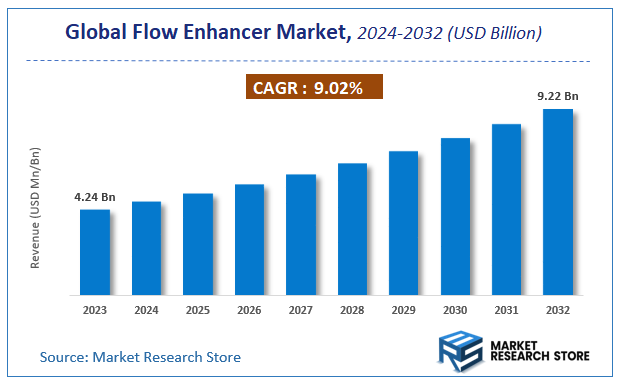
According to Market Research Store, the global flow enhancer market size was valued at around USD 4.24 billion in 2023 and is estimated to reach USD 9.22 billion by 2032, to register a CAGR of approximately 9.02% in terms of revenue during the forecast period 2024-2032.
The flow enhancer report provides a comprehensive analysis of the market, including its size, share, growth trends, revenue details, and other crucial information regarding the target market. It also covers the drivers, restraints, opportunities, and challenges till 2032.
To Get more Insights, Request a Free Sample
Global Flow Enhancer Market: Overview
The Flow Enhancer Market encompasses the production and application of additives designed to improve the flow characteristics of liquids, powders, and granules in various industrial processes. Flow enhancers are widely used in industries such as pharmaceuticals, chemicals, agriculture, food & beverage, and paints & coatings to optimize production efficiency, improve material handling, and ensure uniformity in product quality. These additives help reduce clumping, bridging, and blockages, ensuring smoother processing and transportation.
Key Highlights
- The flow enhancer market is anticipated to grow at a CAGR of 9.02% during the forecast period.
- The global flow enhancer market was estimated to be worth approximately USD 4.24 billion in 2023 and is projected to reach a value of USD 9.22 billion by 2032.
- The growth of the flow enhancer market is being driven by the increasing demand for efficient and reliable fluid flow systems across various industries, including oil and gas, chemicals, and pharmaceuticals.
- Based on the product, the viscosity reducer segment is growing at a high rate and is projected to dominate the market.
- On the basis of application, the refining segment is projected to swipe the largest market share.
- By region, North America is expected to dominate the global market during the forecast period.
Flow Enhancer Market: Dynamics
Key Growth Drivers
- Industrial Applications: Flow enhancers are widely used in industries like oil and gas, chemical processing, and food processing to improve efficiency and reduce operational costs.
- Enhanced Heat Transfer: Flow enhancers can significantly improve heat transfer efficiency in various applications, such as heat exchangers and boilers.
- Reduced Pressure Drop: By optimizing flow patterns, flow enhancers can reduce pressure drop, leading to energy savings.
- Increased Production Capacity: Improved flow can increase production capacity in various industrial processes.
Restraints
- High Initial Investment: The initial cost of implementing flow enhancement technologies can be high, especially for large-scale applications.
- Complex Design and Optimization: Designing and optimizing flow enhancers requires specialized knowledge and expertise.
- Material Compatibility: Ensuring the compatibility of flow enhancers with the fluids and materials used in specific applications is crucial.
- Maintenance and Cleaning: Regular maintenance and cleaning of flow enhancers can be time-consuming and costly.
Opportunities
- Advanced Materials: Developing innovative materials and coatings for flow enhancers to improve performance and durability.
- Digitalization and IoT: Integrating flow enhancers with digital technologies to monitor and optimize performance.
- Emerging Applications: Exploring new applications for flow enhancers, such as in biomedical devices and microfluidics.
- Customized Solutions: Offering customized flow enhancer solutions to meet specific customer needs.
Challenges
- Performance Testing and Validation: Rigorous testing and validation are required to assess the performance of flow enhancers under various operating conditions.
- Scalability: Scaling up the production of flow enhancers while maintaining quality and consistency can be challenging.
- Environmental Impact: Ensuring that flow enhancers are environmentally friendly and sustainable.
- Regulatory Compliance: Adhering to industry standards and regulatory requirements for flow enhancers.
Flow Enhancer Market: Report Scope
| Report Attributes | Report Details |
|---|---|
| Report Name | Flow Enhancer Market |
| Market Size in 2023 | USD 4.24 Billion |
| Market Forecast in 2032 | USD 9.22 Billion |
| Growth Rate | CAGR of 9.02% |
| Number of Pages | 140 |
| Key Companies Covered | Evonik, Clariant, Dow, BASF, Huntsman, Croda, Arkema, Baker Hughes, Flex-Chem, CNPC, ZORANOC, NuGeneration Technologies, Thermax, Pon Pure Chemicals, Dongying Runke, GREAT |
| Segments Covered | By Product Type, By Application, and By Region |
| Regions Covered | North America, Europe, Asia Pacific (APAC), Latin America, Middle East, and Africa (MEA) |
| Base Year | 2023 |
| Historical Year | 2018 to 2023 |
| Forecast Year | 2024 to 2032 |
| Customization Scope | Avail customized purchase options to meet your exact research needs. Request For Customization |
Flow Enhancer Market: Segmentation Insights
The global flow enhancer market is divided by product, application, and region.
Segmentation Insights by Product
Based on Product, the global flow enhancer market is divided into viscosity reducer, emulsion breaker, drop coagulant, and other.
The Viscosity Reducer segment is the most dominant in the flow enhancer market due to its critical role in the transportation of heavy crude oil. This segment's dominance is supported by the growing energy demand and expansion of pipeline infrastructure worldwide. Viscosity reducers are chemicals designed to lower the viscosity of heavy crude oil or fluids, making them easier to transport through pipelines.
Emulsion Breakers are chemicals that separate emulsified water and oil mixtures. This segment holds a significant share in the market, especially in regions with high crude oil production and water treatment requirements. It is a key component in oilfield operations, where crude oil often contains water that must be removed.
Drop Coagulants are chemicals that promote the agglomeration of fine particles in liquids, aiding in the separation of solids from liquids. The drop coagulant segment is gaining traction due to its utility in improving the efficiency of wastewater treatment and solid-liquid separation processes. It is particularly relevant in offshore and onshore oil exploration sites where wastewater management is critical.
Segmentation Insights by Application
On the basis of Application, the global flow enhancer market is bifurcated into refining, extraction, transportation, and others.
The Refining segment dominates the elderly clothing market due to its focus on product innovation and customization. This segment is critical in ensuring that clothing meets the specific needs of elderly consumers, such as ease of wear, comfort, and adaptability. Refining is a crucial segment, as it determines the final product's usability and appeal. This segment is essential for creating value-added products such as adaptive clothing with easy closures, tagless designs, and moisture-wicking properties, which are in high demand.
Transportation refers to the logistical processes involved in delivering elderly clothing from manufacturing units to distribution centers, retail outlets, and online marketplaces. This segment is gaining importance due to the growth of e-commerce platforms and the increasing demand for elderly clothing in remote and urban markets. Transportation plays a vital role in bridging the gap between manufacturers and end-users, especially in regions with high elderly populations.
The Extraction segment has a foundational role in the market, as the quality of raw materials directly impacts the functionality and appeal of the clothing. With increasing focus on comfort, durability, and sustainability, manufacturers are investing in innovative materials for this segment. In this context, "extraction" refers to the sourcing of raw materials or manufacturing processes that cater to elderly-specific clothing needs.
Flow Enhancer Market: Regional Insights
- North America currently leads the global flow enhancer market
North America is a key market for flow enhancers, driven by the robust presence of pharmaceutical, food, and chemical industries in the region. The United States and Canada are leading contributors, with high adoption of flow enhancers in advanced manufacturing processes. In the pharmaceutical sector, flow enhancers are extensively used in tablet production to ensure consistent dosing and quality. The growing focus on process optimization and technological advancements in production facilities further fuels demand in this region.
Europe is another significant market, supported by its well-established industrial base and stringent regulatory standards for product quality. Countries like Germany, the UK, and France are leading consumers of flow enhancers, especially in the food and beverage, pharmaceuticals, and construction industries. The increasing focus on sustainable manufacturing and innovations in material science has led to the adoption of bio-based and eco-friendly flow enhancers in the region.
The Asia Pacific region dominates the flow enhancer market in terms of growth potential, driven by rapid industrialization, urbanization, and expanding end-use industries. China, India, and Japan are the primary contributors, with a strong focus on manufacturing and construction. The pharmaceutical sector in India and the chemicals and paints industries in China are particularly high-growth segments. The rising demand for processed foods and increasing investments in infrastructure further contribute to market expansion in this region.
In Latin America, the market is experiencing moderate growth, driven by the expanding food and beverage and construction sectors. Brazil and Mexico are leading markets, where the growing focus on industrial efficiency is boosting demand for flow enhancers. However, economic fluctuations and limited local manufacturing capabilities may pose challenges to the market's growth in certain parts of the region.
The Middle East and Africa (MEA) region is gradually adopting flow enhancers, particularly in industries like construction, oil and gas, and food processing. Countries such as the UAE, Saudi Arabia, and South Africa are key contributors, supported by increasing investments in infrastructure projects and industrial development. While the market is still in its early stages in many parts of Africa, improving industrial capabilities and rising awareness of process optimization are expected to drive demand.
Flow Enhancer Market: Competitive Landscape
The report provides an in-depth analysis of companies operating in the flow enhancer market, including their geographic presence, business strategies, product offerings, market share, and recent developments. This analysis helps to understand market competition.
Some of the major players in the global flow enhancer market include:
- Arkema
- Baker Hughes
- BASF
- Clariant
- CNPC
- Croda
- Dongying Runke
- Dow
- Evonik
- Flex-Chem
- GREAT
- Huntsman
- NuGeneration Technologies
- Pon Pure Chemicals
- Thermax
- ZORANOC
The global flow enhancer market is segmented as follows:
By Product
- Viscosity Reducer
- Emulsion Breaker
- Drop Coagulant
- Other
By Application
- Refining
- Extraction
- Transportation
By Region
- North America
- U.S.
- Canada
- Europe
- U.K.
- France
- Germany
- Rest of Europe
- Asia Pacific
- China
- Japan
- India
- South Korea
- Rest of Asia Pacific
- Latin America
- Brazil
- Rest of Latin America
- The Middle East and Africa
- GCC Countries
- South Africa
- Rest of Middle East Africa
Frequently Asked Questions
Based on statistics from the Market Research Store, the global flow enhancer market size was projected at approximately US$ 4.24 billion in 2023. Projections indicate that the market is expected to reach around US$ 9.22 billion in revenue by 2032.
The global flow enhancer market is expected to grow at a Compound Annual Growth Rate (CAGR) of around 9.02% during the forecast period from 2024 to 2032.
North America is expected to dominate the global flow enhancer market.
The global flow enhancer market is primarily driven by factors such as the increasing demand for efficient fluid transportation, the need to reduce energy consumption, and the growing emphasis on environmental sustainability.
Some of the prominent players operating in the global flow enhancer market are; Arkema, Baker Hughes, BASF, Clariant, CNPC, Croda, Dongying Runke, Dow, Evonik, Flex-Chem, GREAT, Huntsman, NuGeneration Technologies, Pon Pure Chemicals, Thermax, ZORANOC, and others.
Table Of Content
Inquiry For Buying
Flow Enhancer
Request Sample
Flow Enhancer
