
Virtual Reality Market Size Overview
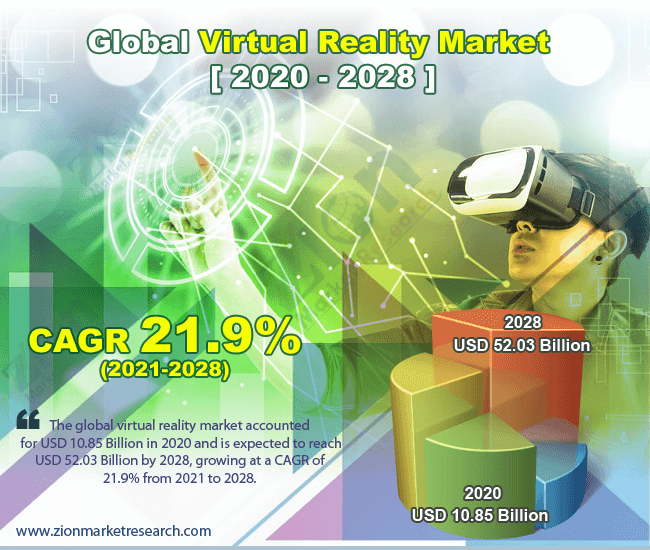
The global virtual reality market size was USD 10.85 Billion in 2023 and it is expected to reach USD 52.03 Billion by 2032, growing at a CAGR of 21.9% from 2024 to 2032.
Virtual reality means a computer-generated simulation through which the user can interact within an artificial 3D environment with the help of devices such as gloves with sensors or goggles with a screen. An increase in the application of VR in various industries is driving the market growth. The implementation of VR helps reduce hefty costs.
To Get more Insights, Request a Free Sample
To know more about this report, request a sample copy.
COVID-19 Impact Analysis
The outbreak of COVID-19 positively impacted the global virtual reality market. Lockdown significantly increased the demand for VR technology. Nowadays, conferences, gatherings, exhibitions, and virtual meets are driving the growth of the VR market. Furthermore, the pandemic is expected to grow the demand for VR devices and likely to stream the growth of the VR market.
To Get more Insights, Request a Free Sample
Growth Factors
5G Network and its implementation all over the world is driving virtual technology. This is majorly complementing the adoption of VR technology. Sectors such as education, healthcare, automotive, and many more are investing in virtual training and solutions. For instance, the educational sector is completely dependent upon virtual sessions. Convocations and celebrations are happening virtually.
The gaming industry has evolved completely after the introduction of 3D technology and VR. The use of Head Mounted displays (HMDs) helped bring an enhanced and unique experience to the users. Video gamers generally prefer HMDs for a better gaming experience.
Report Scope
Component Segment Analysis
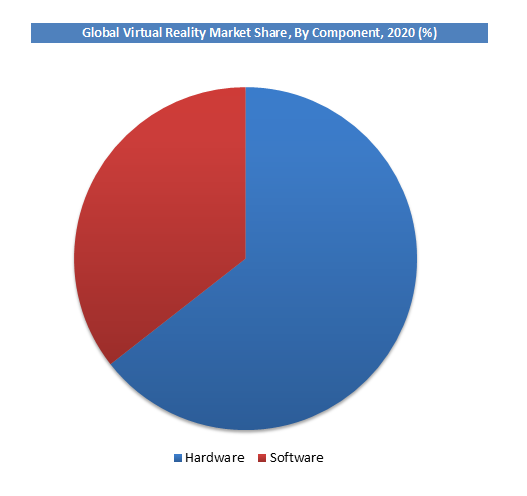
The hardware segment held a share of over 60% in 2020. Increasing use of hardware devices such as mobile phones, speakers, semiconductors, sensors, displays, and many more are boosting the numbers. Increasing applications like entertainment, gaming, live events and more are enhancing the software demand.
To Get more Insights, Request a Free Sample
To know more about this report, Request For Customization.
Device Type Segment Analysis
The VR Glasses segment is projected to grow at a CAGR of around 24% from 2021 to 2028. VR headsets or glasses block the light and distraction to enhance the user experience. It makes users feel like they are actually present in a theatre. The gaming and entertainment industries are the most lucrative ones. HMDs, VR simulators, treadmills, and others form the device type segment.
Industry Segment Analysis
The use of VR in defense and aerospace is growing unexpectedly. It helps the military to visualize and practice combat tactics in a safe manner. Armed forces across the world are investing in VR Technologies as VR can be used in virtual medical treatment, platform design, recruitment, and many other applications. It helps reduce costs and more importantly the risk of life. Gaming, entertainment, automotive, retail, healthcare, education, manufacturing, and others form the industry type segment.
Regional Analysis
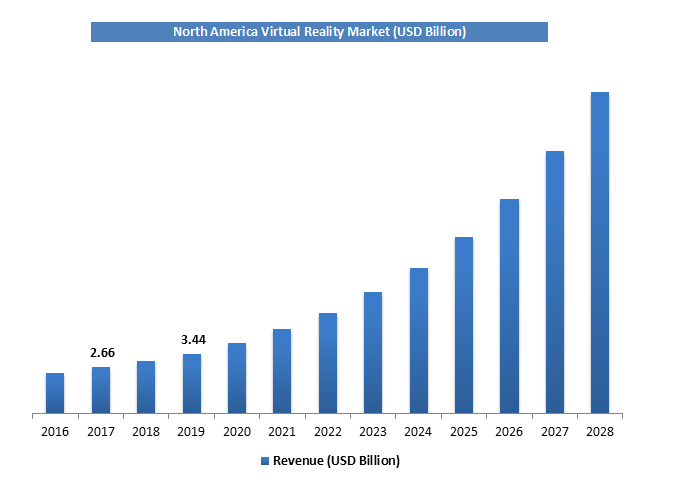
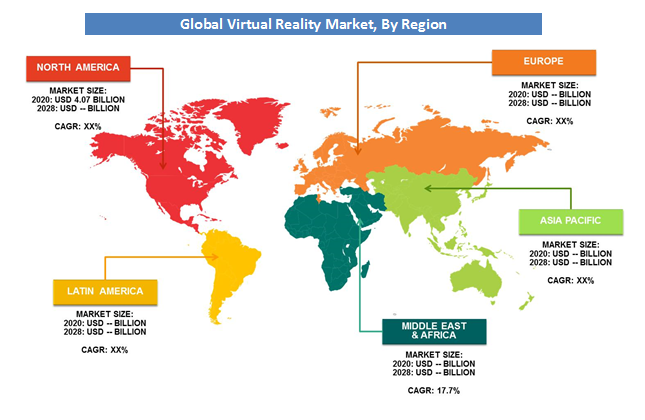
North America accounted for a share of 34% in 2020. The rising growth of the healthcare and educational sectors are the key drivers. The consumer application sector is also estimated to grow fast in the region. The government in the region is also heavily investing in VR technology to boost the market.
To Get more Insights, Request a Free Sample
Asia Pacific is projected to grow at a CAGR of over 22% during the forecast period. China is one of the major distributors of HMDs. China and India are likely to witness significant growth due to government funding. Campaigns like Make in India, and others are encouraging small and medium enterprises to invest and develop their business in India.
Key Market Players & Competitive Landscape
Some of the key players in the virtual reality market are
- HTC Corporation
- Microsoft
- Barco
- CyberGlove Systems, Inc.
- Facebook Technologies, LLC
- Samsung Electronics Co., Ltd.
- Sixense Enterprises, Inc.
- Sensics, Inc.
- Sony
- Eon Reality
- Leap Motion
- Oculus, among others.
Companies are focusing on developing new products and developing strategic partnerships to enhance their market share. For instance, in 2019 December, Oculus introduced a hand tracking feature. In 2020, in March Microsoft came into partnership with Valve and HP to launch a more comfortable and immersive experience in VR.
The global virtual reality market is segmented as follows:
By Component
- Hardware
- Software
By Device Type
- HMDs
- VR Simulators
- VR Glasses
- Haptic Gloves
- Treadmills
- Others
By Industry Type
- Gaming
- Entertainment
- Automotive
- Education
- Manufacturing
- Retail
- Healthcare
- Aerospace & Defense
- Others
By Region
- North America
- The U.S.
- Canada
- Europe
- France
- The UK
- Spain
- Germany
- Italy
- Rest of Europe
- Asia Pacific
- China
- Japan
- India
- South Korea
- Southeast Asia
- Rest of Asia Pacific
- Latin America
- Brazil
- Mexico
- Rest of Latin America
- Middle East & Africa
- GCC
- South Africa
- Rest of Middle East & Africa
Frequently Asked Questions
Table Of Content
Inquiry For Buying
Virtual Reality
Request Sample
Virtual Reality
