Holographic Concave Grating Market Size, Share, and Trends Analysis Report
CAGR :

| Market Size 2023 (Base Year) | USD 1398.5 Million |
| Market Size 2032 (Forecast Year) | USD 3231.41 Million |
| CAGR | 8.7% |
| Forecast Period | 2024 - 2032 |
| Historical Period | 2018 - 2023 |
Holographic Concave Grating Market Insights
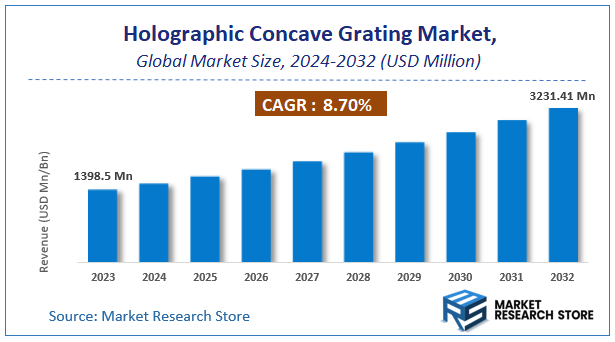
According to Market Research Store, the global holographic concave grating market size was valued at around USD 1398.5 million in 2023 and is estimated to reach USD 3231.41 million by 2032, to register a CAGR of approximately 8.70% in terms of revenue during the forecast period 2024-2032.
The holographic concave grating report provides a comprehensive analysis of the market, including its size, share, growth trends, revenue details, and other crucial information regarding the target market. It also covers the drivers, restraints, opportunities, and challenges till 2032.
To Get more Insights, Request a Free Sample
Global Holographic Concave Grating Market: Overview
A holographic concave grating is an advanced optical component used in spectroscopy and light dispersion applications. Unlike traditional ruled gratings, holographic gratings are manufactured using a laser interference pattern, which creates precise grooves on a concave substrate without mechanical ruling. This eliminates stray light and enhances spectral resolution. The concave design allows the grating to act as both a dispersive element and a focusing mirror, reducing the need for additional optical components in spectroscopic systems. These gratings are widely used in scientific research, telecommunications, and medical diagnostics due to their superior optical performance and compact design.
Key Highlights
- The holographic concave grating market is anticipated to grow at a CAGR of 8.70% during the forecast period.
- The global holographic concave grating market was estimated to be worth approximately USD 1398.5 million in 2023 and is projected to reach a value of USD 3231.41 million by 2032.
- The growth of the holographic concave grating market is being driven by increasing demand for high-resolution spectroscopic devices across industries such as pharmaceuticals, environmental monitoring, and semiconductor manufacturing.
- Based on the type, the transmission grating segment is growing at a high rate and is projected to dominate the market.
- On the basis of application, the monochromator and spectrometer segment is projected to swipe the largest market share.
- By region, North America is expected to dominate the global market during the forecast period.
Holographic Concave Grating Market Dynamics
Key Growth Drivers:
- Advancements in Spectroscopy: Rising demand for high-resolution spectroscopy in fields like astronomy, environmental monitoring, and biomedical research drives the need for advanced grating technologies.
- Miniaturization of Optical Systems: Holographic concave gratings enable compact and efficient optical designs, crucial for portable and space-based instruments.
- Growth in Industrial Applications: Increasing use in industrial processes like quality control, process monitoring, and materials analysis fuels market growth.
- Development of New Materials: The emergence of novel materials with improved optical properties enhances grating performance and expands application possibilities.
Restraints:
- High Manufacturing Costs: The intricate manufacturing process of holographic gratings can be expensive, limiting accessibility and affordability.
- Limited Availability of Skilled Labor: The specialized skills required for designing and manufacturing these gratings can be a bottleneck.
- Competition from Alternative Technologies: Technologies like fiber optics and interferometry pose some competition to holographic gratings in certain applications.
Opportunities:
- Integration with Emerging Technologies: Combining holographic gratings with technologies like photonics, nanotechnology, and artificial intelligence can unlock new applications and improve performance.
- Expansion into New Markets: Exploring new market segments like telecommunications, defense, and security can drive significant growth.
- Customization and Tailoring: Offering customized solutions to meet specific customer requirements can create a competitive advantage.
Challenges:
- Maintaining High Precision and Quality: Ensuring consistent high quality and precision in manufacturing is crucial for optimal grating performance.
- Meeting Increasing Demand: Scaling up production to meet growing demand while maintaining quality standards can be challenging.
- Staying Ahead of Technological Advancements: Continuous research and development are necessary to stay competitive in a rapidly evolving technological landscape.
Holographic Concave Grating Market: Report Scope
| Report Attributes | Report Details |
|---|---|
| Report Name | Holographic Concave Grating Market |
| Market Size in 2023 | USD 1398.5 Million |
| Market Forecast in 2032 | USD 3231.41 Million |
| Growth Rate | CAGR of 8.7% |
| Number of Pages | 140 |
| Key Companies Covered | HORIBA, Newport Corporation, Edmund Optics, Shimadzu Corporation, Zeiss, Dynasil Corporation, Kaiser Optical Systems, Spectrogon AB, Headwall Photonics, Wasatch Photonics, GratingWorks, Shenyang Yibeite Optics |
| Segments Covered | By Product Type, By Application, and By Region |
| Regions Covered | North America, Europe, Asia Pacific (APAC), Latin America, Middle East, and Africa (MEA) |
| Base Year | 2023 |
| Historical Year | 2018 to 2023 |
| Forecast Year | 2024 to 2032 |
| Customization Scope | Avail customized purchase options to meet your exact research needs. Request For Customization |
Holographic Concave Grating Market: Segmentation Insights
The global holographic concave grating market is divided by type, application, and region.
Segmentation Insights by Type
Based on type, the global holographic concave grating market is divided into transmission grating and reflective grating.
Transmission Grating is the most dominant segment in the holographic concave grating market. This dominance is attributed to its widespread use in high-precision optical instruments and spectroscopy applications. Transmission gratings offer superior light efficiency and lower stray light, making them ideal for applications requiring accurate wavelength separation. Their versatility and ability to be integrated into compact optical designs have further boosted their demand across industries such as telecommunications, medical diagnostics, and environmental monitoring.
On the other hand, Reflective Grating holds a smaller but significant share of the market. Reflective gratings are favored for applications that require high thermal and mechanical stability, such as astrophysics and laser systems. They are highly effective in handling high-energy light and can function in environments with fluctuating conditions. Although their application range is more niche compared to transmission gratings, their robust performance in specialized areas maintains their relevance in the market.
Segmentation Insights by Application
On the basis of application, the global holographic concave grating market is bifurcated into monochromator and spectrometer, laser, optical communication, astronomy, and others.
Monochromator and Spectrometer is the most dominant application segment in the holographic concave grating market. These devices heavily rely on holographic concave gratings for precise wavelength selection and dispersion. Their primary use in analytical instruments across industries such as pharmaceuticals, environmental monitoring, and material analysis drives this segment’s dominance. The ability of gratings to provide superior resolution and low stray light makes them indispensable in spectroscopic applications.
Laser applications follow closely as another significant segment. Holographic concave gratings are integral in tuning and stabilizing laser wavelengths, making them essential in high-precision laser systems for medical devices, industrial machining, and scientific research. The demand for reliable and accurate laser systems continues to fuel this segment's growth.
Optical Communication is another key application area, leveraging holographic concave gratings to enhance data transmission through wavelength division multiplexing (WDM) systems. The increasing adoption of high-speed internet and telecommunication infrastructure has amplified the need for gratings in optical communication technologies.
Astronomy also represents a notable application segment. Holographic concave gratings are used in astronomical spectrographs to analyze light from celestial objects, aiding in discoveries and observations in astrophysics. Their use in high-end, research-focused telescopes contributes to their importance, though the segment is relatively niche compared to others.
Holographic Concave Grating Market: Regional Insights
- North America is expected to dominates the global market
North America leads the market, supported by the presence of advanced research institutions and a well-established industrial base. The region's focus on technological innovation, along with the early adoption of cutting-edge optical technologies, cements its stronghold. The concentration of key industry players further contributes to North America’s dominance.
Europe holds a significant share in the market due to its robust research and development capabilities and a strong industrial framework. The region’s emphasis on scientific advancements and the presence of prominent manufacturers and end-users ensures its steady position in the market.
The Asia-Pacific region is experiencing rapid growth, driven by increasing investments in research and development, ongoing industrialization, and the rising demand for high-speed optical communication networks. The booming electronics and semiconductor industries in countries like China, Japan, and India are pivotal to the region’s expanding influence in the market.
Latin America and the Middle East & Africa hold smaller shares but are gradually gaining traction. Developing industrial infrastructure, increasing technological adoption, and growing awareness of optical technologies suggest potential for future market contributions, though at a relatively slower pace compared to other regions.
Holographic Concave Grating Market: Competitive Landscape
The report provides an in-depth analysis of companies operating in the holographic concave grating market, including their geographic presence, business strategies, product offerings, market share, and recent developments. This analysis helps to understand market competition.
Some of the major players in the global holographic concave grating market include:
- HORIBA
- Newport Corporation
- Edmund Optics
- Shimadzu Corporation
- Zeiss
- Dynasil Corporation
- Kaiser Optical Systems
- Spectrogon AB
- Headwall Photonics
- Wasatch Photonics
- GratingWorks
- Shenyang Yibeite Optics
The global holographic concave grating market is segmented as follows:
By Type
- Transmission Grating
- Reflective Grating
By Application
- Monochromator and Spectrometer
- Laser
- Optical Communication
- Astronomy
- Others
By Region
- North America
- U.S.
- Canada
- Europe
- U.K.
- France
- Germany
- Rest of Europe
- Asia Pacific
- China
- Japan
- India
- South Korea
- Rest of Asia Pacific
- Latin America
- Brazil
- Rest of Latin America
- The Middle East and Africa
- GCC Countries
- South Africa
- Rest of Middle East Africa
Frequently Asked Questions
Based on statistics from the Market Research Store, the global holographic concave grating market size was projected at approximately US$ 1398.5 million in 2023. Projections indicate that the market is expected to reach around US$ 3231.41 million in revenue by 2032.
The global holographic concave grating market is expected to grow at a Compound Annual Growth Rate (CAGR) of around 8.70% during the forecast period from 2024 to 2032.
North America is expected to dominate the global holographic concave grating market.
The global holographic concave grating market is driven by the increasing demand for advanced optical technologies in spectroscopy and telecommunications, growing investments in research and development, and expanding applications across industries such as healthcare, electronics, and astronomy.
Some of the prominent players operating in the global holographic concave grating market are; HORIBA, Newport Corporation, Edmund Optics, Shimadzu Corporation, Zeiss, Dynasil Corporation, Kaiser Optical Systems, Spectrogon AB, Headwall Photonics, Wasatch Photonics, GratingWorks, Shenyang Yibeite Optics, and others.
The global holographic concave grating market report provides a comprehensive analysis of market definitions, growth factors, opportunities, challenges, geographic trends, and competitive dynamics.
Table Of Content
Inquiry For Buying
Holographic Concave Grating
Request Sample
Holographic Concave Grating
