Industrial Anti Fatigue Mats Market Size, Share, and Trends Analysis Report
CAGR :

| Market Size 2023 (Base Year) | USD 1946.8 Million |
| Market Size 2032 (Forecast Year) | USD 3220.57 Million |
| CAGR | 5.2% |
| Forecast Period | 2024 - 2032 |
| Historical Period | 2018 - 2023 |
Industrial Anti Fatigue Mats Market Insights
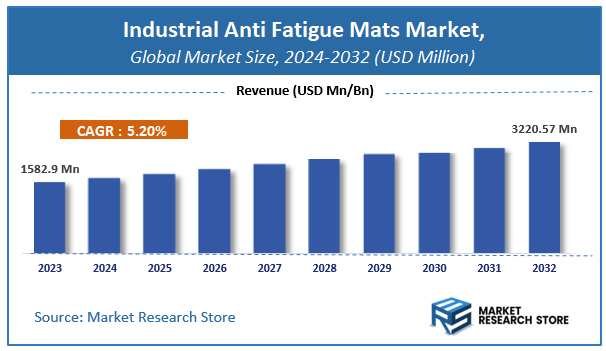
According to Market Research Store, the global industrial anti fatigue mats market size was valued at around USD 1946.8 million in 2023 and is estimated to reach USD 3220.57 million by 2032, to register a CAGR of approximately 5.2% in terms of revenue during the forecast period 2024-2032.
The industrial anti fatigue mats report provides a comprehensive analysis of the market, including its size, share, growth trends, revenue details, and other crucial information regarding the target market. It also covers the drivers, restraints, opportunities, and challenges till 2032.
To Get more Insights, Request a Free Sample
Global Industrial Anti Fatigue Mats Market: Overview
The Industrial Anti-Fatigue Mats Market focuses on mats designed to reduce fatigue and discomfort for workers who stand for extended periods. These mats are commonly used in industrial and manufacturing settings, such as assembly lines, warehouses, and laboratories, to improve worker comfort, productivity, and safety. Anti-fatigue mats are made from materials such as rubber, vinyl, foam, and gel, offering features like shock absorption, slip resistance, and ergonomic support.
The market is driven by growing awareness of workplace safety and employee well-being, coupled with stringent occupational health and safety regulations across industries. Employers increasingly recognize the benefits of anti-fatigue mats in reducing physical strain, improving posture, and preventing work-related injuries, such as musculoskeletal disorders. Additionally, the rise in automation and manufacturing activities worldwide is fueling demand for these mats as part of overall ergonomic workplace solutions.
Key Highlights
- The industrial anti fatigue mats market is anticipated to grow at a CAGR of 5.2% during the forecast period.
- The global industrial anti fatigue mats market was estimated to be worth approximately USD 1946.8 million in 2023 and is projected to reach a value of USD 3220.57 million by 2032.
- The growth of the industrial anti fatigue mats market is being driven by the increasing emphasis on worker safety and comfort in industrial settings.
- Based on the product, the rubber segment is growing at a high rate and is projected to dominate the market.
- On the basis of application, the industrial premises segment is projected to swipe the largest market share.
- By region, North America is expected to dominate the global market during the forecast period.
Industrial Anti Fatigue Mats Market: Dynamics
Key Drivers
- Improved Worker Comfort & Safety: Reduces muscle fatigue, back pain, and discomfort for workers who stand for extended periods. Improves worker safety by reducing the risk of slips, trips, and falls.
- Increased Productivity: By reducing fatigue and discomfort, anti-fatigue mats can enhance worker productivity and efficiency.
- Ergonomics & Workplace Safety Regulations: Growing emphasis on workplace ergonomics and safety regulations is driving demand for anti-fatigue mats in various industries.
- Focus on Employee Well-being: Increasing focus on employee well-being and workplace safety initiatives is driving demand for ergonomic solutions like anti-fatigue mats.
Restraints
- High Initial Investment: The initial cost of purchasing and implementing anti-fatigue mats can be a significant investment for some businesses.
- Maintenance and Cleaning: Regular cleaning and maintenance of mats are necessary to maintain hygiene and prevent slip hazards.
- Space Constraints: In some workplaces, space limitations may restrict the use of large anti-fatigue mats.
- Aesthetic Considerations: The appearance of some industrial anti-fatigue mats may not be aesthetically pleasing in all work environments.
Opportunities
- Technological Advancements: Development of innovative materials and designs, such as anti-microbial mats, self-cleaning mats, and ergonomic designs that provide better support and comfort.
- Customization: Offering customized solutions to meet the specific needs of different industries and work environments.
- Integration with Smart Technologies: Integrating anti-fatigue mats with other workplace technologies, such as smart flooring systems and employee wellness programs.
- Expanding into New Markets: Exploring new markets, such as healthcare, education, and retail, where standing for extended periods is common.
Challenges
- Maintaining Product Quality: Ensuring consistent quality and durability of anti-fatigue mats to withstand wear and tear in industrial environments.
- Meeting Regulatory Requirements: Meeting industry standards and safety regulations for workplace flooring.
- Competition: Competition from other floor covering options and alternative solutions for reducing worker fatigue.
- Educating End-Users: Educating employers and employees about the benefits of using anti-fatigue mats and how to select and use them effectively.
Industrial Anti Fatigue Mats Market: Report Scope
| Report Attributes | Report Details |
|---|---|
| Report Name | Industrial Anti Fatigue Mats Market |
| Market Size in 2023 | USD 1946.8 Million |
| Market Forecast in 2032 | USD 3220.57 Million |
| Growth Rate | CAGR of 5.2% |
| Number of Pages | 140 |
| Key Companies Covered | COBA Europe, Checkers, NoTrax, Kleen-Tex, SmartCells, DURABLE, Wearwell, Crown, Australian Matting Company, ANSELL, Rhino Mat Manufacturing |
| Segments Covered | By Product Type, By Application, and By Region |
| Regions Covered | North America, Europe, Asia Pacific (APAC), Latin America, Middle East, and Africa (MEA) |
| Base Year | 2023 |
| Historical Year | 2018 to 2023 |
| Forecast Year | 2024 to 2032 |
| Customization Scope | Avail customized purchase options to meet your exact research needs. Request For Customization |
Industrial Anti Fatigue Mats Market: Segmentation Insights
The global industrial anti fatigue mats market is divided by product, application, and region.
Segmentation Insights by Product
Based on Product, the global industrial anti fatigue mats market is divided into rubber, PVC foam, EVA foam, vinyl sponge, and others.
Rubber as the dominant product segment in the industrial anti-fatigue mats market, driven by its durability, safety features, and versatility in demanding industrial environments. Rubber mats dominate the market due to their high durability, non-slip properties, and suitability for demanding industrial applications. They are widely used in manufacturing plants, kitchens, and workshops where safety and durability are critical.
PVC Foam mats are widely adopted due to their affordability, ease of cleaning, and versatility in various industrial environments. They are commonly used in light manufacturing and assembly lines. Anti-fatigue mats made of PVC foam are lightweight, flexible, and economical. These mats are typically used in workplaces with moderate foot traffic and where cushioning is essential for reducing worker fatigue.
EVA Foam mats are gaining popularity in industrial settings due to their superior comfort and durability. Industries such as automotive and electronics manufacturing, which require prolonged standing, drive demand for this segment. EVA (Ethylene Vinyl Acetate) foam mats are known for their resilience, shock absorption, and durability.
Vinyl Sponge mats are favored for their affordability and ease of maintenance. However, their adoption is limited to environments with lighter workloads compared to other materials. Vinyl sponge mats are soft, lightweight, and designed for moderate foot traffic. They offer basic anti-fatigue properties and are often used in dry work areas such as retail counters, light assembly lines, and laboratories.
Segmentation Insights by Application
On the basis of Application, the global industrial anti fatigue mats market is bifurcated into industrial premises, business premises, and others.
Industrial Premises as the dominant application segment in the industrial anti-fatigue mats market, driven by the need for ergonomic and durable solutions in high-demand work environments. The industrial segment is the largest consumer of anti-fatigue mats due to the high prevalence of standing jobs in manufacturing and logistics. Worker safety regulations and the increasing focus on reducing workplace injuries are key drivers of this segment.
Business Premises this segment includes the use of anti-fatigue mats in office spaces, retail stores, healthcare facilities, and other commercial environments. The demand in business premises is driven by the growing emphasis on employee comfort and productivity. With increasing awareness of ergonomic benefits, many businesses are investing in anti-fatigue mats to reduce worker fatigue and improve well-being.
Industrial Anti Fatigue Mats Market: Regional Insights
- North America currently leads the global industrial anti fatigue mats market
North America is a leading market for industrial anti-fatigue mats, driven by stringent workplace safety regulations, high awareness of employee wellness, and widespread adoption of ergonomic solutions. The U.S. dominates the region, with strong demand from manufacturing, warehousing, and healthcare industries. The Occupational Safety and Health Administration (OSHA) guidelines on workplace safety further encourage the use of anti-fatigue mats to reduce worker injuries and enhance comfort.
Europe holds a significant share of the industrial anti-fatigue mats market. The demand is propelled by industries such as automotive, food and beverage, and healthcare, particularly in countries like Germany, the UK, and France. The region's focus on workplace safety, employee well-being, and compliance with strict labor regulations supports the growth of the market. Additionally, the increasing adoption of sustainable and eco-friendly materials in mat production aligns with Europe’s sustainability goals.
The Asia-Pacific region is experiencing rapid growth in the industrial anti-fatigue mats market, primarily driven by industrial expansion and the rising adoption of workplace safety measures in countries like China, India, and Japan. The region’s booming manufacturing and logistics sectors, coupled with increasing awareness about ergonomics, are key drivers. Emerging economies in this region are also investing in improving labor productivity and safety, further boosting demand for anti-fatigue mats.
Latin America is an emerging market for industrial anti-fatigue mats, with growth driven by improving industrial infrastructure in countries like Brazil and Mexico. The region’s manufacturing, retail, and food processing industries are increasingly adopting anti-fatigue mats to enhance worker safety and comfort. However, the market is still relatively nascent compared to developed regions, with growth potential tied to increasing awareness and investment in workplace ergonomics.
The Middle East and Africa region has a smaller market share but is showing steady growth due to the expansion of industrial and commercial sectors, particularly in countries like Saudi Arabia, the UAE, and South Africa. The region’s focus on enhancing workplace environments and safety, especially in oil and gas, logistics, and healthcare industries, is driving demand for industrial anti-fatigue mats.
Industrial Anti Fatigue Mats Market: Competitive Landscape
The report provides an in-depth analysis of companies operating in the industrial anti fatigue mats market, including their geographic presence, business strategies, product offerings, market share, and recent developments. This analysis helps to understand market competition.
Some of the major players in the global industrial anti fatigue mats market include:
- ANSELL
- Australian Matting Company
- Checkers
- COBA Europe
- Crown
- DURABLE
- Kleen-Tex
- NoTrax
- Rhino Mat Manufacturing
- SmartCells
- Wearwell
The global industrial anti fatigue mats market is segmented as follows:
By Product
- Rubber
- PVC Foam
- EVA Foam
- Vinyl Sponge
- Others
By Application
- Industrial Premises
- Business Premises
- Others
By Region
- North America
- U.S.
- Canada
- Europe
- U.K.
- France
- Germany
- Rest of Europe
- Asia Pacific
- China
- Japan
- India
- South Korea
- Rest of Asia Pacific
- Latin America
- Brazil
- Rest of Latin America
- The Middle East and Africa
- GCC Countries
- South Africa
- Rest of Middle East Africa
Frequently Asked Questions
Based on statistics from the Market Research Store, the global industrial anti fatigue mats market size was projected at approximately US$ 1946.8 million in 2023. Projections indicate that the market is expected to reach around US$ 3220.57 million in revenue by 2032.
The global industrial anti fatigue mats market is expected to grow at a Compound Annual Growth Rate (CAGR) of around 5.2% during the forecast period from 2024 to 2032.
North America is expected to dominate the global industrial anti fatigue mats market.
The global industrial anti-fatigue mats market is primarily driven by factors such as increasing awareness about worker safety and ergonomics, growing concerns about musculoskeletal disorders, and rising demand for improved workplace productivity.
Some of the prominent players operating in the global industrial anti fatigue mats market are; ANSELL, Australian Matting Company, Checkers, COBA Europe, Crown, DURABLE, Kleen-Tex, NoTrax, Rhino Mat Manufacturing, SmartCells, Wearwell, and others.
The global industrial anti fatigue mats market report provides a comprehensive analysis of market definitions, growth factors, opportunities, challenges, geographic trends, and competitive dynamics.
Table Of Content
Inquiry For Buying
Industrial Anti Fatigue Mats
Request Sample
Industrial Anti Fatigue Mats
