Organic Pigment for Plastics Market Size, Share, and Trends Analysis Report
CAGR :

| Market Size 2023 (Base Year) | USD 4.56 Billion |
| Market Size 2032 (Forecast Year) | USD 8.35 Billion |
| CAGR | 6.2% |
| Forecast Period | 2024 - 2032 |
| Historical Period | 2018 - 2023 |
Organic Pigment for Plastics Market Insights
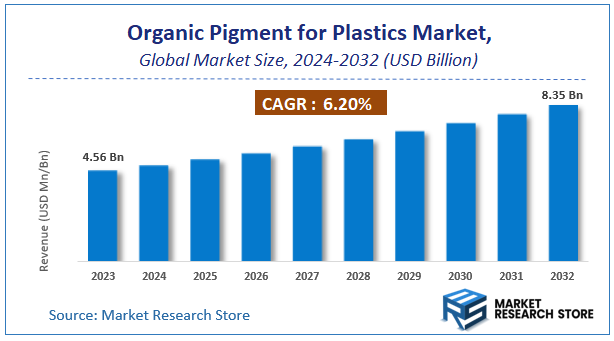
According to Market Research Store, the global organic pigment for plastics market size was valued at around USD 4.56 billion in 2023 and is estimated to reach USD 8.35 billion by 2032, to register a CAGR of approximately 6.2% in terms of revenue during the forecast period 2024-2032.
The organic pigment for plastics report provides a comprehensive analysis of the market, including its size, share, growth trends, revenue details, and other crucial information regarding the target market. It also covers the drivers, restraints, opportunities, and challenges till 2032.
To Get more Insights, Request a Free Sample
Global Organic Pigment for Plastics Market: Overview
Organic pigments for plastics are synthetic colorants derived from organic compounds, primarily composed of carbon-based molecules. These pigments are widely used in the plastics industry due to their bright, vivid colors, excellent dispersion properties, and superior resistance to chemicals and heat. Unlike inorganic pigments, which are derived from minerals and metals, organic pigments offer a broader color range and higher tinting strength, making them ideal for applications in packaging, automotive components, consumer goods, and textiles. Common types of organic pigments used in plastics include azo pigments, phthalocyanine pigments, and quinacridone pigments, each offering specific advantages in terms of color stability, transparency, and durability.
Key Highlights
- The organic pigment for plastics market is anticipated to grow at a CAGR of 6.2% during the forecast period.
- The global organic pigment for plastics market was estimated to be worth approximately USD 4.56 billion in 2023 and is projected to reach a value of USD 8.35 billion by 2032.
- The growth of the organic pigment for plastics market is being driven by the rising use of plastics across multiple industries, stringent regulations favoring eco-friendly and non-toxic pigments, and advancements in polymer processing technologies.
- Based on the type, the azoic pigments segment is growing at a high rate and is projected to dominate the market.
- On the basis of application, the thermoplastic plastics segment is projected to swipe the largest market share.
- By region, Asia Pacific is expected to dominate the global market during the forecast period.
Organic Pigment for Plastics Market: Dynamics
Key Growth Drivers:
- Growing Plastics Industry: The global plastics industry is expanding, driven by increasing consumption of plastics in packaging, automotive, construction, consumer goods, and other sectors. This directly fuels the demand for organic pigments used to color these plastic products.
- Demand for High-Performance Pigments: Organic pigments offer superior color strength, brightness, and transparency compared to inorganic pigments, making them preferred for applications where aesthetics and performance are critical.
- Increasing Focus on Sustainability: Consumers and manufacturers are increasingly interested in sustainable and eco-friendly products. Organic pigments, often perceived as less harmful than some inorganic pigments, can meet this demand.
- Product Innovation: Ongoing research and development are leading to new organic pigments with improved properties, such as enhanced heat stability, lightfastness, and chemical resistance, expanding their applications in plastics.
Restraints:
- Cost of Organic Pigments: Organic pigments are generally more expensive than inorganic pigments, which can be a cost constraint for some plastic product manufacturers, particularly for high-volume, low-cost applications.
- Technical Challenges: Some organic pigments may have limitations in terms of heat stability or lightfastness, which can affect their suitability for certain plastic processing conditions or outdoor applications.
- Regulatory Compliance: The use of pigments in plastics is subject to various regulations, particularly for applications like food packaging or children's toys, and manufacturers need to ensure compliance, which can be challenging.
Opportunities:
- Development of High-Performance Pigments: There is a growing opportunity to develop organic pigments with enhanced properties, such as improved heat stability, lightfastness, and weather resistance, to meet the demanding requirements of various plastic applications.
- Focus on Sustainable and Bio-Based Pigments: Consumers are increasingly interested in sustainable products, creating opportunities for developing organic pigments derived from renewable resources or with reduced environmental impact.
- Specialized Pigments for Specific Plastics: Developing organic pigments tailored for specific types of plastics or processing methods can cater to niche markets and offer optimized performance.
Challenges:
- Competition from Inorganic Pigments: The organic pigments market faces strong competition from inorganic pigments, which are often more cost-effective and offer excellent heat stability and weather resistance.
- Maintaining Color Consistency: Achieving consistent color and quality in plastic products can be challenging due to variations in pigment properties, plastic resins, and processing conditions.
- Meeting Customer Requirements: Plastic product manufacturers have specific requirements for pigments in terms of color, performance, and cost. Meeting these diverse needs can be a challenge.
Organic Pigment for Plastics Market: Report Scope
| Report Attributes | Report Details |
|---|---|
| Report Name | Organic Pigment for Plastics Market |
| Market Size in 2023 | USD 4.56 Billion |
| Market Forecast in 2032 | USD 8.35 Billion |
| Growth Rate | CAGR of 6.2% |
| Number of Pages | 140 |
| Key Companies Covered | Clariant, Kremer Pigmente, Vipul Organics, BASF, DIC, Huntsman, Toyoink, North American Chemical, Heubach, Sudarshan, Jeco Group, Xinguang, Sanyo Color Works, Cappelle Pigment, DCC, Dainichiseika, Sunshine Pigment, Yuhong New Plastic, Hongyan Pigment, KolorJet Chemicals |
| Segments Covered | By Product Type, By Application, and By Region |
| Regions Covered | North America, Europe, Asia Pacific (APAC), Latin America, Middle East, and Africa (MEA) |
| Base Year | 2023 |
| Historical Year | 2018 to 2023 |
| Forecast Year | 2024 to 2032 |
| Customization Scope | Avail customized purchase options to meet your exact research needs. Request For Customization |
Organic Pigment for Plastics Market: Segmentation Insights
The global organic pigment for plastics market is divided by type, application, and region.
Segmentation Insights by Type
Based on type, the global organic pigment for plastics market is divided into azoic pigments, phthalocyanine pigments, and other.
Azoic pigments dominate the organic pigment for plastics market due to their vibrant color range, cost-effectiveness, and excellent compatibility with various plastic resins. These pigments offer high tinting strength, good heat stability, and resistance to solvents, making them ideal for a wide range of plastic applications, including packaging, automotive components, and consumer goods. Their widespread adoption is driven by the increasing demand for aesthetically appealing and durable plastic products across multiple industries.
Phthalocyanine pigments follow as the second most dominant segment, known for their outstanding color strength, excellent lightfastness, and superior chemical resistance. These pigments, primarily available in shades of blue and green, are widely used in plastics that require long-term stability and durability. Their high performance makes them a preferred choice for high-end applications, such as outdoor plastic products, automotive parts, and industrial-grade materials. However, their relatively higher cost compared to azoic pigments limits their broader adoption in cost-sensitive applications.
Segmentation Insights by Application
On the basis of application, the global organic pigment for plastics market is bifurcated into thermoplastic plastics and thermosetting plastic.
Thermoplastic plastics dominate the organic pigment for plastics market due to their widespread use in industries such as packaging, automotive, consumer goods, and electronics. These plastics, including polyethylene (PE), polypropylene (PP), polyvinyl chloride (PVC), and polystyrene (PS), benefit from organic pigments' excellent dispersion, bright coloration, and resistance to fading. The recyclability and ease of processing of thermoplastics make them highly preferred for mass production, further driving the demand for organic pigments. Additionally, the growing trend toward sustainable packaging and aesthetically enhanced plastic products continues to fuel the dominance of this segment.
Thermosetting plastics represent a smaller but significant segment, where organic pigments are used in applications requiring high durability, chemical resistance, and structural integrity. These plastics, including epoxy resins, phenolic resins, and polyurethane, are commonly used in electrical components, coatings, and high-performance automotive and aerospace parts. While thermosetting plastics benefit from organic pigments' stability and color consistency, their relatively lower production volume and limited recyclability compared to thermoplastics result in a smaller market share. However, their role remains essential in industries where high-performance materials are required.
Organic Pigment for Plastics Market: Regional Insights
- Asia Pacific is expected to dominates the global market
The Asia Pacific region stands as the most dominant market for organic pigments in plastics, driven by rapid industrialization and urbanization. Countries such as China, India, and Japan are leading contributors, with robust demand from the packaging, automotive, and consumer goods sectors. The increasing disposable incomes and growing middle-class population in these nations further fuel the demand for premium and customized plastic products, thereby boosting the market for organic pigments. Additionally, the region benefits from abundant raw material availability and lower production costs, attracting significant investments from global industry leaders aiming to establish manufacturing units. This strategic positioning not only satisfies regional demand but also positions Asia Pacific as a significant exporter in the global market.
North America holds a substantial share in the organic pigments for plastics market, primarily due to the strong presence of key players and end-use industries. The United States, in particular, boasts a large paints and coatings industry, with extensive usage of organic pigments across various applications, including plastics, printing inks, and construction. Major companies have established headquarters in the U.S., strengthening the supply chain and driving research and development investments in the region. The stringent environmental regulations in North America also promote the adoption of eco-friendly materials, further propelling the market growth for organic pigments in plastics.
Europe represents a significant market for organic pigments in plastics, driven by the region's focus on sustainability and environmental protection. Countries like Germany, France, and the United Kingdom are leading markets within Europe, with strong demand from the automotive and packaging industries. The increasing production of electric vehicles and the rising adoption of eco-friendly packaging solutions are key factors driving market growth in this region. Additionally, government initiatives and regulations promoting the use of non-toxic and sustainable materials are expected to create further growth opportunities for the organic pigment market in Europe.
Latin America and the Middle East & Africa, while currently holding smaller shares in the global organic pigments for plastics market, are anticipated to experience growth due to increasing industrialization and urbanization. In Latin America, countries like Brazil and Mexico are witnessing expansion in industries such as automotive and packaging, which in turn drives the demand for organic pigments. Similarly, the Middle East & Africa region is seeing growth in construction and consumer goods sectors, contributing to the rising demand for colored plastics. As these regions continue to develop economically, the organic pigments market is expected to expand correspondingly, offering new opportunities for industry participants.
Organic Pigment for Plastics Market: Competitive Landscape
The report provides an in-depth analysis of companies operating in the organic pigment for plastics market, including their geographic presence, business strategies, product offerings, market share, and recent developments. This analysis helps to understand market competition.
Some of the major players in the global organic pigment for plastics market include:
- Clariant
- Kremer Pigmente
- Vipul Organics
- BASF
- DIC
- Huntsman
- Toyoink
- North American Chemical
- Heubach
- Sudarshan
- Jeco Group
- Xinguang
- Sanyo Color Works
- Cappelle Pigment
- DCC
- Dainichiseika
- Sunshine Pigment
- Yuhong New Plastic
- Hongyan Pigment
- KolorJet Chemicals
The global organic pigment for plastics market is segmented as follows:
By Type
- Azoic Pigments
- Phthalocyanine Pigments
- Other
By Application
- Thermoplastic Plastics
- Thermosetting Plastic
By Region
- North America
- U.S.
- Canada
- Europe
- U.K.
- France
- Germany
- Rest of Europe
- Asia Pacific
- China
- Japan
- India
- South Korea
- Rest of Asia Pacific
- Latin America
- Brazil
- Rest of Latin America
- The Middle East and Africa
- GCC Countries
- South Africa
- Rest of Middle East Africa
Frequently Asked Questions
Based on statistics from the Market Research Store, the global organic pigment for plastics market size was projected at approximately US$ 4.56 billion in 2023. Projections indicate that the market is expected to reach around US$ 8.35 billion in revenue by 2032.
The global organic pigment for plastics market is expected to grow at a Compound Annual Growth Rate (CAGR) of around 6.2% during the forecast period from 2024 to 2032.
Asia Pacific is expected to dominate the global organic pigment for plastics market.
The global organic pigment for plastics market is driven by increasing demand in the packaging, automotive, and consumer goods industries, along with a growing preference for eco-friendly and high-performance pigments.
Some of the prominent players operating in the global organic pigment for plastics market are; Clariant, Kremer Pigmente, Vipul Organics, BASF, DIC, Huntsman, Toyoink, North American Chemical, Heubach, Sudarshan, Jeco Group, Xinguang, Sanyo Color Works, Cappelle Pigment, DCC, Dainichiseika, Sunshine Pigment, Yuhong New Plastic, Hongyan Pigment, KolorJet Chemicals, and others.
Table Of Content
Inquiry For Buying
Organic Pigment for Plastics
Request Sample
Organic Pigment for Plastics
