Fragrance and Ambience Market Size, Share, and Trends Analysis Report
CAGR :

| Market Size 2023 (Base Year) | USD 10.56 Billion |
| Market Size 2032 (Forecast Year) | USD 19.64 Billion |
| CAGR | 6.4% |
| Forecast Period | 2024 - 2032 |
| Historical Period | 2018 - 2023 |
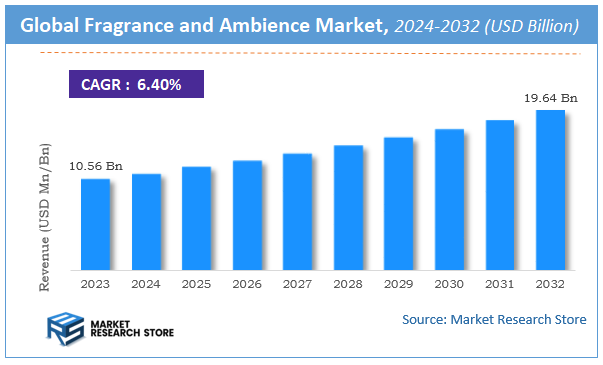
Market Research Store has published a report on the global fragrance and ambience market, estimating its value at USD 10.56 Billion in 2023, with projections indicating it will reach USD 19.64 Billion by the end of 2032. The market is expected to expand at a compound annual growth rate (CAGR) of around 6.4% over the forecast period. The report examines the factors driving market growth, the obstacles that could hinder this expansion, and the opportunities that may emerge in the fragrance and ambience industry. Additionally, it offers a detailed analysis of how these elements will affect demand dynamics and market performance throughout the forecast period.
Fragrance and Ambience Market: Overview
The growth of the fragrance and ambience market is fueled by rising global demand across various industries and applications. The report highlights lucrative opportunities, analyzing cost structures, key segments, emerging trends, regional dynamics, and advancements by leading players to provide comprehensive market insights. The fragrance and ambience market report offers a detailed industry analysis from 2024 to 2032, combining quantitative and qualitative insights. It examines key factors such as pricing, market penetration, GDP impact, industry dynamics, major players, consumer behavior, and socio-economic conditions. Structured into multiple sections, the report provides a comprehensive perspective on the market from all angles.
Key sections of the fragrance and ambience market report include market segments, outlook, competitive landscape, and company profiles. Market Segments offer in-depth details based on Product Type, Distribution Channel, Application, and other relevant classifications to support strategic marketing initiatives. Market Outlook thoroughly analyzes market trends, growth drivers, restraints, opportunities, challenges, Porter’s Five Forces framework, macroeconomic factors, value chain analysis, and pricing trends shaping the market now and in the future. The Competitive Landscape and Company Profiles section highlights major players, their strategies, and market positioning to guide investment and business decisions. The report also identifies innovation trends, new business opportunities, and investment prospects for the forecast period.
Key Highlights:
- As per the analysis shared by our research analyst, the global fragrance and ambience market is estimated to grow annually at a CAGR of around 6.4% over the forecast period (2024-2032).
- In terms of revenue, the global fragrance and ambience market size was valued at around USD 10.56 Billion in 2023 and is projected to reach USD 19.64 Billion by 2032.
- The market is projected to grow at a significant rate due to Rising consumer focus on home aesthetics and wellness is boosting demand for ambient scents.
- Based on the Product Type, the Scented Candles segment is growing at a high rate and will continue to dominate the global market as per industry projections.
- On the basis of Distribution Channel, the Online segment is anticipated to command the largest market share.
- In terms of Application, the Residential segment is projected to lead the global market.
- Based on region, Europe is projected to dominate the global market during the forecast period.
Fragrance and Ambience Market: Report Scope
This report thoroughly analyzes the fragrance and ambience market, exploring its historical trends, current state, and future projections. The market estimates presented result from a robust research methodology, incorporating primary research, secondary sources, and expert opinions. These estimates are influenced by the prevailing market dynamics as well as key economic, social, and political factors. Furthermore, the report considers the impact of regulations, government expenditures, and advancements in research and development on the market. Both positive and negative shifts are evaluated to ensure a comprehensive and accurate market outlook.
| Report Attributes | Report Details |
|---|---|
| Report Name | Fragrance and Ambience Market |
| Market Size in 2023 | USD 10.56 Billion |
| Market Forecast in 2032 | USD 19.64 Billion |
| Growth Rate | CAGR of 6.4% |
| Number of Pages | 212 |
| Key Companies Covered | Coty, Estée Lauder, Symrise AG, International Flavors & Fragrances (IFF), L’Oréal, Shiseido, Givaudan, Avon, Dior, Chanel, LVMH, Procter & Gamble, S. C. Johnson & Son, Reckitt Benckiser, Newell Brands, Circle E Candles, Bridgewater Candle Company, The Copenhagen Candle Company |
| Segments Covered | By Product Type, By Distribution Channel, By Application, and By Region |
| Regions Covered | North America, Europe, Asia Pacific (APAC), Latin America, Middle East, and Africa (MEA) |
| Base Year | 2023 |
| Historical Year | 2018 to 2023 |
| Forecast Year | 2024 to 2032 |
| Customization Scope | Avail customized purchase options to meet your exact research needs. Request For Customization |
Fragrance and Ambience Market: Dynamics
Key Growth Drivers:
The most significant driver for the Fragrance and Ambience market is the increasing consumer focus on well-being, mood enhancement, and creating personalized sensory experiences in their homes and personal spaces. As lifestyles evolve and stress levels rise, individuals seek fragrances and ambient products (like diffusers, candles, room sprays) to evoke specific moods, promote relaxation, or energize their environment. The burgeoning demand for luxury and premium home fragrance products, driven by rising disposable incomes and a desire for sophisticated interior aesthetics, also fuels market growth. Furthermore, the pervasive influence of social media and home décor trends, showcasing visually appealing and aromatic living spaces, encourages consumers to invest in ambient products to enhance their surroundings.
Restraints:
The market faces significant restraints primarily due to concerns regarding the health impacts of synthetic fragrances. A growing segment of health-conscious consumers worries about potential allergens, respiratory irritants, and chemical sensitivities associated with artificial scents, leading them to seek natural or "clean" alternatives. The volatility of raw material prices, particularly for natural essential oils and aroma chemicals, can impact manufacturing costs and retail prices, affecting profit margins for producers. Additionally, intense competition from a multitude of brands, ranging from luxury niche players to mass-market producers, can lead to price wars and make it challenging for new entrants to gain market share.
Opportunities:
Significant opportunities lie in the continuous innovation of natural and sustainable fragrance solutions. This includes the development of plant-based ingredients, eco-friendly extraction methods, and biodegradable packaging, appealing to environmentally conscious consumers. The expansion into personalized fragrance experiences, utilizing AI and data analytics to recommend or even custom-blend scents based on individual preferences and moods, presents a lucrative avenue for market growth. The increasing adoption of smart home technologies creates opportunities for integrating ambient fragrance systems that can be controlled remotely or programmed to release scents based on time of day, occupancy, or even biometric data. Furthermore, the growing awareness of aromatherapy benefits and the demand for functional fragrances that offer specific therapeutic effects (e.g., sleep aid, focus enhancement) open new product categories.
Challenges:
A key challenge is ensuring consistent and long-lasting scent diffusion across various ambient product formats, as factors like room size, airflow, and material quality can significantly impact fragrance longevity and intensity. The market also faces intense regulatory scrutiny regarding ingredient disclosure, safety testing, and labeling, particularly for products with potential allergenic compounds, requiring continuous compliance efforts. Developing truly innovative and unique scent profiles that stand out in a highly saturated market while appealing to diverse consumer preferences remains a significant creative and R&D hurdle. Additionally, managing the supply chain for complex natural ingredients, which can be affected by weather conditions and agricultural yields, poses an ongoing operational challenge for manufacturers.
Fragrance and Ambience Market: Segmentation Insights
The global fragrance and ambience market is segmented based on Product Type, Distribution Channel, Application, and Region. All the segments of the fragrance and ambience market have been analyzed based on present & future trends and the market is estimated from 2024 to 2032.
Based on Product Type, the global fragrance and ambience market is divided into Scented Candles, Diffusers, Sprays, Essential Oils.
On the basis of Distribution Channel, the global fragrance and ambience market is bifurcated into Online, Offline.
In terms of Application, the global fragrance and ambience market is categorized into Residential, Commercial, Automotive.
Fragrance and Ambience Market: Regional Insights
The global fragrance and ambience market is dominated by North America, which accounted for over 35% of market revenue in 2023, driven by high consumer spending on premium home fragrances, strong demand for luxury personal care products, and the presence of leading brands like Bath & Body Works and Yankee Candle in the U.S. Europe follows closely, with Germany, France, and the UK leading due to a rich heritage in perfumery, high disposable incomes, and growing demand for eco-friendly and sustainable scents.
Meanwhile, Asia-Pacific is the fastest-growing market, fueled by rising urbanization, increasing middle-class spending, and the popularity of aromatherapy in China, Japan, and India. North America’s dominance is reinforced by its innovation in scent diffusion technologies, strong retail distribution networks, and consumer preference for personalized and experiential fragrances.
Fragrance and Ambience Market: Competitive Landscape
The fragrance and ambience market report offers a thorough analysis of both established and emerging players within the market. It includes a detailed list of key companies, categorized based on the types of products they offer and other relevant factors. The report also highlights the market entry year for each player, providing further context for the research analysis.
The "Global Fragrance and Ambience Market" study offers valuable insights, focusing on the global market landscape, with an emphasis on major industry players such as;
- Coty
- Estée Lauder
- Symrise AG
- International Flavors & Fragrances (IFF)
- L’Oréal
- Shiseido
- Givaudan
- Avon
- Dior
- Chanel
- LVMH
- Procter & Gamble
- S. C. Johnson & Son
- Reckitt Benckiser
- Newell Brands
- Circle E Candles
- Bridgewater Candle Company
- The Copenhagen Candle Company
The Global Fragrance and Ambience Market is Segmented as Follows:
By Product Type
- Scented Candles
- Diffusers
- Sprays
- Essential Oils
By Distribution Channel
- Online
- Offline
By Application
- Residential
- Commercial
- Automotive
By Region
- North America
- The U.S.
- Canada
- Mexico
- Europe
- France
- The UK
- Spain
- Germany
- Italy
- Rest of Europe
- Asia Pacific
- China
- Japan
- India
- Australia
- South Korea
- Rest of Asia Pacific
- The Middle East & Africa
- Saudi Arabia
- UAE
- Egypt
- Kuwait
- South Africa
- Rest of the Middle East & Africa
- Latin America
- Brazil
- Argentina
- Rest of Latin America
Market Evolution
This section evaluates the market position of the product or service by examining its development pathway and competitive dynamics. It provides a detailed overview of the product's growth stages, including the early (historical) phase, the mid-stage, and anticipated future advancements influenced by innovation and emerging technologies.
Porter’s Analysis
Porter’s Five Forces framework offers a strategic lens for assessing competitor behavior and the positioning of key players in the fragrance and ambience industry. This section explores the external factors shaping competitive dynamics and influencing market strategies in the years ahead. The analysis focuses on five critical forces:
- Competitive Rivalry
- Threat of New Entrants
- Threat of Substitutes
- Supplier Bargaining Power
- Buyer Bargaining Power
Value Chain & Market Attractiveness Analysis
The value chain analysis helps businesses optimize operations by mapping the product flow from suppliers to end consumers, identifying opportunities to streamline processes and gain a competitive edge. Segment-wise market attractiveness analysis evaluates key dimensions like product categories, demographics, and regions, assessing growth potential, market size, and profitability. This enables businesses to focus resources on high-potential segments for better ROI and long-term value.
PESTEL Analysis
PESTEL analysis is a powerful tool in market research reports that enhances market understanding by systematically examining the external macro-environmental factors influencing a business or industry. The acronym stands for Political, Economic, Social, Technological, Environmental, and Legal factors. By evaluating these dimensions, PESTEL analysis provides a comprehensive overview of the broader context within which a market operates, helping businesses identify potential opportunities and threats.
- Political factors assess government policies, stability, trade regulations, and political risks that could impact market operations.
- Economic factors examine variables like inflation, exchange rates, economic growth, and consumer spending power to determine market viability.
- Social factors explore cultural trends, demographics, and lifestyle changes that shape consumer behavior and preferences.
- Technological factors evaluate innovation, R&D, and technological advancements affecting product development and operational efficiencies.
- Environmental factors focus on sustainability, climate change impacts, and eco-friendly practices shaping market trends.
- Legal factors address compliance requirements, industry regulations, and intellectual property laws impacting market entry and operations.
Import-export Analysis & Pricing Analysis
An import-export analysis is vital for market research, revealing global trade dynamics, trends, and opportunities. It examines trade volumes, product categories, and regional competitiveness, offering insights into supply chains and market demand. This section also analyzes past and future pricing trends, helping businesses optimize strategies and enabling consumers to assess product value effectively.
Fragrance and Ambience Market: Company Profiles
The report identifies key players in the fragrance and ambience market through a competitive landscape and company profiles, evaluating their offerings, financial performance, strategies, and market positioning. It includes a SWOT analysis of the top 3-5 companies, assessing strengths, weaknesses, opportunities, and threats. The competitive landscape highlights rankings, recent activities (mergers, acquisitions, partnerships, product launches), and regional footprints using the Ace matrix. Customization is available to meet client-specific needs.
Regional & Industry Footprint
This section details the geographic reach, sales networks, and market penetration of companies profiled in the fragrance and ambience report, showcasing their operations and distribution across regions. It analyzes the alignment of companies with specific industry verticals, highlighting the industries they serve and the scope of their products and services within those sectors.
Ace Matrix
This section categorizes companies into four distinct groups—Active, Cutting Edge, Innovator, and Emerging—based on their product and business strategies. The evaluation of product strategy focuses on aspects such as the range and depth of offerings, commitment to innovation, product functionalities, and scalability. Key elements like global reach, sector coverage, strategic acquisitions, and long-term growth plans are considered for business strategy. This analysis provides a detailed view of companies' position within the market and highlights their potential for future growth and development.
Research Methodology
The qualitative and quantitative insights for the fragrance and ambience market are derived through a multi-faceted research approach, combining input from subject matter experts, primary research, and secondary data sources. Primary research includes gathering critical information via face-to-face or telephonic interviews, surveys, questionnaires, and feedback from industry professionals, key opinion leaders (KOLs), and customers. Regular interviews with industry experts are conducted to deepen the analysis and reinforce the existing data, ensuring a robust and well-rounded market understanding.
Secondary research for this report was carried out by the Market Research Store team, drawing on a variety of authoritative sources, such as:
- Official company websites, annual reports, financial statements, investor presentations, and SEC filings
- Internal and external proprietary databases, as well as relevant patent and regulatory databases
- Government publications, national statistical databases, and industry-specific market reports
- Media coverage, including news articles, press releases, and webcasts about market participants
- Paid industry databases for detailed market insights
Market Research Store conducted in-depth consultations with various key opinion leaders in the industry, including senior executives from top companies and regional leaders from end-user organizations. This effort aimed to gather critical insights on factors such as the market share of dominant brands in specific countries and regions, along with pricing strategies for products and services.
To determine total sales data, the research team conducted primary interviews across multiple countries with influential stakeholders, including:
- Distributors
- Marketing, Brand, and Product Managers
- Procurement and Production Managers
- Sales and Regional Sales Managers, Country Managers
- Technical Specialists
- C-Level Executives
These subject matter experts, with their extensive industry experience, helped validate and refine the findings. For secondary research, data was sourced from a wide range of materials, including online resources, company annual reports, industry publications, research papers, association reports, and government websites. These various sources provide a comprehensive and well-rounded perspective on the market.
Frequently Asked Questions
Table Of Content
Table of Content 1 Report Overview 1.1 Study Scope 1.2 Key Market Segments 1.3 Regulatory Scenario by Region/Country 1.4 Market Investment Scenario Strategic 1.5 Market Analysis by Type 1.5.1 Global Fragrance and Ambience Market Share by Type (2020-2026) 1.5.2 Natural-Based 1.5.3 Synthetic-Based 1.6 Market by Application 1.6.1 Global Fragrance and Ambience Market Share by Application (2020-2026) 1.6.2 Online 1.6.3 Offline 1.7 Fragrance and Ambience Industry Development Trends under COVID-19 Outbreak 1.7.1 Global COVID-19 Status Overview 1.7.2 Influence of COVID-19 Outbreak on Fragrance and Ambience Industry Development 2. Global Market Growth Trends 2.1 Industry Trends 2.1.1 SWOT Analysis 2.1.2 Porter’s Five Forces Analysis 2.2 Potential Market and Growth Potential Analysis 2.3 Industry News and Policies by Regions 2.3.1 Industry News 2.3.2 Industry Policies 2.4 Industry Trends Under COVID-19 3 Value Chain of Fragrance and Ambience Market 3.1 Value Chain Status 3.2 Fragrance and Ambience Manufacturing Cost Structure Analysis 3.2.1 Production Process Analysis 3.2.2 Manufacturing Cost Structure of Fragrance and Ambience 3.2.3 Labor Cost of Fragrance and Ambience 3.2.3.1 Labor Cost of Fragrance and Ambience Under COVID-19 3.3 Sales and Marketing Model Analysis 3.4 Downstream Major Customer Analysis (by Region) 3.5 Value Chain Status Under COVID-19 4 Players Profiles 4.1 Chanel S.A 4.1.1 Chanel S.A Basic Information 4.1.2 Fragrance and Ambience Product Profiles, Application and Specification 4.1.3 Chanel S.A Fragrance and Ambience Market Performance (2015-2020) 4.1.4 Chanel S.A Business Overview 4.2 L’Oreal 4.2.1 L’Oreal Basic Information 4.2.2 Fragrance and Ambience Product Profiles, Application and Specification 4.2.3 L’Oreal Fragrance and Ambience Market Performance (2015-2020) 4.2.4 L’Oreal Business Overview 4.3 LVMH 4.3.1 LVMH Basic Information 4.3.2 Fragrance and Ambience Product Profiles, Application and Specification 4.3.3 LVMH Fragrance and Ambience Market Performance (2015-2020) 4.3.4 LVMH Business Overview 4.4 Estee Lauder 4.4.1 Estee Lauder Basic Information 4.4.2 Fragrance and Ambience Product Profiles, Application and Specification 4.4.3 Estee Lauder Fragrance and Ambience Market Performance (2015-2020) 4.4.4 Estee Lauder Business Overview 4.5 Symrise AG 4.5.1 Symrise AG Basic Information 4.5.2 Fragrance and Ambience Product Profiles, Application and Specification 4.5.3 Symrise AG Fragrance and Ambience Market Performance (2015-2020) 4.5.4 Symrise AG Business Overview 4.6 International Flavors & Fragrances 4.6.1 International Flavors & Fragrances Basic Information 4.6.2 Fragrance and Ambience Product Profiles, Application and Specification 4.6.3 International Flavors & Fragrances Fragrance and Ambience Market Performance (2015-2020) 4.6.4 International Flavors & Fragrances Business Overview 4.7 Shiseido 4.7.1 Shiseido Basic Information 4.7.2 Fragrance and Ambience Product Profiles, Application and Specification 4.7.3 Shiseido Fragrance and Ambience Market Performance (2015-2020) 4.7.4 Shiseido Business Overview 4.8 Elizabeth Arden 4.8.1 Elizabeth Arden Basic Information 4.8.2 Fragrance and Ambience Product Profiles, Application and Specification 4.8.3 Elizabeth Arden Fragrance and Ambience Market Performance (2015-2020) 4.8.4 Elizabeth Arden Business Overview 4.9 Dior 4.9.1 Dior Basic Information 4.9.2 Fragrance and Ambience Product Profiles, Application and Specification 4.9.3 Dior Fragrance and Ambience Market Performance (2015-2020) 4.9.4 Dior Business Overview 4.10 Givaudan 4.10.1 Givaudan Basic Information 4.10.2 Fragrance and Ambience Product Profiles, Application and Specification 4.10.3 Givaudan Fragrance and Ambience Market Performance (2015-2020) 4.10.4 Givaudan Business Overview 4.11 Coty 4.11.1 Coty Basic Information 4.11.2 Fragrance and Ambience Product Profiles, Application and Specification 4.11.3 Coty Fragrance and Ambience Market Performance (2015-2020) 4.11.4 Coty Business Overview 4.12 Avon 4.12.1 Avon Basic Information 4.12.2 Fragrance and Ambience Product Profiles, Application and Specification 4.12.3 Avon Fragrance and Ambience Market Performance (2015-2020) 4.12.4 Avon Business Overview 5 Global Fragrance and Ambience Market Analysis by Regions 5.1 Global Fragrance and Ambience Sales, Revenue and Market Share by Regions 5.1.1 Global Fragrance and Ambience Sales by Regions (2015-2020) 5.1.2 Global Fragrance and Ambience Revenue by Regions (2015-2020) 5.2 North America Fragrance and Ambience Sales and Growth Rate (2015-2020) 5.3 Europe Fragrance and Ambience Sales and Growth Rate (2015-2020) 5.4 Asia-Pacific Fragrance and Ambience Sales and Growth Rate (2015-2020) 5.5 Middle East and Africa Fragrance and Ambience Sales and Growth Rate (2015-2020) 5.6 South America Fragrance and Ambience Sales and Growth Rate (2015-2020) 6 North America Fragrance and Ambience Market Analysis by Countries 6.1 North America Fragrance and Ambience Sales, Revenue and Market Share by Countries 6.1.1 North America Fragrance and Ambience Sales by Countries (2015-2020) 6.1.2 North America Fragrance and Ambience Revenue by Countries (2015-2020) 6.1.3 North America Fragrance and Ambience Market Under COVID-19 6.2 United States Fragrance and Ambience Sales and Growth Rate (2015-2020) 6.2.1 United States Fragrance and Ambience Market Under COVID-19 6.3 Canada Fragrance and Ambience Sales and Growth Rate (2015-2020) 6.4 Mexico Fragrance and Ambience Sales and Growth Rate (2015-2020) 7 Europe Fragrance and Ambience Market Analysis by Countries 7.1 Europe Fragrance and Ambience Sales, Revenue and Market Share by Countries 7.1.1 Europe Fragrance and Ambience Sales by Countries (2015-2020) 7.1.2 Europe Fragrance and Ambience Revenue by Countries (2015-2020) 7.1.3 Europe Fragrance and Ambience Market Under COVID-19 7.2 Germany Fragrance and Ambience Sales and Growth Rate (2015-2020) 7.2.1 Germany Fragrance and Ambience Market Under COVID-19 7.3 UK Fragrance and Ambience Sales and Growth Rate (2015-2020) 7.3.1 UK Fragrance and Ambience Market Under COVID-19 7.4 France Fragrance and Ambience Sales and Growth Rate (2015-2020) 7.4.1 France Fragrance and Ambience Market Under COVID-19 7.5 Italy Fragrance and Ambience Sales and Growth Rate (2015-2020) 7.5.1 Italy Fragrance and Ambience Market Under COVID-19 7.6 Spain Fragrance and Ambience Sales and Growth Rate (2015-2020) 7.6.1 Spain Fragrance and Ambience Market Under COVID-19 7.7 Russia Fragrance and Ambience Sales and Growth Rate (2015-2020) 7.7.1 Russia Fragrance and Ambience Market Under COVID-19 8 Asia-Pacific Fragrance and Ambience Market Analysis by Countries 8.1 Asia-Pacific Fragrance and Ambience Sales, Revenue and Market Share by Countries 8.1.1 Asia-Pacific Fragrance and Ambience Sales by Countries (2015-2020) 8.1.2 Asia-Pacific Fragrance and Ambience Revenue by Countries (2015-2020) 8.1.3 Asia-Pacific Fragrance and Ambience Market Under COVID-19 8.2 China Fragrance and Ambience Sales and Growth Rate (2015-2020) 8.2.1 China Fragrance and Ambience Market Under COVID-19 8.3 Japan Fragrance and Ambience Sales and Growth Rate (2015-2020) 8.3.1 Japan Fragrance and Ambience Market Under COVID-19 8.4 South Korea Fragrance and Ambience Sales and Growth Rate (2015-2020) 8.4.1 South Korea Fragrance and Ambience Market Under COVID-19 8.5 Australia Fragrance and Ambience Sales and Growth Rate (2015-2020) 8.6 India Fragrance and Ambience Sales and Growth Rate (2015-2020) 8.6.1 India Fragrance and Ambience Market Under COVID-19 8.7 Southeast Asia Fragrance and Ambience Sales and Growth Rate (2015-2020) 8.7.1 Southeast Asia Fragrance and Ambience Market Under COVID-19 9 Middle East and Africa Fragrance and Ambience Market Analysis by Countries 9.1 Middle East and Africa Fragrance and Ambience Sales, Revenue and Market Share by Countries 9.1.1 Middle East and Africa Fragrance and Ambience Sales by Countries (2015-2020) 9.1.2 Middle East and Africa Fragrance and Ambience Revenue by Countries (2015-2020) 9.1.3 Middle East and Africa Fragrance and Ambience Market Under COVID-19 9.2 Saudi Arabia Fragrance and Ambience Sales and Growth Rate (2015-2020) 9.3 UAE Fragrance and Ambience Sales and Growth Rate (2015-2020) 9.4 Egypt Fragrance and Ambience Sales and Growth Rate (2015-2020) 9.5 Nigeria Fragrance and Ambience Sales and Growth Rate (2015-2020) 9.6 South Africa Fragrance and Ambience Sales and Growth Rate (2015-2020) 10 South America Fragrance and Ambience Market Analysis by Countries 10.1 South America Fragrance and Ambience Sales, Revenue and Market Share by Countries 10.1.1 South America Fragrance and Ambience Sales by Countries (2015-2020) 10.1.2 South America Fragrance and Ambience Revenue by Countries (2015-2020) 10.1.3 South America Fragrance and Ambience Market Under COVID-19 10.2 Brazil Fragrance and Ambience Sales and Growth Rate (2015-2020) 10.2.1 Brazil Fragrance and Ambience Market Under COVID-19 10.3 Argentina Fragrance and Ambience Sales and Growth Rate (2015-2020) 10.4 Columbia Fragrance and Ambience Sales and Growth Rate (2015-2020) 10.5 Chile Fragrance and Ambience Sales and Growth Rate (2015-2020) 11 Global Fragrance and Ambience Market Segment by Types 11.1 Global Fragrance and Ambience Sales, Revenue and Market Share by Types (2015-2020) 11.1.1 Global Fragrance and Ambience Sales and Market Share by Types (2015-2020) 11.1.2 Global Fragrance and Ambience Revenue and Market Share by Types (2015-2020) 11.2 Natural-Based Sales and Price (2015-2020) 11.3 Synthetic-Based Sales and Price (2015-2020) 12 Global Fragrance and Ambience Market Segment by Applications 12.1 Global Fragrance and Ambience Sales, Revenue and Market Share by Applications (2015-2020) 12.1.1 Global Fragrance and Ambience Sales and Market Share by Applications (2015-2020) 12.1.2 Global Fragrance and Ambience Revenue and Market Share by Applications (2015-2020) 12.2 Online Sales, Revenue and Growth Rate (2015-2020) 12.3 Offline Sales, Revenue and Growth Rate (2015-2020) 13 Fragrance and Ambience Market Forecast by Regions (2020-2026) 13.1 Global Fragrance and Ambience Sales, Revenue and Growth Rate (2020-2026) 13.2 Fragrance and Ambience Market Forecast by Regions (2020-2026) 13.2.1 North America Fragrance and Ambience Market Forecast (2020-2026) 13.2.2 Europe Fragrance and Ambience Market Forecast (2020-2026) 13.2.3 Asia-Pacific Fragrance and Ambience Market Forecast (2020-2026) 13.2.4 Middle East and Africa Fragrance and Ambience Market Forecast (2020-2026) 13.2.5 South America Fragrance and Ambience Market Forecast (2020-2026) 13.3 Fragrance and Ambience Market Forecast by Types (2020-2026) 13.4 Fragrance and Ambience Market Forecast by Applications (2020-2026) 13.5 Fragrance and Ambience Market Forecast Under COVID-19 14 Appendix 14.1 Methodology 14.2 Research Data Source
Inquiry For Buying
Fragrance and Ambience
Request Sample
Fragrance and Ambience
