Kiwi Fruit Market Size, Share, and Trends Analysis Report
CAGR :

| Market Size 2024 (Base Year) | USD 9.37 Billion |
| Market Size 2032 (Forecast Year) | USD 13.35 Billion |
| CAGR | 4.52% |
| Forecast Period | 2025 - 2032 |
| Historical Period | 2020 - 2024 |
Market Research Store has published a report on the global kiwi fruit market, estimating its value at USD 9.37 Billion in 2024, with projections indicating it will reach USD 13.35 Billion by the end of 2032. The market is expected to expand at a compound annual growth rate (CAGR) of around 4.52% over the forecast period. The report examines the factors driving market growth, the obstacles that could hinder this expansion, and the opportunities that may emerge in the kiwi fruit industry. Additionally, it offers a detailed analysis of how these elements will affect demand dynamics and market performance throughout the forecast period.
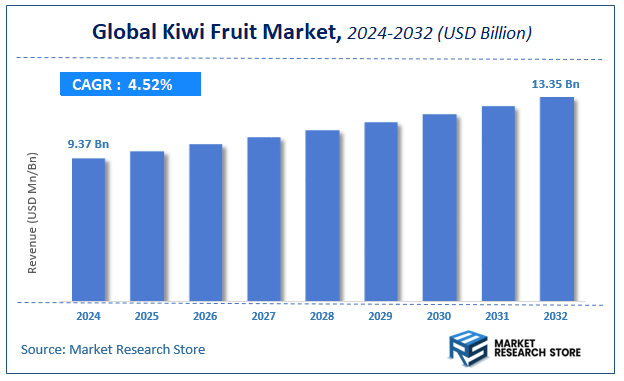
Kiwi Fruit Market: Overview
The growth of the kiwi fruit market is fueled by rising global demand across various industries and applications. The report highlights lucrative opportunities, analyzing cost structures, key segments, emerging trends, regional dynamics, and advancements by leading players to provide comprehensive market insights. The kiwi fruit market report offers a detailed industry analysis from 2024 to 2032, combining quantitative and qualitative insights. It examines key factors such as pricing, market penetration, GDP impact, industry dynamics, major players, consumer behavior, and socio-economic conditions. Structured into multiple sections, the report provides a comprehensive perspective on the market from all angles.
Key sections of the kiwi fruit market report include market segments, outlook, competitive landscape, and company profiles. Market Segments offer in-depth details based on Product Type, Distribution Channel, Consumer Segment, and other relevant classifications to support strategic marketing initiatives. Market Outlook thoroughly analyzes market trends, growth drivers, restraints, opportunities, challenges, Porter’s Five Forces framework, macroeconomic factors, value chain analysis, and pricing trends shaping the market now and in the future. The Competitive Landscape and Company Profiles section highlights major players, their strategies, and market positioning to guide investment and business decisions. The report also identifies innovation trends, new business opportunities, and investment prospects for the forecast period.
Key Highlights:
- As per the analysis shared by our research analyst, the global kiwi fruit market is estimated to grow annually at a CAGR of around 4.52% over the forecast period (2025-2032).
- In terms of revenue, the global kiwi fruit market size was valued at around USD 9.37 Billion in 2024 and is projected to reach USD 13.35 Billion by 2032.
- The market is projected to grow at a significant rate due to rising demand for nutrient-rich superfruits, health-conscious diets, and growth in food processing and smoothie industries.
- Based on the Product Type, the Green Kiwi segment is growing at a high rate and will continue to dominate the global market as per industry projections.
- On the basis of Distribution Channel, the Supermarkets and Hypermarkets segment is anticipated to command the largest market share.
- In terms of Consumer Segment, the Households segment is projected to lead the global market.
- Based on region, Asia-Pacific is projected to dominate the global market during the forecast period.
Kiwi Fruit Market: Report Scope
This report thoroughly analyzes the kiwi fruit market, exploring its historical trends, current state, and future projections. The market estimates presented result from a robust research methodology, incorporating primary research, secondary sources, and expert opinions. These estimates are influenced by the prevailing market dynamics as well as key economic, social, and political factors. Furthermore, the report considers the impact of regulations, government expenditures, and advancements in research and development on the market. Both positive and negative shifts are evaluated to ensure a comprehensive and accurate market outlook.
| Report Attributes | Report Details |
|---|---|
| Report Name | Kiwi Fruit Market |
| Market Size in 2024 | USD 9.37 Billion |
| Market Forecast in 2032 | USD 13.35 Billion |
| Growth Rate | CAGR of 4.52% |
| Number of Pages | 241 |
| Key Companies Covered | Zespri International, T&G Global, Sunraysia Tropical Fruit, Copefruit New Zealand, Apofruit, Sun World International, Freshmax |
| Segments Covered | By Product Type, By Distribution Channel, By Consumer Segment, and By Region |
| Regions Covered | North America, Europe, Asia Pacific (APAC), Latin America, Middle East, and Africa (MEA) |
| Base Year | 2024 |
| Historical Year | 2018 to 2024 |
| Forecast Year | 2025 to 2032 |
| Customization Scope | Avail customized purchase options to meet your exact research needs. Request For Customization |
Kiwi Fruit Market: Dynamics
Key Growth Drivers :
The market is primarily driven by the increasing global health and wellness trend, as consumers seek out nutrient-dense foods. Kiwi fruit, with its high content of Vitamin C, antioxidants, and dietary fiber, is positioned as a healthy choice for boosting immunity and aiding digestion. The growing popularity of exotic and new fruit varieties among consumers in developed and emerging markets, particularly for gold and red kiwifruit, has also spurred market expansion. Furthermore, advancements in cold-chain logistics and post-harvest technology have significantly extended the shelf life of kiwi fruit, allowing it to be transported to distant markets while maintaining quality and freshness. The increased availability of kiwi in processed forms, such as juices, dried snacks, and purees, also contributes to its market growth.
Restraints :
Despite the positive momentum, the kiwi fruit market faces several restraints. A significant challenge is the sensitivity of the crop to climate change, as it requires specific temperature ranges and is vulnerable to extreme weather events like frost and heatwaves. This can lead to crop damage and reduced yields. The market is also hindered by the high production costs associated with specialized cultivation and labor, which can make the fruit more expensive than other common fruits. Another restraint is the risk of disease outbreaks, such as the kiwifruit canker, which can devastate entire crops and severely impact supply. Furthermore, trade barriers and tariffs between countries can affect market access and increase the final cost for consumers.
Opportunities :
The market is ripe with opportunities for innovation and growth. There is a strong opportunity in developing and marketing new kiwi fruit varieties with different colors, flavors, and nutritional profiles, such as the sweeter golden kiwifruit, to attract a broader consumer base. The increasing consumer demand for organic and sustainably grown produce presents a key avenue for brands to differentiate themselves and command a price premium. Expanding the use of kiwi fruit as an ingredient in other food and beverage products, such as in smoothies, salads, and dietary supplements, also offers a significant growth opportunity. Lastly, leveraging e-commerce platforms allows producers to bypass traditional retail channels and connect directly with consumers, especially in urban areas.
Challenges :
Beyond the general restraints, specific challenges exist. The market is highly vulnerable to a lack of skilled labor, particularly during the labor-intensive harvesting period. This can lead to supply chain disruptions and an inability to meet demand. The lack of widespread consumer awareness in some regions, especially in countries where kiwi fruit is not a native crop, is a challenge that requires significant investment in marketing and consumer education. Furthermore, the fragile nature of the fruit makes it susceptible to damage during handling and transportation, which can lead to post-harvest losses and reduced profitability. Lastly, the highly competitive nature of the global fruit market, with competition from a vast array of other healthy fruits, requires continuous innovation and strong branding to maintain market share.
Kiwi Fruit Market: Segmentation Insights
The global kiwi fruit market is segmented based on Product Type, Distribution Channel, Consumer Segment, and Region. All the segments of the kiwi fruit market have been analyzed based on present & future trends and the market is estimated from 2024 to 2032.
Based on Product Type, the global kiwi fruit market is divided into Green Kiwi, Golden Kiwi, Organic Kiwi, Kiwi Varieties.
On the basis of Distribution Channel, the global kiwi fruit market is bifurcated into Supermarkets and Hypermarkets, Specialty Stores, Online Retail, Local Markets.
In terms of Consumer Segment, the global kiwi fruit market is categorized into Households, Foodservice Industry, Industrial Buyers.
Kiwi Fruit Market: Regional Insights
The Asia-Pacific region is the undisputed dominant force in the global kiwi fruit market, overwhelmingly due to its role as the world's primary producer. China is the colossal leader, accounting for roughly 50% of global production and supply, dwarfing the output of traditional leaders like Italy and New Zealand. This dominance is rooted in ideal growing conditions in provinces like Shaanxi and Sichuan, coupled with massive scale and increasing investments in quality and varietal development (e.g., gold and red kiwifruit).
While domestic consumption is rising rapidly, China's export volume is also growing significantly, solidifying the Asia-Pacific region's role as the production epicenter that supplies both its own vast population and the rest of the world.
Kiwi Fruit Market: Competitive Landscape
The kiwi fruit market report offers a thorough analysis of both established and emerging players within the market. It includes a detailed list of key companies, categorized based on the types of products they offer and other relevant factors. The report also highlights the market entry year for each player, providing further context for the research analysis.
The "Global Kiwi Fruit Market" study offers valuable insights, focusing on the global market landscape, with an emphasis on major industry players such as;
- Zespri International
- T&G Global
- Sunraysia Tropical Fruit
- Copefruit New Zealand
- Apofruit
- Sun World International
- Freshmax
The Global Kiwi Fruit Market is Segmented as Follows:
By Product Type
- Green Kiwi
- Golden Kiwi
- Organic Kiwi
- Kiwi Varieties
By Distribution Channel
- Supermarkets and Hypermarkets
- Specialty Stores
- Online Retail
- Local Markets
By Consumer Segment
- Households
- Foodservice Industry
- Industrial Buyers
By Region
- North America
- The U.S.
- Canada
- Mexico
- Europe
- France
- The UK
- Spain
- Germany
- Italy
- Rest of Europe
- Asia Pacific
- China
- Japan
- India
- Australia
- South Korea
- Rest of Asia Pacific
- The Middle East & Africa
- Saudi Arabia
- UAE
- Egypt
- Kuwait
- South Africa
- Rest of the Middle East & Africa
- Latin America
- Brazil
- Argentina
- Rest of Latin America
Frequently Asked Questions
Table Of Content
Table of Content 1 Report Overview 1.1 Study Scope 1.2 Key Market Segments 1.3 Regulatory Scenario by Region/Country 1.4 Market Investment Scenario Strategic 1.5 Market Analysis by Type 1.5.1 Global Kiwi Fruit Market Share by Type (2020-2026) 1.5.2 Qinmei kiwi 1.5.3 Hayward Kiwi 1.5.4 Xu Xiang Kiwi 1.5.5 Cinnamon Kiwi 1.5.6 Huayou Kiwi 1.5.7 Yate kiwi 1.5.8 Jinyan kiwi 1.5.9 Hongyang kiwi 1.6 Market by Application 1.6.1 Global Kiwi Fruit Market Share by Application (2020-2026) 1.6.2 Supermarkets 1.6.3 Online Stores 1.6.4 Others 1.7 Kiwi Fruit Industry Development Trends under COVID-19 Outbreak 1.7.1 Global COVID-19 Status Overview 1.7.2 Influence of COVID-19 Outbreak on Kiwi Fruit Industry Development 2. Global Market Growth Trends 2.1 Industry Trends 2.1.1 SWOT Analysis 2.1.2 Porter’s Five Forces Analysis 2.2 Potential Market and Growth Potential Analysis 2.3 Industry News and Policies by Regions 2.3.1 Industry News 2.3.2 Industry Policies 2.4 Industry Trends Under COVID-19 3 Value Chain of Kiwi Fruit Market 3.1 Value Chain Status 3.2 Kiwi Fruit Manufacturing Cost Structure Analysis 3.2.1 Production Process Analysis 3.2.2 Manufacturing Cost Structure of Kiwi Fruit 3.2.3 Labor Cost of Kiwi Fruit 3.2.3.1 Labor Cost of Kiwi Fruit Under COVID-19 3.3 Sales and Marketing Model Analysis 3.4 Downstream Major Customer Analysis (by Region) 3.5 Value Chain Status Under COVID-19 4 Players Profiles 4.1 Zespri International Limited 4.1.1 Zespri International Limited Basic Information 4.1.2 Kiwi Fruit Product Profiles, Application and Specification 4.1.3 Zespri International Limited Kiwi Fruit Market Performance (2015-2020) 4.1.4 Zespri International Limited Business Overview 4.2 Seeka 4.2.1 Seeka Basic Information 4.2.2 Kiwi Fruit Product Profiles, Application and Specification 4.2.3 Seeka Kiwi Fruit Market Performance (2015-2020) 4.2.4 Seeka Business Overview 4.3 GULLINO 4.3.1 GULLINO Basic Information 4.3.2 Kiwi Fruit Product Profiles, Application and Specification 4.3.3 GULLINO Kiwi Fruit Market Performance (2015-2020) 4.3.4 GULLINO Business Overview 5 Global Kiwi Fruit Market Analysis by Regions 5.1 Global Kiwi Fruit Sales, Revenue and Market Share by Regions 5.1.1 Global Kiwi Fruit Sales by Regions (2015-2020) 5.1.2 Global Kiwi Fruit Revenue by Regions (2015-2020) 5.2 North America Kiwi Fruit Sales and Growth Rate (2015-2020) 5.3 Europe Kiwi Fruit Sales and Growth Rate (2015-2020) 5.4 Asia-Pacific Kiwi Fruit Sales and Growth Rate (2015-2020) 5.5 Middle East and Africa Kiwi Fruit Sales and Growth Rate (2015-2020) 5.6 South America Kiwi Fruit Sales and Growth Rate (2015-2020) 6 North America Kiwi Fruit Market Analysis by Countries 6.1 North America Kiwi Fruit Sales, Revenue and Market Share by Countries 6.1.1 North America Kiwi Fruit Sales by Countries (2015-2020) 6.1.2 North America Kiwi Fruit Revenue by Countries (2015-2020) 6.1.3 North America Kiwi Fruit Market Under COVID-19 6.2 United States Kiwi Fruit Sales and Growth Rate (2015-2020) 6.2.1 United States Kiwi Fruit Market Under COVID-19 6.3 Canada Kiwi Fruit Sales and Growth Rate (2015-2020) 6.4 Mexico Kiwi Fruit Sales and Growth Rate (2015-2020) 7 Europe Kiwi Fruit Market Analysis by Countries 7.1 Europe Kiwi Fruit Sales, Revenue and Market Share by Countries 7.1.1 Europe Kiwi Fruit Sales by Countries (2015-2020) 7.1.2 Europe Kiwi Fruit Revenue by Countries (2015-2020) 7.1.3 Europe Kiwi Fruit Market Under COVID-19 7.2 Germany Kiwi Fruit Sales and Growth Rate (2015-2020) 7.2.1 Germany Kiwi Fruit Market Under COVID-19 7.3 UK Kiwi Fruit Sales and Growth Rate (2015-2020) 7.3.1 UK Kiwi Fruit Market Under COVID-19 7.4 France Kiwi Fruit Sales and Growth Rate (2015-2020) 7.4.1 France Kiwi Fruit Market Under COVID-19 7.5 Italy Kiwi Fruit Sales and Growth Rate (2015-2020) 7.5.1 Italy Kiwi Fruit Market Under COVID-19 7.6 Spain Kiwi Fruit Sales and Growth Rate (2015-2020) 7.6.1 Spain Kiwi Fruit Market Under COVID-19 7.7 Russia Kiwi Fruit Sales and Growth Rate (2015-2020) 7.7.1 Russia Kiwi Fruit Market Under COVID-19 8 Asia-Pacific Kiwi Fruit Market Analysis by Countries 8.1 Asia-Pacific Kiwi Fruit Sales, Revenue and Market Share by Countries 8.1.1 Asia-Pacific Kiwi Fruit Sales by Countries (2015-2020) 8.1.2 Asia-Pacific Kiwi Fruit Revenue by Countries (2015-2020) 8.1.3 Asia-Pacific Kiwi Fruit Market Under COVID-19 8.2 China Kiwi Fruit Sales and Growth Rate (2015-2020) 8.2.1 China Kiwi Fruit Market Under COVID-19 8.3 Japan Kiwi Fruit Sales and Growth Rate (2015-2020) 8.3.1 Japan Kiwi Fruit Market Under COVID-19 8.4 South Korea Kiwi Fruit Sales and Growth Rate (2015-2020) 8.4.1 South Korea Kiwi Fruit Market Under COVID-19 8.5 Australia Kiwi Fruit Sales and Growth Rate (2015-2020) 8.6 India Kiwi Fruit Sales and Growth Rate (2015-2020) 8.6.1 India Kiwi Fruit Market Under COVID-19 8.7 Southeast Asia Kiwi Fruit Sales and Growth Rate (2015-2020) 8.7.1 Southeast Asia Kiwi Fruit Market Under COVID-19 9 Middle East and Africa Kiwi Fruit Market Analysis by Countries 9.1 Middle East and Africa Kiwi Fruit Sales, Revenue and Market Share by Countries 9.1.1 Middle East and Africa Kiwi Fruit Sales by Countries (2015-2020) 9.1.2 Middle East and Africa Kiwi Fruit Revenue by Countries (2015-2020) 9.1.3 Middle East and Africa Kiwi Fruit Market Under COVID-19 9.2 Saudi Arabia Kiwi Fruit Sales and Growth Rate (2015-2020) 9.3 UAE Kiwi Fruit Sales and Growth Rate (2015-2020) 9.4 Egypt Kiwi Fruit Sales and Growth Rate (2015-2020) 9.5 Nigeria Kiwi Fruit Sales and Growth Rate (2015-2020) 9.6 South Africa Kiwi Fruit Sales and Growth Rate (2015-2020) 10 South America Kiwi Fruit Market Analysis by Countries 10.1 South America Kiwi Fruit Sales, Revenue and Market Share by Countries 10.1.1 South America Kiwi Fruit Sales by Countries (2015-2020) 10.1.2 South America Kiwi Fruit Revenue by Countries (2015-2020) 10.1.3 South America Kiwi Fruit Market Under COVID-19 10.2 Brazil Kiwi Fruit Sales and Growth Rate (2015-2020) 10.2.1 Brazil Kiwi Fruit Market Under COVID-19 10.3 Argentina Kiwi Fruit Sales and Growth Rate (2015-2020) 10.4 Columbia Kiwi Fruit Sales and Growth Rate (2015-2020) 10.5 Chile Kiwi Fruit Sales and Growth Rate (2015-2020) 11 Global Kiwi Fruit Market Segment by Types 11.1 Global Kiwi Fruit Sales, Revenue and Market Share by Types (2015-2020) 11.1.1 Global Kiwi Fruit Sales and Market Share by Types (2015-2020) 11.1.2 Global Kiwi Fruit Revenue and Market Share by Types (2015-2020) 11.2 Qinmei kiwi Sales and Price (2015-2020) 11.3 Hayward Kiwi Sales and Price (2015-2020) 11.4 Xu Xiang Kiwi Sales and Price (2015-2020) 11.5 Cinnamon Kiwi Sales and Price (2015-2020) 11.6 Huayou Kiwi Sales and Price (2015-2020) 11.7 Yate kiwi Sales and Price (2015-2020) 11.8 Jinyan kiwi Sales and Price (2015-2020) 11.9 Hongyang kiwi Sales and Price (2015-2020) 12 Global Kiwi Fruit Market Segment by Applications 12.1 Global Kiwi Fruit Sales, Revenue and Market Share by Applications (2015-2020) 12.1.1 Global Kiwi Fruit Sales and Market Share by Applications (2015-2020) 12.1.2 Global Kiwi Fruit Revenue and Market Share by Applications (2015-2020) 12.2 Supermarkets Sales, Revenue and Growth Rate (2015-2020) 12.3 Online Stores Sales, Revenue and Growth Rate (2015-2020) 12.4 Others Sales, Revenue and Growth Rate (2015-2020) 13 Kiwi Fruit Market Forecast by Regions (2020-2026) 13.1 Global Kiwi Fruit Sales, Revenue and Growth Rate (2020-2026) 13.2 Kiwi Fruit Market Forecast by Regions (2020-2026) 13.2.1 North America Kiwi Fruit Market Forecast (2020-2026) 13.2.2 Europe Kiwi Fruit Market Forecast (2020-2026) 13.2.3 Asia-Pacific Kiwi Fruit Market Forecast (2020-2026) 13.2.4 Middle East and Africa Kiwi Fruit Market Forecast (2020-2026) 13.2.5 South America Kiwi Fruit Market Forecast (2020-2026) 13.3 Kiwi Fruit Market Forecast by Types (2020-2026) 13.4 Kiwi Fruit Market Forecast by Applications (2020-2026) 13.5 Kiwi Fruit Market Forecast Under COVID-19 14 Appendix 14.1 Methodology 14.2 Research Data Source
Inquiry For Buying
Kiwi Fruit
Request Sample
Kiwi Fruit
