Naturally Fermented Food Market Size, Share, and Trends Analysis Report
CAGR :

| Market Size 2024 (Base Year) | USD 25.86 Billion |
| Market Size 2032 (Forecast Year) | USD 41.53 Billion |
| CAGR | 6.1% |
| Forecast Period | 2025 - 2032 |
| Historical Period | 2020 - 2024 |
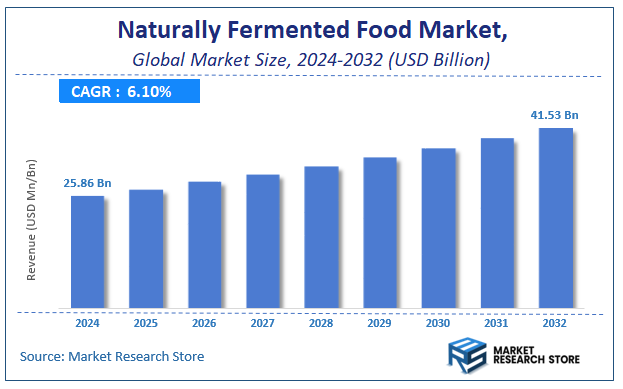
Market Research Store has published a report on the global naturally fermented food market, estimating its value at USD 25.86 Billion in 2024, with projections indicating it will reach USD 41.53 Billion by the end of 2032. The market is expected to expand at a compound annual growth rate (CAGR) of around 6.1% over the forecast period. The report examines the factors driving market growth, the obstacles that could hinder this expansion, and the opportunities that may emerge in the naturally fermented food industry. Additionally, it offers a detailed analysis of how these elements will affect demand dynamics and market performance throughout the forecast period.
Naturally Fermented Food Market: Overview
The growth of the naturally fermented food market is fueled by rising global demand across various industries and applications. The report highlights lucrative opportunities, analyzing cost structures, key segments, emerging trends, regional dynamics, and advancements by leading players to provide comprehensive market insights. The naturally fermented food market report offers a detailed industry analysis from 2024 to 2032, combining quantitative and qualitative insights. It examines key factors such as pricing, market penetration, GDP impact, industry dynamics, major players, consumer behavior, and socio-economic conditions. Structured into multiple sections, the report provides a comprehensive perspective on the market from all angles.
Key sections of the naturally fermented food market report include market segments, outlook, competitive landscape, and company profiles. Market Segments offer in-depth details based on Product Type, Ingredient Source, Distribution Channel, End-Use, and other relevant classifications to support strategic marketing initiatives. Market Outlook thoroughly analyzes market trends, growth drivers, restraints, opportunities, challenges, Porter’s Five Forces framework, macroeconomic factors, value chain analysis, and pricing trends shaping the market now and in the future. The Competitive Landscape and Company Profiles section highlights major players, their strategies, and market positioning to guide investment and business decisions. The report also identifies innovation trends, new business opportunities, and investment prospects for the forecast period.
Key Highlights:
- As per the analysis shared by our research analyst, the global naturally fermented food market is estimated to grow annually at a CAGR of around 6.1% over the forecast period (2025-2032).
- In terms of revenue, the global naturally fermented food market size was valued at around USD 25.86 Billion in 2024 and is projected to reach USD 41.53 Billion by 2032.
- The market is projected to grow at a significant rate due to rising preference for traditional, preservative-free fermentation.
- Based on the Product Type, the Sauerkraut segment is growing at a high rate and will continue to dominate the global market as per industry projections.
- On the basis of Ingredient Source, the Plant-Based segment is anticipated to command the largest market share.
- In terms of Distribution Channel, the Supermarkets/Hypermarkets segment is projected to lead the global market.
- By End-Use, the Household segment is predicted to dominate the global market.
- Based on region, North America is projected to dominate the global market during the forecast period.
Naturally Fermented Food Market: Report Scope
This report thoroughly analyzes the naturally fermented food market, exploring its historical trends, current state, and future projections. The market estimates presented result from a robust research methodology, incorporating primary research, secondary sources, and expert opinions. These estimates are influenced by the prevailing market dynamics as well as key economic, social, and political factors. Furthermore, the report considers the impact of regulations, government expenditures, and advancements in research and development on the market. Both positive and negative shifts are evaluated to ensure a comprehensive and accurate market outlook.
| Report Attributes | Report Details |
|---|---|
| Report Name | Naturally Fermented Food Market |
| Market Size in 2024 | USD 25.86 Billion |
| Market Forecast in 2032 | USD 41.53 Billion |
| Growth Rate | CAGR of 6.1% |
| Number of Pages | 233 |
| Key Companies Covered | Danone, Pepsico Inc., The Boston Beer Company, Nestle S.A., Constellation Brands Inc., Chr. Hansen, Barry Callebaut, Cargill, Anheuser-busch Inbev, Fonterra Co-operative Group, Heineken N.V., Yakult Honsha Co. Ltd, GTs Living Food, General Mills |
| Segments Covered | By Product Type, By Ingredient Source, By Distribution Channel, By End-Use, and By Region |
| Regions Covered | North America, Europe, Asia Pacific (APAC), Latin America, Middle East, and Africa (MEA) |
| Base Year | 2024 |
| Historical Year | 2020 to 2024 |
| Forecast Year | 2025 to 2032 |
| Customization Scope | Avail customized purchase options to meet your exact research needs. Request For Customization |
Naturally Fermented Food Market: Dynamics
Key Growth Drivers :
The primary driver for the naturally fermented food market is the rising global awareness of the health benefits associated with probiotics and gut health. Consumers are increasingly seeking out foods like kimchi, kefir, kombucha, and sauerkraut to improve digestion, boost immunity, and enhance overall wellness. This trend is amplified by the growing preference for "clean-label" and minimally processed foods that are free from artificial additives. The market also benefits from the revival of traditional and artisanal foods, which are now being positioned as premium, health-focused offerings. The expansion of retail channels, particularly specialty stores and e-commerce, has significantly improved accessibility to these products, further fueling market growth.
Restraints :
Despite the strong drivers, the naturally fermented food market faces several notable restraints. The high cost and complexity of production can be a major barrier, especially for small-scale producers. The fermentation process requires careful handling, precise temperature and pH control, and sophisticated quality control to ensure product consistency and safety. This also contributes to the short shelf life of many fermented products, which can increase logistical costs and limit their distribution. The market also grapples with a lack of standardized regulations and a need for clear labeling, particularly concerning probiotic claims. This regulatory uncertainty can create confusion for both producers and consumers and slow down market growth in some regions.
Opportunities :
The naturally fermented food market is full of promising opportunities for future growth. A key opportunity lies in product diversification, by introducing a wider variety of fermented products and flavors to cater to different tastes and dietary needs. Manufacturers can develop new fermented foods from a wide range of ingredients, including fruits, grains, and legumes, to appeal to vegan, gluten-free, and other specific consumer segments. The market can also capitalize on the functional food trend by creating fermented products fortified with added vitamins, minerals, and other health-enhancing ingredients. Furthermore, the use of advanced technologies, such as precision fermentation and AI-powered monitoring systems, can help to optimize production, ensure consistency, and reduce waste.
Challenges :
The market must navigate several challenges to ensure sustained growth. One of the main hurdles is the risk of microbial contamination and spoilage, as the production process relies on a complex microbial ecosystem. Maintaining strict hygiene and safety standards is crucial to prevent the growth of pathogens. The industry also faces the challenge of scaling up production of traditional foods without losing their authentic taste and nutritional benefits. This requires a delicate balance between modern technology and traditional techniques. Lastly, the intense competition from both established corporations and new entrants in the health and wellness food space requires continuous innovation in product development, marketing, and branding to stand out and maintain a competitive edge.
Naturally Fermented Food Market: Segmentation Insights
The global naturally fermented food market is segmented based on Product Type, Ingredient Source, Distribution Channel, End-Use, and Region. All the segments of the naturally fermented food market have been analyzed based on present & future trends and the market is estimated from 2024 to 2032.
Based on Product Type, the global naturally fermented food market is divided into Sauerkraut, Kimchi, Pickles, Yogurt, Kefir, Miso, Tempeh, Others.
On the basis of Ingredient Source, the global naturally fermented food market is bifurcated into Plant-Based, Animal-Based.
In terms of Distribution Channel, the global naturally fermented food market is categorized into Supermarkets/Hypermarkets, Convenience Stores, Specialty Stores, Online Retail, Others.
Based on End-Use, the global naturally fermented food market is split into Household, Food Service.
Naturally Fermented Food Market: Regional Insights
The Asia-Pacific (APAC) region is the dominant and originating force in the global naturally fermented food market, accounting for the largest consumption and production share. This leadership is deeply rooted in centuries-old culinary traditions, where products like kimchi (Korea), miso (Japan), pickled vegetables (India, China), and various fermented sauces and pastes are dietary staples.
The region's vast population and cultural acceptance drive immense volume. However, North America is the fastest-growing and highest-value market, driven by a surge in health and wellness trends, the popularity of probiotics for gut health, and the mainstream adoption of foods like kombucha, sauerkraut, and kimchi. This growth is characterized by premiumization, innovation in flavors, and strong retail distribution. Europe remains a significant and mature market, with its own rich traditions of fermented foods like sauerkraut (Germany), yogurt, and kefir (Eastern Europe).
Naturally Fermented Food Market: Competitive Landscape
The naturally fermented food market report offers a thorough analysis of both established and emerging players within the market. It includes a detailed list of key companies, categorized based on the types of products they offer and other relevant factors. The report also highlights the market entry year for each player, providing further context for the research analysis.
The "Global Naturally Fermented Food Market" study offers valuable insights, focusing on the global market landscape, with an emphasis on major industry players such as;
- Danone
- Pepsico Inc.
- The Boston Beer Company
- Nestle S.A.
- Constellation Brands Inc.
- Chr. Hansen
- Barry Callebaut
- Cargill
- Anheuser-busch Inbev
- Fonterra Co-operative Group
- Heineken N.V.
- Yakult Honsha Co. Ltd
- GTs Living Food
- General Mills
The Global Naturally Fermented Food Market is Segmented as Follows:
By Product Type
- Sauerkraut
- Kimchi
- Pickles
- Yogurt
- Kefir
- Miso
- Tempeh
- Others
By Ingredient Source
- Plant-Based
- Animal-Based
By Distribution Channel
- Supermarkets/Hypermarkets
- Convenience Stores
- Specialty Stores
- Online Retail
- Others
By End-Use
- Household
- Food Service
By Region
- North America
- The U.S.
- Canada
- Mexico
- Europe
- France
- The UK
- Spain
- Germany
- Italy
- Rest of Europe
- Asia Pacific
- China
- Japan
- India
- Australia
- South Korea
- Rest of Asia Pacific
- The Middle East & Africa
- Saudi Arabia
- UAE
- Egypt
- Kuwait
- South Africa
- Rest of the Middle East & Africa
- Latin America
- Brazil
- Argentina
- Rest of Latin America
Frequently Asked Questions
Table Of Content
Table of Content 1 Report Overview 1.1 Study Scope 1.2 Key Market Segments 1.3 Regulatory Scenario by Region/Country 1.4 Market Investment Scenario Strategic 1.5 Market Analysis by Type 1.5.1 Global Naturally Fermented Food Market Share by Type (2020-2026) 1.5.2 Dairy 1.5.3 Bakery 1.5.4 Kimchi & Sauerkraut 1.5.5 Alcohols 1.5.6 Others 1.6 Market by Application 1.6.1 Global Naturally Fermented Food Market Share by Application (2020-2026) 1.6.2 Supermarket/Hypermarket 1.6.3 Convenience Store 1.6.4 Online Channel 1.6.5 Others 1.7 Naturally Fermented Food Industry Development Trends under COVID-19 Outbreak 1.7.1 Global COVID-19 Status Overview 1.7.2 Influence of COVID-19 Outbreak on Naturally Fermented Food Industry Development 2. Global Market Growth Trends 2.1 Industry Trends 2.1.1 SWOT Analysis 2.1.2 Porter’s Five Forces Analysis 2.2 Potential Market and Growth Potential Analysis 2.3 Industry News and Policies by Regions 2.3.1 Industry News 2.3.2 Industry Policies 2.4 Industry Trends Under COVID-19 3 Value Chain of Naturally Fermented Food Market 3.1 Value Chain Status 3.2 Naturally Fermented Food Manufacturing Cost Structure Analysis 3.2.1 Production Process Analysis 3.2.2 Manufacturing Cost Structure of Naturally Fermented Food 3.2.3 Labor Cost of Naturally Fermented Food 3.2.3.1 Labor Cost of Naturally Fermented Food Under COVID-19 3.3 Sales and Marketing Model Analysis 3.4 Downstream Major Customer Analysis (by Region) 3.5 Value Chain Status Under COVID-19 4 Players Profiles 4.1 Danone 4.1.1 Danone Basic Information 4.1.2 Naturally Fermented Food Product Profiles, Application and Specification 4.1.3 Danone Naturally Fermented Food Market Performance (2015-2020) 4.1.4 Danone Business Overview 4.2 Pepsico Inc. 4.2.1 Pepsico Inc. Basic Information 4.2.2 Naturally Fermented Food Product Profiles, Application and Specification 4.2.3 Pepsico Inc. Naturally Fermented Food Market Performance (2015-2020) 4.2.4 Pepsico Inc. Business Overview 4.3 The Boston Beer Company 4.3.1 The Boston Beer Company Basic Information 4.3.2 Naturally Fermented Food Product Profiles, Application and Specification 4.3.3 The Boston Beer Company Naturally Fermented Food Market Performance (2015-2020) 4.3.4 The Boston Beer Company Business Overview 4.4 Nestle S.A. 4.4.1 Nestle S.A. Basic Information 4.4.2 Naturally Fermented Food Product Profiles, Application and Specification 4.4.3 Nestle S.A. Naturally Fermented Food Market Performance (2015-2020) 4.4.4 Nestle S.A. Business Overview 4.5 Constellation Brands Inc. 4.5.1 Constellation Brands Inc. Basic Information 4.5.2 Naturally Fermented Food Product Profiles, Application and Specification 4.5.3 Constellation Brands Inc. Naturally Fermented Food Market Performance (2015-2020) 4.5.4 Constellation Brands Inc. Business Overview 4.6 Chr. Hansen 4.6.1 Chr. Hansen Basic Information 4.6.2 Naturally Fermented Food Product Profiles, Application and Specification 4.6.3 Chr. Hansen Naturally Fermented Food Market Performance (2015-2020) 4.6.4 Chr. Hansen Business Overview 4.7 Barry Callebaut 4.7.1 Barry Callebaut Basic Information 4.7.2 Naturally Fermented Food Product Profiles, Application and Specification 4.7.3 Barry Callebaut Naturally Fermented Food Market Performance (2015-2020) 4.7.4 Barry Callebaut Business Overview 4.8 Cargill 4.8.1 Cargill Basic Information 4.8.2 Naturally Fermented Food Product Profiles, Application and Specification 4.8.3 Cargill Naturally Fermented Food Market Performance (2015-2020) 4.8.4 Cargill Business Overview 4.9 Anheuser-busch Inbev 4.9.1 Anheuser-busch Inbev Basic Information 4.9.2 Naturally Fermented Food Product Profiles, Application and Specification 4.9.3 Anheuser-busch Inbev Naturally Fermented Food Market Performance (2015-2020) 4.9.4 Anheuser-busch Inbev Business Overview 4.10 Fonterra Co-operative Group 4.10.1 Fonterra Co-operative Group Basic Information 4.10.2 Naturally Fermented Food Product Profiles, Application and Specification 4.10.3 Fonterra Co-operative Group Naturally Fermented Food Market Performance (2015-2020) 4.10.4 Fonterra Co-operative Group Business Overview 4.11 Heineken N.V. 4.11.1 Heineken N.V. Basic Information 4.11.2 Naturally Fermented Food Product Profiles, Application and Specification 4.11.3 Heineken N.V. Naturally Fermented Food Market Performance (2015-2020) 4.11.4 Heineken N.V. Business Overview 4.12 Yakult Honsha Co. Ltd 4.12.1 Yakult Honsha Co. Ltd Basic Information 4.12.2 Naturally Fermented Food Product Profiles, Application and Specification 4.12.3 Yakult Honsha Co. Ltd Naturally Fermented Food Market Performance (2015-2020) 4.12.4 Yakult Honsha Co. Ltd Business Overview 4.13 GTs Living Food 4.13.1 GTs Living Food Basic Information 4.13.2 Naturally Fermented Food Product Profiles, Application and Specification 4.13.3 GTs Living Food Naturally Fermented Food Market Performance (2015-2020) 4.13.4 GTs Living Food Business Overview 4.14 General Mills 4.14.1 General Mills Basic Information 4.14.2 Naturally Fermented Food Product Profiles, Application and Specification 4.14.3 General Mills Naturally Fermented Food Market Performance (2015-2020) 4.14.4 General Mills Business Overview 5 Global Naturally Fermented Food Market Analysis by Regions 5.1 Global Naturally Fermented Food Sales, Revenue and Market Share by Regions 5.1.1 Global Naturally Fermented Food Sales by Regions (2015-2020) 5.1.2 Global Naturally Fermented Food Revenue by Regions (2015-2020) 5.2 North America Naturally Fermented Food Sales and Growth Rate (2015-2020) 5.3 Europe Naturally Fermented Food Sales and Growth Rate (2015-2020) 5.4 Asia-Pacific Naturally Fermented Food Sales and Growth Rate (2015-2020) 5.5 Middle East and Africa Naturally Fermented Food Sales and Growth Rate (2015-2020) 5.6 South America Naturally Fermented Food Sales and Growth Rate (2015-2020) 6 North America Naturally Fermented Food Market Analysis by Countries 6.1 North America Naturally Fermented Food Sales, Revenue and Market Share by Countries 6.1.1 North America Naturally Fermented Food Sales by Countries (2015-2020) 6.1.2 North America Naturally Fermented Food Revenue by Countries (2015-2020) 6.1.3 North America Naturally Fermented Food Market Under COVID-19 6.2 United States Naturally Fermented Food Sales and Growth Rate (2015-2020) 6.2.1 United States Naturally Fermented Food Market Under COVID-19 6.3 Canada Naturally Fermented Food Sales and Growth Rate (2015-2020) 6.4 Mexico Naturally Fermented Food Sales and Growth Rate (2015-2020) 7 Europe Naturally Fermented Food Market Analysis by Countries 7.1 Europe Naturally Fermented Food Sales, Revenue and Market Share by Countries 7.1.1 Europe Naturally Fermented Food Sales by Countries (2015-2020) 7.1.2 Europe Naturally Fermented Food Revenue by Countries (2015-2020) 7.1.3 Europe Naturally Fermented Food Market Under COVID-19 7.2 Germany Naturally Fermented Food Sales and Growth Rate (2015-2020) 7.2.1 Germany Naturally Fermented Food Market Under COVID-19 7.3 UK Naturally Fermented Food Sales and Growth Rate (2015-2020) 7.3.1 UK Naturally Fermented Food Market Under COVID-19 7.4 France Naturally Fermented Food Sales and Growth Rate (2015-2020) 7.4.1 France Naturally Fermented Food Market Under COVID-19 7.5 Italy Naturally Fermented Food Sales and Growth Rate (2015-2020) 7.5.1 Italy Naturally Fermented Food Market Under COVID-19 7.6 Spain Naturally Fermented Food Sales and Growth Rate (2015-2020) 7.6.1 Spain Naturally Fermented Food Market Under COVID-19 7.7 Russia Naturally Fermented Food Sales and Growth Rate (2015-2020) 7.7.1 Russia Naturally Fermented Food Market Under COVID-19 8 Asia-Pacific Naturally Fermented Food Market Analysis by Countries 8.1 Asia-Pacific Naturally Fermented Food Sales, Revenue and Market Share by Countries 8.1.1 Asia-Pacific Naturally Fermented Food Sales by Countries (2015-2020) 8.1.2 Asia-Pacific Naturally Fermented Food Revenue by Countries (2015-2020) 8.1.3 Asia-Pacific Naturally Fermented Food Market Under COVID-19 8.2 China Naturally Fermented Food Sales and Growth Rate (2015-2020) 8.2.1 China Naturally Fermented Food Market Under COVID-19 8.3 Japan Naturally Fermented Food Sales and Growth Rate (2015-2020) 8.3.1 Japan Naturally Fermented Food Market Under COVID-19 8.4 South Korea Naturally Fermented Food Sales and Growth Rate (2015-2020) 8.4.1 South Korea Naturally Fermented Food Market Under COVID-19 8.5 Australia Naturally Fermented Food Sales and Growth Rate (2015-2020) 8.6 India Naturally Fermented Food Sales and Growth Rate (2015-2020) 8.6.1 India Naturally Fermented Food Market Under COVID-19 8.7 Southeast Asia Naturally Fermented Food Sales and Growth Rate (2015-2020) 8.7.1 Southeast Asia Naturally Fermented Food Market Under COVID-19 9 Middle East and Africa Naturally Fermented Food Market Analysis by Countries 9.1 Middle East and Africa Naturally Fermented Food Sales, Revenue and Market Share by Countries 9.1.1 Middle East and Africa Naturally Fermented Food Sales by Countries (2015-2020) 9.1.2 Middle East and Africa Naturally Fermented Food Revenue by Countries (2015-2020) 9.1.3 Middle East and Africa Naturally Fermented Food Market Under COVID-19 9.2 Saudi Arabia Naturally Fermented Food Sales and Growth Rate (2015-2020) 9.3 UAE Naturally Fermented Food Sales and Growth Rate (2015-2020) 9.4 Egypt Naturally Fermented Food Sales and Growth Rate (2015-2020) 9.5 Nigeria Naturally Fermented Food Sales and Growth Rate (2015-2020) 9.6 South Africa Naturally Fermented Food Sales and Growth Rate (2015-2020) 10 South America Naturally Fermented Food Market Analysis by Countries 10.1 South America Naturally Fermented Food Sales, Revenue and Market Share by Countries 10.1.1 South America Naturally Fermented Food Sales by Countries (2015-2020) 10.1.2 South America Naturally Fermented Food Revenue by Countries (2015-2020) 10.1.3 South America Naturally Fermented Food Market Under COVID-19 10.2 Brazil Naturally Fermented Food Sales and Growth Rate (2015-2020) 10.2.1 Brazil Naturally Fermented Food Market Under COVID-19 10.3 Argentina Naturally Fermented Food Sales and Growth Rate (2015-2020) 10.4 Columbia Naturally Fermented Food Sales and Growth Rate (2015-2020) 10.5 Chile Naturally Fermented Food Sales and Growth Rate (2015-2020) 11 Global Naturally Fermented Food Market Segment by Types 11.1 Global Naturally Fermented Food Sales, Revenue and Market Share by Types (2015-2020) 11.1.1 Global Naturally Fermented Food Sales and Market Share by Types (2015-2020) 11.1.2 Global Naturally Fermented Food Revenue and Market Share by Types (2015-2020) 11.2 Dairy Sales and Price (2015-2020) 11.3 Bakery Sales and Price (2015-2020) 11.4 Kimchi & Sauerkraut Sales and Price (2015-2020) 11.5 Alcohols Sales and Price (2015-2020) 11.6 Others Sales and Price (2015-2020) 12 Global Naturally Fermented Food Market Segment by Applications 12.1 Global Naturally Fermented Food Sales, Revenue and Market Share by Applications (2015-2020) 12.1.1 Global Naturally Fermented Food Sales and Market Share by Applications (2015-2020) 12.1.2 Global Naturally Fermented Food Revenue and Market Share by Applications (2015-2020) 12.2 Supermarket/Hypermarket Sales, Revenue and Growth Rate (2015-2020) 12.3 Convenience Store Sales, Revenue and Growth Rate (2015-2020) 12.4 Online Channel Sales, Revenue and Growth Rate (2015-2020) 12.5 Others Sales, Revenue and Growth Rate (2015-2020) 13 Naturally Fermented Food Market Forecast by Regions (2020-2026) 13.1 Global Naturally Fermented Food Sales, Revenue and Growth Rate (2020-2026) 13.2 Naturally Fermented Food Market Forecast by Regions (2020-2026) 13.2.1 North America Naturally Fermented Food Market Forecast (2020-2026) 13.2.2 Europe Naturally Fermented Food Market Forecast (2020-2026) 13.2.3 Asia-Pacific Naturally Fermented Food Market Forecast (2020-2026) 13.2.4 Middle East and Africa Naturally Fermented Food Market Forecast (2020-2026) 13.2.5 South America Naturally Fermented Food Market Forecast (2020-2026) 13.3 Naturally Fermented Food Market Forecast by Types (2020-2026) 13.4 Naturally Fermented Food Market Forecast by Applications (2020-2026) 13.5 Naturally Fermented Food Market Forecast Under COVID-19 14 Appendix 14.1 Methodology 14.2 Research Data Source
Inquiry For Buying
Naturally Fermented Food
Request Sample
Naturally Fermented Food
