14-Jul-2025 | Market Research Store
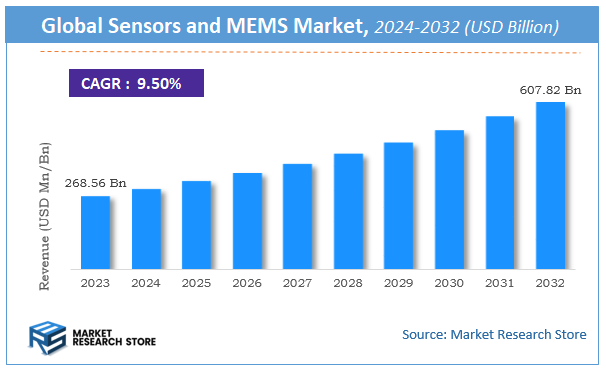
A new, comprehensive market research report, "Sensors and MEMS Market," released by Market Research Store, forecasts a monumental expansion in the global market for Sensors and Micro-Electro-Mechanical Systems (MEMS). Valued at USD 268.56 Billion in 2023, the Sensors and MEMS (Micro-Electro-Mechanical Systems) Market is projected to surge to an impressive USD 607.82 Billion by 2032, demonstrating a robust Compound Annual Growth Rate (CAGR) of 9.5% during the forecast period from 2024 to 2032. This remarkable growth underscores the indispensable role of these technologies as the fundamental building blocks of the digital world, enabling intelligence and connectivity across virtually every industry.
This in-depth analysis provides stakeholders with crucial insights into the dynamic landscape of the Sensors and MEMS market. It offers a detailed, step-by-step examination of market value, definition, key highlights, challenges, opportunities, and future outlook. The report is meticulously built upon extensive historical data from 2018 to 2023, with 2023 serving as the base year for its forward-looking projections.
Browse Summary of the Research Report: https://www.marketresearchstore.com/market-insights/sensors-and-mems-market-828795
Market Definition
The Sensors and MEMS Market encompasses a vast array of devices that detect and respond to physical inputs from the environment, converting them into electrical signals that can be read by other instruments.
- Sensors are devices that measure physical quantities such as temperature, pressure, light, motion, sound, or chemical presence, and convert them into measurable outputs. They are the primary interface between the physical world and electronic systems.
- MEMS (Micro-Electro-Mechanical Systems) are microscopic devices that integrate mechanical and electrical components on a single chip, fabricated using silicon-based microfabrication techniques similar to those used for integrated circuits. MEMS technology enables the creation of highly miniaturized, high-performance sensors and actuators, often with integrated electronics. Examples include accelerometers, gyroscopes, pressure sensors, microphones, and micro-mirrors.
Together, sensors and MEMS are the critical enablers of smart devices, autonomous systems, and the Internet of Things (IoT), providing the data necessary for intelligent decision-making and automated control across countless applications, from consumer electronics and automotive systems to industrial automation, healthcare, and environmental monitoring. The market's explosive growth is intrinsically linked to the pervasive digitalization of industries, the increasing demand for automation, and the continuous drive for enhanced data collection and analysis.
Key Highlights
Market Size and Growth: The report meticulously details the market's explosive trajectory, confirming its rapid expansion. The ascent from USD 268.56 Billion in 2023 to USD 607.82 Billion by 2032, at a remarkable CAGR of 9.5%, is primarily driven by several key factors. These include the exponential growth of the Internet of Things (IoT) ecosystem, the increasing adoption of smart devices across consumer electronics, the rapid advancement in automotive electronics for safety and autonomous driving, and the growing demand for automation and predictive maintenance in industrial settings. Furthermore, continuous miniaturization, improved performance, and cost reduction in sensor and MEMS manufacturing significantly contribute to this upward trend, making these technologies accessible for a broader range of applications.
Consumer Preferences: Consumer preferences, both from individual users and industrial clients, are increasingly focused on smart, intuitive, and highly reliable devices that offer enhanced functionality and seamless connectivity. End-users prioritize sensors and MEMS that provide accurate data, consume low power, are durable, and can be easily integrated into existing systems. In consumer electronics, the demand is for smaller, more precise sensors that enable new features in smartphones, wearables, and smart home devices. In industrial and automotive sectors, the focus is on robust, high-performance sensors that can operate in harsh environments, provide real-time data for critical applications, and contribute to overall system efficiency and safety.
Technological Innovations: The market is witnessing continuous and rapid technological advancements aimed at improving the functionality, precision, energy efficiency, and cost-effectiveness of sensors and MEMS. Innovations include the development of highly integrated multi-sensor modules, advanced fabrication techniques that enable smaller form factors and higher performance, and the integration of artificial intelligence (AI) and machine learning (ML) directly into sensor nodes for edge processing. Advancements in material science are leading to new types of sensors with enhanced sensitivity and selectivity. Furthermore, the evolution of wireless sensor networks and energy harvesting technologies is enabling self-powered and truly ubiquitous sensor deployments, expanding their reach into previously inaccessible environments.
Market Segmentation: The sensors and mems market report segments the market comprehensively by Sensor Type, By Technology, By Application, By End User, and By Configuration.
- By Sensor Type: This segment analyzes various types such as pressure sensors, accelerometers, gyroscopes, magnetometers, temperature sensors, image sensors, optical sensors, environmental sensors, and more.
- By Technology: This segment differentiates between various MEMS fabrication processes and sensing principles.
- By Application: This segment covers diverse uses such as consumer electronics, automotive, industrial, healthcare, aerospace & defense, and smart homes/cities.
- By End User: This segment identifies the primary industries and sectors utilizing these technologies.
- By Configuration: This segment examines discrete sensors, sensor modules, and integrated sensor systems.
The Consumer Electronics application segment is anticipated to hold a dominating share. This is due to the massive volume of sensors and MEMS integrated into smartphones, wearables, tablets, gaming consoles, and other personal electronic devices, enabling features like motion tracking, display orientation, environmental sensing, and enhanced user interaction, making it a primary driver of market growth.
Regional Analysis: The report provides an exhaustive regional analysis, covering North America, Europe, Asia Pacific (APAC), Latin America, and the Middle East and Africa (MEA). The Asia Pacific (APAC) region is projected to dominate the global Sensors and MEMS market throughout the forecast period. This dominance is attributed to the region's strong manufacturing base for consumer electronics and automotive components, rapid industrialization, increasing adoption of IoT devices, and significant investments in smart city initiatives in countries like China, Japan, South Korea, and Taiwan. Furthermore, the large population base and growing disposable incomes contribute to the high demand for sensor-enabled devices.
Competitive Landscape: The competitive landscape of the Sensors and MEMS market is highly dynamic and characterized by the presence of both established semiconductor giants and specialized MEMS manufacturers. Key companies profiled in the report include Robert Bosch, Honeywell International, HP, STMicroelectronics, Texas Instruments, and InvenSense. These market leaders are actively engaged in strategic initiatives such as extensive research and development for next-generation sensor technologies, strategic mergers and acquisitions to expand their product portfolios and technological capabilities, and forging partnerships with original equipment manufacturers (OEMs) and system integrators to secure market share across diverse applications.
Sustainability Trends: Sustainability is an increasingly important factor influencing the Sensors and MEMS market. There is a growing emphasis on developing energy-efficient sensors that consume minimal power, thereby extending battery life in portable devices and reducing the overall energy footprint of large-scale IoT deployments. Manufacturers are also focusing on using environmentally friendly materials, reducing waste in fabrication processes, and designing sensors with longer lifespans to minimize electronic waste. The inherent ability of sensors to enable optimized resource management (e.g., smart agriculture, smart grids) and environmental monitoring further positions the market as a key enabler of global sustainability efforts.
Challenges & Opportunities
The market faces challenges such as the intense pricing pressure due to high competition, the complexity of integrating diverse sensor technologies, the need for robust data security and privacy protocols, and the continuous demand for miniaturization without compromising performance. However, these challenges are outweighed by significant opportunities. The exponential growth of IoT across all sectors, the rapid advancements in autonomous vehicles and ADAS (Advanced Driver-Assistance Systems), the increasing demand for remote patient monitoring and wearable healthcare devices, and the expansion of smart infrastructure projects present lucrative growth avenues. Furthermore, the development of multi-functional sensors and the integration of AI at the edge offer new frontiers for innovation and market expansion.
Future Outlook
The future of the Sensors and MEMS market appears incredibly promising and transformative. As the world becomes increasingly connected and intelligent, sensors and MEMS will continue to be the unsung heroes, providing the critical data foundation for virtually every technological advancement. We anticipate continued innovation in terms of ultra-miniaturization, enhanced sensitivity, and the integration of advanced processing capabilities directly into the sensor itself. The market will see a proliferation of specialized sensors for niche applications and a greater emphasis on solutions that enable true ambient intelligence. Sensors and MEMS are poised to remain at the forefront of technological evolution, driving efficiency, safety, and convenience across all facets of human life and industrial operations.
About Us
Market Research Store is a single destination for all types of industries, global, and regional reports. We feature large repository of latest industry reports and market statistics published by reputed private publishers and public organizations. Market Research Store is the comprehensive collection of market intelligence products and services available. Our vast database of reports enables our clients to benefit from expert insights on global industries, products, and market trends.
Contact Us
Market Research Store
244 Fifth Avenue, Suite N202
New York, 10001, United States
Tel: +1-302-444-0166
USA/Canada Toll Free No.+1 (855) 465-4651
Email: sales@marketresearchstore.com
Website: www.marketresearchstore.com