Audio-Visual over Internet Protocol Decoder Market Size, Share, and Trends Analysis Report
CAGR :

| Market Size 2023 (Base Year) | USD 5.11 Billion |
| Market Size 2032 (Forecast Year) | USD 12.55 Billion |
| CAGR | 10.5% |
| Forecast Period | 2024 - 2032 |
| Historical Period | 2018 - 2023 |
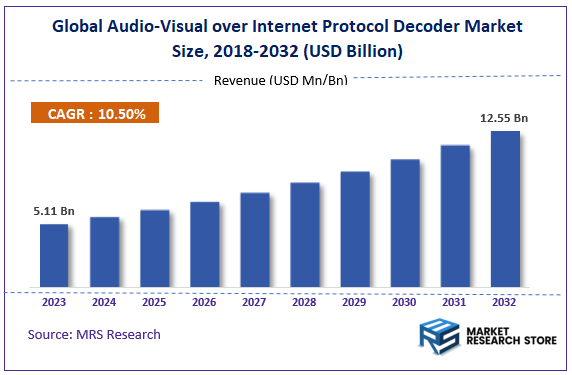
According to Market Research Store, the global audio-visual over internet protocol decoder market size was valued at around USD 5.11 billion in 2023 and is estimated to reach USD 12.55 billion by 2032, to register a CAGR of approximately 10.50% in terms of revenue during the forecast period 2024-2032.
To Get more Insights, Request a Free Sample
The audio-visual over internet protocol decoder report provides a comprehensive analysis of the market, including its size, share, growth trends, revenue details, and other crucial information regarding the target market. It also covers the drivers, restraints, opportunities, and challenges till 2032.
Global Audio-Visual over Internet Protocol Decoder Market: Overview
Audio-Visual Over Internet Protocol (AVoIP) decoders are devices that facilitate the transmission and reception of audio and video signals over IP networks. These decoders are essential for converting digital data streams into usable audio and video formats for display or playback. AVoIP technology supports high-quality audio and video distribution, making it an ideal choice for various applications, including broadcasting, live events, corporate communications, and educational settings.
Key Highlights
- The audio-visual over internet protocol decoder market is anticipated to grow at a CAGR of 10.50% during the forecast period.
- The global audio-visual over internet protocol decoder market was estimated to be worth approximately USD 5.11 billion in 2023 and is projected to reach a value of USD 12.55 billion by 2032.
- The growth of the audio-visual over internet protocol decoder market is being driven by the increasing demand for high-definition content delivery, the growth of streaming services, and the transition to IP-based broadcasting methods.
- Based on the type, the uncompressed decoders segment is growing at a high rate and is projected to dominate the market.
- On the basis of application, the corporate segment is projected to swipe the largest market share.
- By region, North America is expected to dominate the global market during the forecast period.
Audio-Visual over Internet Protocol Decoder Market: Dynamics
Key Growth Drivers
- Increasing demand for high-quality video content: The proliferation of streaming services, online gaming, and video conferencing has driven a surge in demand for high-resolution, low-latency video content.
- Advancements in internet infrastructure: The expansion of broadband networks and the development of 5G technology have enabled the transmission of large amounts of data over the internet, facilitating the use of AV over IP decoders.
- Cost-effectiveness compared to traditional AV systems: AV over IP decoders offer a more cost-effective solution than traditional AV systems, as they eliminate the need for costly cabling and distribution infrastructure.
Restraints
- Complexity of network management: Implementing and managing AV over IP systems can be complex, requiring specialized skills and knowledge.
- Interoperability concerns: Ensuring compatibility between different AV over IP devices and systems can be challenging.
- Security risks: AV over IP systems are vulnerable to cyberattacks, which can compromise the security and integrity of transmitted data.
Opportunities
- Integration with IoT and smart home technologies: AV over IP decoders can be integrated with IoT devices and smart home systems to create personalized and immersive experiences.
- Expansion into new markets: The AV over IP market is still relatively new, presenting opportunities for growth in emerging markets and industries.
- Development of innovative applications: AV over IP technology can be used to develop innovative applications in fields such as education, healthcare, and entertainment.
Challenges
- Competition from established AV technologies: AV over IP faces competition from traditional AV technologies, such as HDMI and VGA, which are widely used and well-established.
- Technical limitations: AV over IP technology may have technical limitations, such as latency or compression artifacts, that can affect the quality of the user experience.
- Regulatory and compliance issues: Adherence to regulatory and compliance standards can be a challenge for AV over IP manufacturers and users.
Audio-Visual over Internet Protocol Decoder Market: Segmentation Insights
The global audio-visual over internet protocol decoder market is divided by type, application, and region.
Segmentation Insights by Type
Based on type, the global audio-visual over internet protocol decoder market is divided into uncompressed, HD, and others.
Uncompressed decoders are anticipated to be the most dominating segment within the audio-visual over IP decoder market. These decoders transmit high-quality audio and video signals without compression, resulting in superior fidelity and performance. They are widely used in professional broadcasting environments, high-end video conferencing, and live event productions where maintaining the integrity of the audio-visual content is critical. The increasing demand for high-resolution content and the growth of professional broadcasting networks are driving the adoption of uncompressed decoders. Their ability to support various formats, coupled with low latency, makes them ideal for applications that require real-time processing of audio-visual data.
HD decoders are another significant segment in the audio-visual over IP decoder market, characterized by their ability to support high-definition video and audio content. These decoders typically compress audio-visual data to facilitate efficient transmission while preserving acceptable quality levels. The growing popularity of HD content, driven by streaming services, consumer demand for high-quality home entertainment systems, and advancements in display technologies, is propelling the HD decoder market forward. With applications in residential setups, educational institutions, and corporate environments, HD decoders provide an effective solution for delivering quality audio-visual experiences without requiring excessive bandwidth.
Segmentation Insights by Application
On the basis of application, the global audio-visual over internet protocol decoder market is bifurcated into corporate, education, government, hospitality, and others.
The corporate segment is the most dominant in the audio-visual over IP decoder market. This growth is driven by the rising adoption of video conferencing solutions, virtual meetings, and presentations that require high-quality audio and video transmission. Companies are increasingly integrating audio-visual technologies into their communication strategies to enhance collaboration and productivity. Decoders in this segment facilitate seamless content delivery during meetings, training sessions, and corporate events. The demand for sophisticated audio-visual setups in office environments is expected to propel the growth of corporate applications significantly, with businesses seeking solutions that provide reliable performance and flexibility.
The education segment represents a significant share of the audio-visual over IP decoder market, driven by the increasing use of technology in classrooms and online learning environments. Educational institutions are investing in audio-visual systems to enhance the learning experience through interactive lessons, remote learning, and hybrid teaching methods. Decoders are essential for delivering high-quality video lectures, presentations, and educational content across various platforms. The rise of e-learning and the need for effective distance education solutions, especially post-pandemic, are fueling the growth of this segment as schools and universities look for reliable audio-visual tools to engage students effectively.
The government segment is growing steadily, with audio-visual over IP decoders being used in various applications such as public announcements, conferences, and training sessions. Government agencies are increasingly adopting audio-visual technologies to improve communication with citizens and enhance transparency in operations. Decoders facilitate the distribution of information in real-time, supporting various functions such as town hall meetings, public broadcasts, and official presentations. The focus on modernization and efficient communication strategies within government agencies is expected to contribute to the growth of this segment.
The hospitality sector is witnessing a rising demand for audio-visual solutions as hotels and event venues strive to offer enhanced guest experiences. Audio-visual over IP decoders are integral to providing high-quality entertainment, information dissemination, and support for events such as conferences, weddings, and corporate meetings. The ability to deliver reliable and high-definition audio-visual content is crucial in attracting and retaining customers in a competitive market. As the hospitality industry continues to focus on improving guest services and hosting events, the demand for advanced audio-visual technologies, including decoders, is anticipated to grow.
Audio-Visual over Internet Protocol Decoder Market: Report Scope
| Report Attributes | Report Details |
|---|---|
| Report Name | Audio-Visual over Internet Protocol Decoder Market |
| USD 5.11 Billion | |
| USD 12.55 Billion | |
| Growth Rate | CAGR of 10.50% |
| Number of Pages | 218 |
| Key Companies Covered | Atlona, Kramer, PureLink, WyreStorm, ZeeVee, Extron, Key Digital, AMX, Netgear, Nexgio, PeakConference, Matrox, Midwich, and others. |
| Segments Covered | By Type, By Application, and By Region |
| Regions Covered | North America, Europe, Asia Pacific (APAC), Latin America, Middle East, and Africa (MEA) |
| Base Year | 2023 |
| Historical Year | 2018 to 2022 |
| Forecast Year | 2024 - 2032 |
| Customization Scope | Avail customized purchase options to meet your exact research needs. Request For Customization |
Audio-Visual over Internet Protocol Decoder Market: Regional Insights
- North America is expected to dominates the global market
North America leads the audio-visual over IP decoder market, driven by its advanced technological infrastructure and high demand for streaming services. The region is home to major market players and sees significant investments in the entertainment and media sector. With a strong focus on digital transformation and the delivery of high-definition content, North America remains at the forefront of this industry.
Europe ranks as the second-largest market for audio-visual over IP decoders, bolstered by the proliferation of IPTV services and growing demand for high-quality broadcasting solutions. Key players in the region are enhancing content delivery networks (CDNs) to improve streaming quality. Regulatory policies promoting digital media and continuous innovations in broadcast technology further support market growth in Europe.
The Asia-Pacific region is experiencing rapid growth in the audio-visual over IP decoder market, driven by a rising number of internet users and advancements in the telecommunications sector. Countries such as China, India, and Japan are investing heavily in digital infrastructure, which fosters the adoption of IP-based services. Increased disposable incomes and the shift towards over-the-top (OTT) platforms are also significant factors contributing to the region's expansion.
Latin America presents a developing market for audio-visual over IP decoders, with a growing number of broadband users and the emergence of digital streaming services. Although still evolving compared to North America and Europe, the region is witnessing rising adoption of mobile devices and greater internet penetration. Local service providers are enhancing their offerings to compete with established global players, paving the way for future growth.
The Middle East and Africa region is in the early stages of the audio-visual over IP decoder market, with several countries beginning to invest in digital technologies. Growth is primarily driven by improving internet connectivity and government initiatives to promote digital media and entertainment. However, regulatory hurdles and limited infrastructure in certain areas pose challenges. Investments in smart cities and digital infrastructure are gradually gaining traction, suggesting potential for future development.
Audio-Visual over Internet Protocol Decoder Market: Competitive Landscape
The report provides an in-depth analysis of companies operating in the audio-visual over internet protocol decoder market, including their geographic presence, business strategies, product offerings, market share, and recent developments. This analysis helps to understand market competition.
Some of the major players in the global audio-visual over internet protocol decoder market include:
- Atlona
- Kramer
- PureLink
- WyreStorm
- ZeeVee
- Extron
- Key Digital
- AMX
- Netgear
- Nexgio
- PeakConference
- Matrox
- Midwich
The global audio-visual over internet protocol decoder market is segmented as follows:
By Type
- Uncompressed
- HD
- Others
By Application
- Corporate
- Education
- Government
- Hospitality
- Others
By Region
- North America
- U.S.
- Canada
- Europe
- U.K.
- France
- Germany
- Rest of Europe
- Asia Pacific
- China
- Japan
- India
- South Korea
- Rest of Asia Pacific
- Latin America
- Brazil
- Rest of Latin America
- The Middle East and Africa
- GCC Countries
- South Africa
- Rest of Middle East Africa
Frequently Asked Questions
Based on statistics from the Market Research Store, the global audio-visual over internet protocol decoder market size was projected at approximately US$ 5.11 billion in 2023. Projections indicate that the market is expected to reach around US$ 12.55 billion in revenue by 2032.
The global audio-visual over internet protocol decoder market is expected to grow at a Compound Annual Growth Rate (CAGR) of around 10.50% during the forecast period from 2024 to 2032.
North America is expected to dominate the global audio-visual over internet protocol decoder market.
The global audio-visual over Internet Protocol (AVoIP) decoder market is driven by the increasing demand for high-definition content delivery, the growth of streaming services, and the transition to IP-based broadcasting methods.
Some of the prominent players operating in the global audio-visual over internet protocol decoder market are; Atlona, Kramer, PureLink, WyreStorm, ZeeVee, Extron, Key Digital, AMX, Netgear, Nexgio, PeakConference, Matrox, Midwich, and others.
Table Of Content
Inquiry For Buying
Audio-Visual over Internet Protocol Decoder
Request Sample
Audio-Visual over Internet Protocol Decoder
