CRISPR Genome Editing Market Size, Share, and Trends Analysis Report
CAGR :

| Market Size 2023 (Base Year) | USD 3.35 Billion |
| Market Size 2032 (Forecast Year) | USD 25.75 Billion |
| CAGR | 25.43% |
| Forecast Period | 2024 - 2032 |
| Historical Period | 2018 - 2023 |
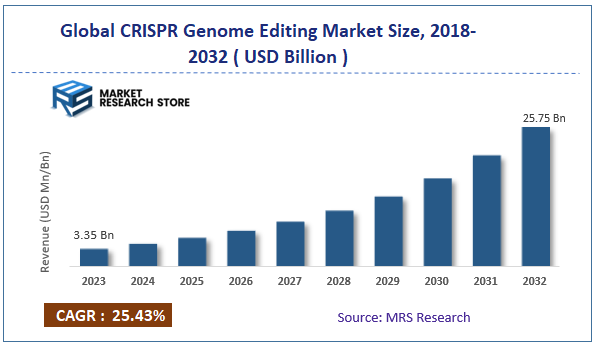
According to Market Research Store, the global CRISPR genome editing market size was valued at around USD 3.35 billion in 2023 and is estimated to reach USD 25.75 billion by 2032, to register a CAGR of approximately 25.43% in terms of revenue during the forecast period 2024-2032.
To Get more Insights, Request a Free Sample
The CRISPR genome editing report provides a comprehensive analysis of the market, including its size, share, growth trends, revenue details, and other crucial information regarding the target market. It also covers the drivers, restraints, opportunities, and challenges till 2032.
Global CRISPR Genome Editing Market: Overview
The CRISPR Genome Editing Market revolves around the development and application of CRISPR (Clustered Regularly Interspaced Short Palindromic Repeats) technology for precise genome editing across various fields, including healthcare, agriculture, and biotechnology. CRISPR offers a powerful and relatively simple tool for modifying specific DNA sequences, allowing researchers and companies to conduct gene editing more accurately, efficiently, and at lower costs than traditional methods.
This technology is essential for advancements in genetic engineering, drug development, gene therapy, and agricultural biotechnology, enabling applications such as the treatment of genetic disorders, the development of genetically modified crops, and the study of complex diseases.
The market growth is fueled by significant investments in genetic research, an increase in the prevalence of genetic disorders, and a rising focus on personalized medicine. The healthcare sector remains a primary driver, as CRISPR technology enables the development of therapies targeting previously untreatable conditions, such as sickle cell anemia, cystic fibrosis, and certain cancers.
Furthermore, the agricultural sector is using CRISPR to create crop varieties with improved yield, disease resistance, and climate resilience, which is crucial in light of global food security challenges. Rising R&D initiatives, partnerships between biotechnology companies and research institutions, and government funding also contribute to the robust growth of this market.
Key Highlights
- The CRISPR genome editing market is anticipated to grow at a CAGR of 25.43% during the forecast period.
- The global CRISPR genome editing market was estimated to be worth approximately USD 3.35 billion in 2023 and is projected to reach a value of USD 25.75 billion by 2032.
- The growth of the CRISPR genome editing market is being driven by the advancements in genomic research are making CRISPR technology more precise and efficient, allowing for more accurate genetic modifications.
- Based on the product, the genetic engineering segment is growing at a high rate and is projected to dominate the market.
- On the basis of application, the pharmaceutical companies segment is projected to swipe the largest market share.
- By region, North America is expected to dominate the global market during the forecast period.
CRISPR Genome Editing Market: Dynamics
Key Growth Drivers
- Advancements in Technology: Continuous advancements in CRISPR technology, such as improved precision and efficiency, are driving market growth.
- Therapeutic Applications: CRISPR-based therapies hold immense potential for treating genetic diseases, including inherited disorders and cancer.
- Agricultural Applications: CRISPR technology can be used to develop genetically modified crops with improved yield, resistance to pests and diseases, and enhanced nutritional value.
- Research and Development: The increasing investment in research and development activities related to CRISPR technology is fueling market growth.
Restraints
- Ethical Concerns: Ethical considerations surrounding the use of gene editing technology, particularly in human applications, can pose challenges and regulatory hurdles.
- Technical Challenges: Delivering CRISPR-based therapies to target cells efficiently and safely remains a significant challenge.
- Regulatory Hurdles: The regulatory approval process for CRISPR-based therapies is complex and time-consuming.
- Public Perception: Negative public perception and concerns about the potential risks of gene editing can hinder market adoption.
Opportunities
- Therapeutic Applications: The development of CRISPR-based therapies for a wide range of diseases, including genetic disorders, cancer, and infectious diseases, offers significant market potential.
- Agricultural Applications: CRISPR technology can be used to develop crop varieties with improved traits, such as drought resistance, pest resistance, and nutritional value.
- Industrial Biotechnology: CRISPR can be used to engineer microorganisms for the production of biofuels, chemicals, and other valuable products.
- Research Tools: CRISPR-based tools can be used for fundamental research in biology and medicine, driving scientific discovery.
Challenges
- Off-Target Effects: The risk of off-target effects, where the CRISPR system edits unintended genes, is a major concern.
- Intellectual Property Issues: Patent disputes and intellectual property rights can complicate the commercialization of CRISPR-based technologies.
- Public Perception and Ethical Considerations: Addressing public concerns and ensuring ethical use of CRISPR technology is essential for long-term market growth.
- Regulatory Landscape: Navigating the complex regulatory landscape for gene editing technologies can be challenging.
CRISPR Genome Editing Market: Segmentation Insights
The global CRISPR genome editing market is divided by product, application, and region.
Segmentation Insights by Product
Based on Product, the global CRISPR genome editing market is divided into genetic engineering, gene library, human stem cells, and others.
The Genetic Engineering segment is the largest and most dominant in the CRISPR Genome Editing Market. Its comprehensive applications across healthcare, agriculture, and biotechnology make it the foundation of CRISPR-based advancements. Genetic Engineering holds a prominent share of the CRISPR genome editing market due to its broad application in diverse fields and its critical role in drug discovery and development.
The Gene Library segment has gained traction in recent years, especially within research institutions and biotech companies focused on drug discovery. Its ability to facilitate large-scale gene function studies makes it a valuable resource in understanding complex diseases and biological pathways. Gene Libraries refer to collections of genes or gene variants that researchers use for high-throughput screening and functional genomics studies.
The Human Stem Cells segment holds a significant position within the market, driven by increasing research in regenerative medicine and disease modeling. The use of CRISPR to modify human stem cells is instrumental in developing therapies for degenerative diseases and injuries.
Human Stem Cells in CRISPR research involve using stem cell lines for genetic modifications to study development, disease models, and regenerative medicine applications.
Segmentation Insights by Application
On the basis of Application, the global CRISPR genome editing market is bifurcated into pharmaceutical companies, biotechnology companies, and others.
The Pharmaceutical Companies segment is the largest and most dominant in the CRISPR Genome Editing Market. Its prominence is driven by the critical role CRISPR plays in accelerating drug discovery, development, and personalized medicine.
This segment benefits significantly from rising investment in gene therapy and the growing potential of CRISPR in developing treatments for complex diseases. Pharmaceutical Companies focus on CRISPR applications in drug discovery, development, and gene therapy.
Biotechnology Companies hold a substantial share of the CRISPR genome editing market, as they drive CRISPR applications in agriculture, industrial biotechnology, and bioengineering. The segment benefits from continuous investment and partnerships aimed at advancing genome editing technologies.
Biotechnology Companies use CRISPR genome editing for diverse applications such as genetic modification, agriculture, and synthetic biology.
CRISPR Genome Editing Market: Report Scope
| Report Attributes | Report Details |
|---|---|
| Report Name | CRISPR Genome Editing Market |
| Market Size in 2023 | USD 3.35 Billion |
| USD 25.75 Billion | |
| Growth Rate | CAGR of 25.43% |
| Number of Pages | 216 |
| Key Companies Covered | Caribou Biosciences, Cellectis, CRISPR Therapeutics, Editas Medicine, Genscript, Horizon Discovery, Integrated DNA Technologies, Intellia Therapeutics, Lonza Group, New England Biolabs, Origene Technologies, Precision Biosciences, Sangamo Biosciences, Sigma-Aldrich, Thermo Fisher Scientific, Transposagen Biopharmaceuticals, and others. |
| Segments Covered | By Product, By Application, and By Region |
| Regions Covered | North America, Europe, Asia Pacific (APAC), Latin America, Middle East, and Africa (MEA) |
| Base Year | 2023 |
| Historical Year | 2018 to 2022 |
| Forecast Year | 2024 - 2032 |
| Customization Scope | Avail customized purchase options to meet your exact research needs. Request For Customization |
CRISPR Genome Editing Market: Regional Insights
- North America currently leads the global CRISPR genome editing market
North America, especially the United States, is the leading market for CRISPR genome editing, driven by strong investment in biotechnology and a well-established healthcare infrastructure. The U.S. government and private sector are actively funding CRISPR research for therapeutic applications, including oncology, rare diseases, and genetic disorders. The region's advanced R&D capabilities, coupled with robust regulatory frameworks and academic partnerships, support its dominance in the global CRISPR market.
Europe is a key market, with countries such as Germany, the UK, and France at the forefront of CRISPR research. The region's well-established pharmaceutical sector and strong academic institutions contribute to its leadership in this market. Europe has a robust regulatory environment that supports CRISPR research and commercialization, particularly for therapeutic and agricultural applications. The region's increasing focus on genetic research for chronic diseases, along with ethical guidelines, is expected to drive growth.
Asia-Pacific is anticipated to experience the fastest growth in the CRISPR genome editing market. The region has a rapidly growing biotechnology sector, especially in countries like China, Japan, and South Korea, where governments are supporting CRISPR research and applications in healthcare and agriculture. China, in particular, is emerging as a leader in CRISPR research, driven by strong government support and high investment in genomic science. The region’s focus on food security and innovation in agricultural biotechnology further accelerates the adoption of CRISPR in this sector.
Latin America is an emerging market for CRISPR, especially in Brazil and Argentina, which are focusing on agricultural biotechnology applications. The region is seeing increased investment in gene editing technologies for crop improvement, driven by the need to enhance food production and tackle challenges posed by climate change. Although regulatory frameworks are still evolving, the potential of CRISPR for crop breeding and pest resistance is gaining attention in this region.
The Middle East & Africa region has a smaller CRISPR genome editing market, but growing interest in agricultural applications. Countries such as Israel and the UAE are investing in biotechnology to address food security and agricultural sustainability. With a focus on healthcare infrastructure improvement, there is a growing awareness and interest in gene editing technologies for potential medical applications.
CRISPR Genome Editing Market: Competitive Landscape
The report provides an in-depth analysis of companies operating in the CRISPR genome editing market, including their geographic presence, business strategies, product offerings, market share, and recent developments. This analysis helps to understand market competition.
Some of the major players in the global CRISPR genome editing market include:
- Caribou Biosciences
- Cellectis
- CRISPR Therapeutics
- Editas Medicine
- Genscript
- Horizon Discovery
- Integrated DNA Technologies
- Intellia Therapeutics
- Lonza Group
- New England Biolabs
- Origene Technologies
- Precision Biosciences
- Sangamo Biosciences
- Sigma-Aldrich
- Thermo Fisher Scientific
- Transposagen Biopharmaceuticals
The global CRISPR genome editing market is segmented as follows:
By Product
- Genetic Engineering
- Gene Library
- Human Stem Cells
- Others
By Application
- Pharmaceutical Companies
- Biotechnology Companies
- Others
By Region
- North America
- U.S.
- Canada
- Europe
- U.K.
- France
- Germany
- Rest of Europe
- Asia Pacific
- China
- Japan
- India
- South Korea
- Rest of Asia Pacific
- Latin America
- Brazil
- Rest of Latin America
- The Middle East and Africa
- GCC Countries
- South Africa
- Rest of Middle East Africa
Frequently Asked Questions
Based on statistics from the Market Research Store, the global CRISPR genome editing market size was projected at approximately US$ 3.35 billion in 2023. Projections indicate that the market is expected to reach around US$ 25.75 billion in revenue by 2032.
The global CRISPR genome editing market is expected to grow at a Compound Annual Growth Rate (CAGR) of around 25.43% during the forecast period from 2024 to 2032.
North America is expected to dominate the global CRISPR genome editing market.
The increasing prevalence of genetic disorders and chronic diseases has created a demand for innovative therapeutic solutions are key factors of CRISPR genome editing market growth.
Some of the prominent players operating in the global CRISPR genome editing market are; Caribou Biosciences, Cellectis, CRISPR Therapeutics, Editas Medicine, Genscript, Horizon Discovery, Integrated DNA Technologies, Intellia Therapeutics, Lonza Group, New England Biolabs, Origene Technologies, Precision Biosciences, Sangamo Biosciences, Sigma-Aldrich, Thermo Fisher Scientific, Transposagen Biopharmaceuticals, and others.
Table Of Content
Inquiry For Buying
CRISPR Genome Editing
Request Sample
CRISPR Genome Editing
