Disposable Mask Without Valve Market Size, Share, and Trends Analysis Report
CAGR :

| Market Size 2023 (Base Year) | USD 2.91 Billion |
| Market Size 2032 (Forecast Year) | USD 4.84 Billion |
| CAGR | 5.8% |
| Forecast Period | 2024 - 2032 |
| Historical Period | 2018 - 2023 |
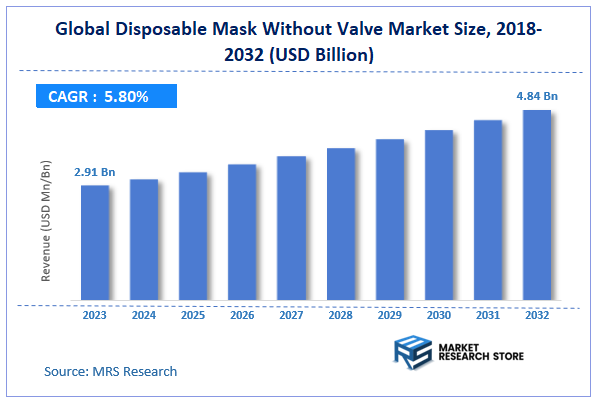
According to Market Research Store, the global disposable mask without valve market size was valued at around USD 2.91 billion in 2023 and is estimated to reach USD 4.84 billion by 2032, to register a CAGR of approximately 5.8% in terms of revenue during the forecast period 2024-2032.
To Get more Insights, Request a Free Sample
The disposable mask without valve report provides a comprehensive analysis of the market, including its size, share, growth trends, revenue details, and other crucial information regarding the target market. It also covers the drivers, restraints, opportunities, and challenges till 2032.
Global Disposable Mask Without Valve Market: Overview
A disposable mask without a valve is a single-use facial covering designed to filter out airborne particles, dust, and pathogens without an exhaust valve for easier breathing.
Unlike masks with valves, these masks prevent the release of unfiltered air when exhaling, making them more effective at protecting both the wearer and others from potential contamination. They are commonly used in healthcare, industrial settings, and daily life for hygiene and respiratory protection.
Key Highlights
- The disposable mask without valve market is anticipated to grow at a CAGR of 5.8% during the forecast period.
- The global disposable mask without valve market was estimated to be worth approximately USD 2.91 billion in 2023 and is projected to reach a value of USD 4.84 billion by 2032.
- The growth of the disposable mask without valve market is being driven by heightened awareness of personal health and hygiene, particularly after the COVID-19 pandemic.
- Based on the type, the surgical masks segment is growing at a high rate and is projected to dominate the market.
- On the basis of application, the medical industry segment is projected to swipe the largest market share.
- By region, Asia-Pacific is expected to dominate the global market during the forecast period.
Disposable Mask Without Valve Market: Dynamics
Key Growth Drivers
- Increasing Awareness of Respiratory Health: Rising awareness about respiratory diseases and air pollution has driven demand for masks to protect against airborne particles and pathogens.
- Post-Pandemic Hygiene Practices: The COVID-19 pandemic has significantly increased the adoption of face masks as a preventive measure, leading to sustained demand.
- Growing Healthcare Sector: The expansion of healthcare facilities and the increasing number of healthcare workers require reliable personal protective equipment, including masks.
Restraints
- Environmental Concerns: The disposal of large quantities of disposable masks contributes to environmental pollution and waste management challenges.
- Comfort Issues: Prolonged use of masks can lead to discomfort, particularly in hot and humid conditions.
- Economic Downturns: Economic downturns may reduce consumer purchasing power, impacting demand for non-essential items like disposable masks.
Opportunities
- Innovation in Mask Design: Advancements in materials and filtration technologies can lead to more comfortable, efficient, and eco-friendly masks.
- Emerging Markets: Expanding markets in developing countries offer significant growth potential as awareness of respiratory health and hygiene practices increases.
- Integration with Technology: Smart masks with features like air quality monitoring and filtration efficiency indicators can attract tech-savvy consumers.
Challenges
- Supply Chain Disruptions: Global supply chain disruptions can impact the availability of raw materials and the production of masks.
- Counterfeit Products: The prevalence of counterfeit masks compromises quality and effectiveness, posing risks to consumer health.
- Regulatory Hurdles: Stricter regulations regarding mask standards and production processes can increase costs and complexity for manufacturers.
Disposable Mask Without Valve Market: Segmentation Insights
The global disposable mask without valve market is divided by type, application, and region.
Segmentation Insights by Type
Based on type, the global disposable mask without valve market is divided into conventional masks, activated charcoal mask, and surgical masks.
Surgical masks dominate the disposable mask without valve market due to their widespread usage in the healthcare sector. These masks are designed to provide a high level of protection against airborne particles, preventing the spread of infectious agents during surgical procedures or medical care. They are a staple in hospitals, clinics, and other healthcare settings, primarily driven by regulatory mandates and hygiene standards. Their usage has expanded beyond medical facilities into everyday scenarios, particularly during public health emergencies, further solidifying their market dominance.
Conventional masks hold the second position in the market, favored for their affordability and general-purpose application. These masks are typically made from simple non-woven fabrics, offering basic filtration against dust, pollen, and other non-toxic particles. Their usage is prominent in sectors like construction, manufacturing, and public areas where high filtration is not mandatory but protection from environmental contaminants is required. Their lightweight design and cost-effectiveness make them accessible to a broad consumer base.
Activated charcoal masks constitute a niche but growing segment in the market, primarily used in environments requiring enhanced filtration. These masks are infused with activated charcoal, which helps in absorbing odors, gases, and harmful chemicals. They are especially popular among individuals in urban settings dealing with high pollution levels and professionals in industries handling chemicals or hazardous materials. While their adoption is increasing, the segment’s growth is limited by their higher cost compared to conventional and surgical masks.
Segmentation Insights by Application
On the basis of application, the global disposable mask without valve market is bifurcated into medical industry, family expenses, construction, food industry, agriculture industry, industrial, and other.
The medical industry dominates the disposable mask without valve market due to its high reliance on masks for infection control and patient care. Masks are a critical component in hospitals, clinics, and diagnostic labs to protect healthcare workers and patients from cross-contamination. Their mandatory use in surgeries, medical procedures, and during health crises such as pandemics significantly drives demand in this segment, making it the largest contributor to the market.
The family expenses segment holds a significant share of the market, driven by the growing awareness of personal hygiene and health protection among consumers. Families increasingly use disposable masks for daily activities, especially in urban and polluted areas, or during outbreaks of contagious diseases. The affordability and convenience of disposable masks make them a preferred choice for everyday use, particularly for children and elderly members who require additional care.
The construction industry is a prominent application segment, where disposable masks are essential for protecting workers from dust, debris, and particulate matter. Regulatory standards for workplace safety have further boosted the adoption of masks in this sector. Lightweight and cost-effective masks are commonly used by laborers, with an emphasis on durability and filtration efficiency to ensure worker safety in harsh environments.
In the food industry, disposable masks are crucial for maintaining hygiene standards and preventing contamination during food preparation, packaging, and handling. Restaurants, food processing units, and catering services rely on masks to ensure food safety and comply with health regulations. The rising focus on quality assurance and consumer safety in the food sector continues to support the demand for disposable masks.
The agriculture industry utilizes disposable masks primarily for protection against dust, pollen, pesticides, and other airborne particles. Farmers and agricultural workers often wear masks to minimize exposure to these elements, especially during planting, harvesting, or pesticide application. The growing awareness of occupational health and safety in the agricultural sector has led to increased adoption of disposable masks.
The industrial segment encompasses a broad range of applications where disposable masks are used for respiratory protection. Industries such as manufacturing, chemical processing, and mining require masks to safeguard workers from exposure to harmful particles, fumes, and gases. Compliance with workplace safety norms and a focus on employee health drive the demand for high-quality masks in this sector.
Disposable Mask Without Valve Market: Report Scope
| Report Attributes | Report Details |
|---|---|
| Report Name | Disposable Mask Without Valve Market |
| Market Size in 2023 | USD 2.91 Billion |
| USD 4.84 Billion | |
| Growth Rate | CAGR of 5.8% |
| Number of Pages | 221 |
| Key Companies Covered | 3M, Gerson, Honeywell, Kimberly-Clark, Moldex, Filter Service, BioClean, UVEX, Drager Safety, Fido Masks, SHIGEMATSU WORKS, and others. |
| Segments Covered | By Type, By Application, and By Region |
| Regions Covered | North America, Europe, Asia Pacific (APAC), Latin America, Middle East, and Africa (MEA) |
| Base Year | 2023 |
| Historical Year | 2018 to 2022 |
| Forecast Year | 2024 - 2032 |
| Customization Scope | Avail customized purchase options to meet your exact research needs. Request For Customization |
Disposable Mask Without Valve Market: Regional Insights
- Asia-Pacific is expected to dominates the global market
Asia-Pacific leads the disposable mask without valve market, driven by its large population and heightened awareness of health and hygiene. Countries like China, India, and Japan are major contributors due to extensive industrialization, urban pollution, and governmental initiatives promoting mask usage. The region's manufacturing capabilities ensure a steady supply of affordable masks, supporting widespread adoption across various sectors, including healthcare and personal use.
North America ranks second in the market, with the U.S. being the largest contributor. The high emphasis on occupational safety, especially in healthcare and manufacturing industries, boosts demand for disposable masks. Additionally, frequent outbreaks of seasonal flu and respiratory conditions create a consistent need for masks among the general population. Advanced healthcare infrastructure and strong regulatory standards also drive market growth.
Europe is another significant market, driven by stringent workplace safety regulations and a growing focus on environmental health. Countries like Germany, France, and the UK exhibit high adoption rates, particularly in the healthcare and industrial sectors. Additionally, awareness campaigns during health crises and concerns over air quality in urban areas contribute to steady demand.
South America has moderate market penetration, led by countries such as Brazil and Argentina. The demand is primarily driven by health initiatives, industrial applications, and the growing awareness of respiratory safety. However, economic constraints in certain regions can limit market expansion, leading to slower adoption rates compared to more developed regions.
The Middle East & Africa represent the smallest market share, attributed to economic challenges and limited healthcare access in several areas. However, urbanization and industrial growth in nations like the UAE and South Africa are slowly boosting demand. Additionally, government programs aimed at improving public health standards are fostering incremental market growth in this region.
Disposable Mask Without Valve Market: Competitive Landscape
The report provides an in-depth analysis of companies operating in the disposable mask without valve market, including their geographic presence, business strategies, product offerings, market share, and recent developments. This analysis helps to understand market competition.
Some of the major players in the global disposable mask without valve market include:
- 3M
- Gerson
- Honeywell
- Kimberly-Clark
- Moldex
- Filter Service
- BioClean
- UVEX
- Drager Safety
- Fido Masks
- SHIGEMATSU WORKS
The global disposable mask without valve market is segmented as follows:
By Type
- Conventional Masks
- Activated Charcoal Mask
- Surgical Masks
By Application
- Medical Industry
- Family Expenses
- Construction
- Food Industry
- Agriculture Industry
- Industrial
- Other
By Region
- North America
- U.S.
- Canada
- Europe
- U.K.
- France
- Germany
- Rest of Europe
- Asia Pacific
- China
- Japan
- India
- South Korea
- Rest of Asia Pacific
- Latin America
- Brazil
- Rest of Latin America
- The Middle East and Africa
- GCC Countries
- South Africa
- Rest of Middle East Africa
Frequently Asked Questions
Based on statistics from the Market Research Store, the global disposable mask without valve market size was projected at approximately US$ 2.91 billion in 2023. Projections indicate that the market is expected to reach around US$ 4.84 billion in revenue by 2032.
The global disposable mask without valve market is expected to grow at a Compound Annual Growth Rate (CAGR) of around 5.8% during the forecast period from 2024 to 2032.
Asia-Pacific is expected to dominate the global disposable mask without valve market.
The global disposable mask without valve market is driven by increasing health awareness, stringent safety regulations across industries, and rising demand for protective equipment in healthcare and public settings. Technological advancements in materials for comfort and filtration efficiency also contribute significantly to market growth.
Some of the prominent players operating in the global disposable mask without valve market are; 3M, Gerson, Honeywell, Kimberly-Clark, Moldex, Filter Service, BioClean, UVEX, Drager Safety, Fido Masks, SHIGEMATSU WORKS, and others.
Table Of Content
Inquiry For Buying
Disposable Mask Without Valve
Request Sample
Disposable Mask Without Valve
