Ferric Chloride as Oxidizing Agent Market Size, Share, and Trends Analysis Report
CAGR :

| Market Size 2023 (Base Year) | USD 226.42 Million |
| Market Size 2032 (Forecast Year) | USD 330.16 Million |
| CAGR | 4.28% |
| Forecast Period | 2024 - 2032 |
| Historical Period | 2018 - 2023 |
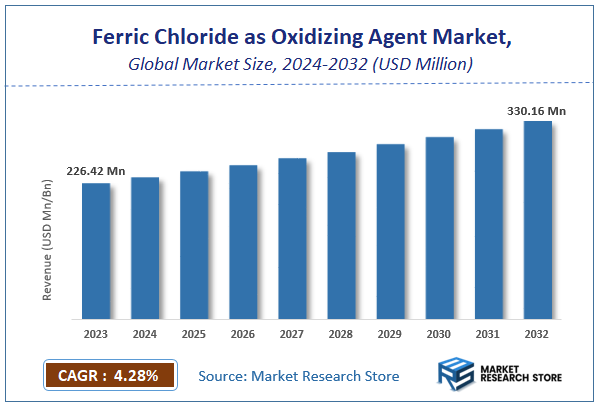
According to Market Research Store, the global ferric chloride as oxidizing agent market size was valued at around USD 226.42 million in 2023 and is estimated to reach USD 330.16 million by 2032, to register a CAGR of approximately 4.28%in terms of revenue during the forecast period 2024-2032.
The ferric chloride as oxidizing agent report provides a comprehensive analysis of the market, including its size, share, growth trends, revenue details, and other crucial information regarding the target market. It also covers the drivers, restraints, opportunities, and challenges till 2032.
To Get more Insights, Request a Free Sample
Global Ferric Chloride as Oxidizing Agent Market: Overview
Ferric chloride (FeCl₃) is a widely used inorganic compound that serves as a strong oxidizing agent in various chemical processes. It is commonly employed in industrial applications for its ability to accept electrons and facilitate oxidation reactions. In these reactions, ferric chloride typically converts from Fe³⁺ to Fe²⁺ while oxidizing other substances. It is particularly useful in water treatment, where it helps remove contaminants by promoting the oxidation of organic impurities and inorganic ions.
Additionally, ferric chloride is essential in etching processes in the electronics industry, acting as a reagent in the preparation of circuit boards. Its oxidizing properties also make it valuable in chemical synthesis, where it assists in reactions requiring electron transfer, such as in the production of pharmaceuticals, dyes, and other specialty chemicals.
Key Highlights
- The ferric chloride as oxidizing agent market is anticipated to grow at a CAGR of 4.28%during the forecast period.
- The global ferric chloride as oxidizing agent market was estimated to be worth approximately USD 226.42 million in 2023 and is projected to reach a value of USD 330.16 million by 2032.
- The growth of the ferric chloride as oxidizing agent market is being driven by its broad applicability in industries like water treatment, electronics, chemical synthesis, and pharmaceuticals.
- Based on the type, the liquid ferric chloride segment is growing at a high rate and is projected to dominate the market.
- On the basis of application, the etching agent segment is projected to swipe the largest market share.
- By region, North America is expected to dominate the global market during the forecast period.
Ferric Chloride as Oxidizing Agent Market: Dynamics
Key Growth Drivers:
- Water Treatment: Ferric chloride is widely used as a coagulant and flocculant in water and wastewater treatment, effectively removing impurities and contaminants.
- Industrial Applications: It finds applications in various industries, including electronics (PCB etching), metal processing (etching and pickling), and textile dyeing.
- Increasing Environmental Regulations: Stricter environmental regulations are driving the demand for efficient and eco-friendly water treatment solutions.
Restraints:
- Volatility in Raw Material Prices: Fluctuations in the prices of raw materials, such as iron and chlorine, can impact production costs and profitability.
- Stringent Safety Regulations: Handling and transporting ferric chloride requires adherence to strict safety regulations, which can increase operational costs.
Opportunities:
- Emerging Markets: Growing industrialization and urbanization in developing countries offer significant growth opportunities.
- Technological Advancements: Innovations in water treatment technologies and process optimization can enhance the efficiency and effectiveness of ferric chloride-based solutions.
- Expanding Applications: Exploring new applications, such as in the pharmaceutical and agricultural industries, can open up new market avenues.
Challenges:
- Competition from Alternative Technologies: Competition from other coagulants and flocculants, such as aluminum sulfate, can pose a challenge.
- Supply Chain Disruptions: Global supply chain disruptions, such as those caused by geopolitical tensions or natural disasters, can impact the availability and cost of raw materials.
- Environmental Concerns: Proper handling and disposal of ferric chloride waste are essential to minimize environmental impact.
Ferric Chloride as Oxidizing Agent Market: Report Scope
| Report Attributes | Report Details |
|---|---|
| Report Name | Ferric Chloride as Oxidizing Agent Market |
| Market Size in 2023 | USD 226.42 Million |
| Market Forecast in 2032 | USD 330.16 Million |
| Growth Rate | CAGR of 4.28% |
| Number of Pages | 140 |
| Key Companies Covered | Kemira, Tessenderlo Group, BorsodChem(Wanhua), Feracid, SIDRA Wasserchemie, Basic Chemical Industries, Chemifloc, Saf Sulphur Company, BASF, AguaChem Ltd, Al-Kout, Swedish Jordanian Chemicals |
| Segments Covered | By Product Type, By Application, and By Region |
| Regions Covered | North America, Europe, Asia Pacific (APAC), Latin America, Middle East, and Africa (MEA) |
| Base Year | 2023 |
| Historical Year | 2018 to 2023 |
| Forecast Year | 2024 to 2032 |
| Customization Scope | Avail customized purchase options to meet your exact research needs. Request For Customization |
Ferric Chloride as Oxidizing Agent Market: Segmentation Insights
The global ferric chloride as oxidizing agent market is divided by type, application, and region.
Segmentation Insights by Type
Based on type, the global ferric chloride as oxidizing agent market is divided into liquid ferric chloride and solid ferric chloride.
In the ferric chloride as an oxidizing agent market, the liquid ferric chloride segment is the most dominating. Liquid ferric chloride is widely preferred due to its ease of use and versatility in various applications such as water treatment, chemical synthesis, and electronics manufacturing. Its liquid form allows for better handling and precise dosing, which is crucial in processes that require controlled reactions.
Additionally, liquid ferric chloride is easier to transport and integrate into industrial systems, making it highly favored in large-scale operations. The high demand for liquid ferric chloride in municipal water treatment, where it is used as a coagulant, contributes to its dominance in the market.
The solid ferric chloride segment, while still significant, is less dominant compared to its liquid counterpart. Solid ferric chloride is typically used in applications that require long-term storage or where a more concentrated form of the compound is needed. It is commonly used in industrial processes such as ore refining and metal surface treatment, but it has limitations in terms of ease of handling and precise application compared to the liquid form. Solid ferric chloride is also more difficult to dissolve, which can add complexity to certain processes. However, it remains a valuable option in specific industries that require solid formulations for their chemical reactions.
Segmentation Insights by Application
On the basis of application, the global ferric chloride as oxidizing agent market is bifurcated into catalyst and etching agent.
In the ferric chloride as an oxidizing agent market, the etching agent application segment is the most dominant. Ferric chloride is widely used in the electronics industry, particularly in the production of printed circuit boards (PCBs), where it serves as an etching agent to remove unwanted copper from the surface of the PCB. Its effectiveness in dissolving copper and its cost efficiency make it the preferred choice for this application. The high demand for printed circuit boards across industries such as consumer electronics, automotive, and telecommunications contributes to the substantial growth of the etching agent segment, driving its dominance in the market.
The catalyst application segment, while important, is less dominant than the etching agent segment. Ferric chloride is used as a catalyst in various chemical processes, such as in the synthesis of petrochemicals, the production of fine chemicals, and in certain organic reactions like Friedel-Crafts acylation and alkylation. It accelerates reactions by facilitating the formation of reactive intermediates.
However, its use as a catalyst is more specialized and less widespread compared to its role in etching, which is a common and high-volume application. Despite this, the catalyst segment is crucial in industries such as chemicals and petrochemicals, where ferric chloride aids in reaction efficiency and product quality.
Ferric Chloride as Oxidizing Agent Market: Regional Insights
- North America is expected to dominates the global market
North America is the largest market for ferric chloride as an oxidizing agent, primarily driven by its extensive industrial applications. The U.S. and Canada lead in demand, especially due to high consumption in wastewater treatment and manufacturing processes. The presence of major chemical and industrial companies in this region significantly boosts market growth, making it the most dominant region globally.
Europe follows closely, with strong demand in countries like Germany, the UK, and France. Europe's market is largely influenced by the industrial and water treatment sectors, alongside stringent environmental regulations that drive the need for advanced oxidizing agents. The region also benefits from the high adoption of ferric chloride in metal surface treatment and electronics.
Asia Pacific is a rapidly growing market for ferric chloride, with China, India, and Japan showing increasing demand. The region's fast-growing industrial sectors, including textiles, chemicals, and electronics, contribute heavily to the market's growth. The need for wastewater treatment and etching applications also fuels demand, positioning APAC as a key player with robust expansion potential.
Latin America sees moderate growth, with countries like Brazil and Mexico leading the market. The region's demand for ferric chloride is influenced by the agricultural, chemical, and water treatment industries, although the market is still relatively small compared to North America and Europe.
Middle East and Africa (MEA) has the smallest market share, but it is expected to grow steadily. The demand in this region is mainly driven by industrial applications in countries with developing manufacturing sectors. However, the region faces challenges such as limited local production and a reliance on imports, which slightly hampers growth.
Ferric Chloride as Oxidizing Agent Market: Competitive Landscape
The report provides an in-depth analysis of companies operating in the ferric chloride as oxidizing agent market, including their geographic presence, business strategies, product offerings, market share, and recent developments. This analysis helps to understand market competition.
Some of the major players in the global ferric chloride as oxidizing agent market include:
- Kemira
- Tessenderlo Group
- BorsodChem(Wanhua)
- Feracid
- SIDRA Wasserchemie
- Basic Chemical Industries
- Chemifloc
- Saf Sulphur Company
- BASF
- AguaChem Ltd
- Al-Kout
- Swedish Jordanian Chemicals
The global ferric chloride as oxidizing agent market is segmented as follows:
By Type
- Liquid Ferric Chloride
- Solid Ferric Chloride
By Application
- Catalyst
- Etching Agent
- Others
By Region
- North America
- U.S.
- Canada
- Europe
- U.K.
- France
- Germany
- Rest of Europe
- Asia Pacific
- China
- Japan
- India
- South Korea
- Rest of Asia Pacific
- Latin America
- Brazil
- Rest of Latin America
- The Middle East and Africa
- GCC Countries
- South Africa
- Rest of Middle East Africa
Frequently Asked Questions
Based on statistics from the Market Research Store, the global ferric chloride as oxidizing agent market size was projected at approximately US$ 226.42 million in 2023. Projections indicate that the market is expected to reach around US$ 330.16 million in revenue by 2032.
The global ferric chloride as oxidizing agent market is expected to grow at a Compound Annual Growth Rate (CAGR) of around 4.28%during the forecast period from 2024 to 2032.
North America is expected to dominate the global ferric chloride as oxidizing agent market.
The global ferric chloride as an oxidizing agent market is primarily driven by its widespread use in water treatment, electronics manufacturing, and metal etching applications. Additionally, growing industrialization and stringent environmental regulations boosting the demand for effective chemical agents are significant factors supporting market growth.
Some of the prominent players operating in the global ferric chloride as oxidizing agent market are; Kemira, Tessenderlo Group, BorsodChem(Wanhua), Feracid, SIDRA Wasserchemie, Basic Chemical Industries, Chemifloc, Saf Sulphur Company, BASF, AguaChem Ltd, Al-Kout, Swedish Jordanian Chemicals, and others.
The global ferric chloride as oxidizing agent market report provides a comprehensive analysis of market definitions, growth factors, opportunities, challenges, geographic trends, and competitive dynamics.
Table Of Content
Inquiry For Buying
Ferric Chloride as Oxidizing Agent
Request Sample
Ferric Chloride as Oxidizing Agent
