Location-Based Services in Healthcare Market Size, Share, and Trends Analysis Report
CAGR :

| Market Size 2023 (Base Year) | USD 2.40 Billion |
| Market Size 2032 (Forecast Year) | USD 10.15 Billion |
| CAGR | 17.4% |
| Forecast Period | 2024 - 2032 |
| Historical Period | 2018 - 2023 |
Location-based Services in Healthcare Market Insights
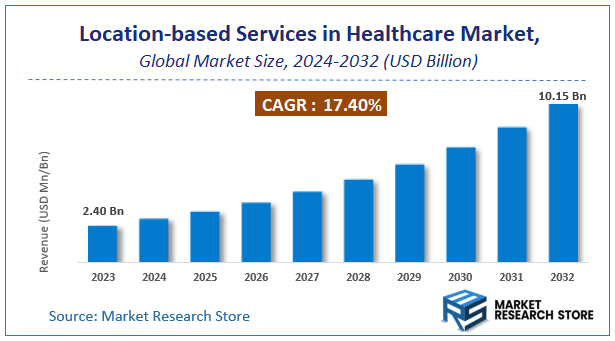
According to Market Research Store, the global location-based services in healthcare market size was valued at around USD 2.40 billion in 2023 and is estimated to reach USD 10.15 billion by 2032, to register a CAGR of approximately 17.4% in terms of revenue during the forecast period 2024-2032.
The location-based services in healthcare report provides a comprehensive analysis of the market, including its size, share, growth trends, revenue details, and other crucial information regarding the target market. It also covers the drivers, restraints, opportunities, and challenges till 2032.
To Get more Insights, Request a Free Sample
Global Location-Based Services in Healthcare Market: Overview
Location-based services (LBS) in healthcare refer to technologies that use real-time location data to provide various services that improve the delivery of care, patient experience, and operational efficiency in healthcare settings. LBS utilize GPS, RFID, Wi-Fi, and Bluetooth technologies to track patients, staff, and medical equipment, enabling healthcare providers to deliver better patient care, optimize hospital operations, and enhance workflow management. This can include patient tracking, real-time alerts, asset management, and geofencing for restricted areas. It also helps healthcare professionals navigate complex healthcare facilities and deliver personalized care. LBS play a significant role in reducing response times during emergencies, enhancing hospital management, and ensuring safety in healthcare environments.
Key Highlights
- The location-based services in healthcare market is anticipated to grow at a CAGR of 17.4% during the forecast period.
- The global location-based services in healthcare market was estimated to be worth approximately USD 2.40 billion in 2023 and is projected to reach a value of USD 10.15 billion by 2032.
- The growth of the location-based services in healthcare market is being driven by the increasing adoption of smartphones, the growing demand for patient-centric care, and advancements in IoT (Internet of Things) technologies.
- Based on the type, the indoor LBS segment is growing at a high rate and is projected to dominate the market.
- In terms of technology, the RTLS segment is expected to dominate the market.
- On the basis of application, the hospital segment is projected to swipe the largest market share.
- By region, North America is expected to dominate the global market during the forecast period.
Location-Based Services in Healthcare Market: Dynamics
Key Growth Drivers:
- Enhanced Patient Care: LBS enable real-time tracking of patients, improving emergency response times, and facilitating remote patient monitoring.
- Improved Healthcare Access: Connecting patients with nearby healthcare providers, pharmacies, and support services, especially in underserved areas.
- Personalized Healthcare: Tailoring healthcare services based on location and individual needs, such as recommending nearby specialists or providing location-specific health alerts.
- Efficient Resource Allocation: Optimizing resource utilization by tracking healthcare personnel, equipment, and inventory, leading to cost savings and improved efficiency.
- Public Health Initiatives: Supporting disease surveillance, outbreak monitoring, and targeted public health campaigns through location-based data analysis.
Restraints:
- Data Privacy and Security Concerns: Protecting sensitive patient data while leveraging location information is crucial to building trust and ensuring compliance with regulations.
- Integration Challenges: Seamless integration of LBS with existing healthcare IT systems can be complex and time-consuming.
- Limited Interoperability: Lack of standardized data formats and protocols can hinder data sharing and collaboration across different healthcare providers and systems.
- Unequal Access to Technology: Disparities in access to smartphones and reliable internet connectivity can limit the reach and effectiveness of LBS in certain populations.
Opportunities:
- Telehealth Expansion: LBS can enhance telehealth services by enabling virtual consultations, remote patient monitoring, and home healthcare delivery.
- Preventive Care Initiatives: Promoting healthy lifestyles through location-based reminders, personalized health recommendations, and access to local fitness resources.
- Disaster Response and Preparedness: Improving emergency response capabilities by leveraging real-time location data to track casualties, coordinate relief efforts, and identify vulnerable populations.
- New Business Models: Creating innovative business models that leverage LBS to deliver personalized healthcare services, such as location-based subscription services or on-demand healthcare delivery.
Challenges:
- Regulatory Hurdles: Navigating complex regulatory landscapes related to data privacy, healthcare IT, and telemedicine can be challenging for healthcare providers and technology companies.
- Technical Limitations: Ensuring accurate and reliable location data, especially in indoor environments, remains a technical challenge.
- User Adoption: Encouraging widespread adoption of LBS among healthcare providers and patients requires effective education, training, and support.
- Maintaining Data Quality: Ensuring the accuracy, completeness, and consistency of location-based data is crucial for effective decision-making and service delivery.
Location-based Services in Healthcare Market: Report Scope
| Report Attributes | Report Details |
|---|---|
| Report Name | Location-based Services in Healthcare Market |
| Market Size in 2023 | USD 2.40 Billion |
| Market Forecast in 2032 | USD 10.15 Billion |
| Growth Rate | CAGR of 17.4% |
| Number of Pages | 140 |
| Key Companies Covered | AiRISTA Flow Inc., Cardinal Health Inc., Cisco Systems Inc., Emanate Wireless, Esri Global Inc., General Electric Co., Halma Plc, Hewlett Packard Enterprise Co. |
| Segments Covered | By Product Type, By Application, and By Region |
| Regions Covered | North America, Europe, Asia Pacific (APAC), Latin America, Middle East, and Africa (MEA) |
| Base Year | 2023 |
| Historical Year | 2018 to 2023 |
| Forecast Year | 2024 to 2032 |
| Customization Scope | Avail customized purchase options to meet your exact research needs. Request For Customization |
Location-Based Services in Healthcare Market: Segmentation Insights
The global location-based services in healthcare market is divided by type, technology, application, and region.
Segmentation Insights by Type
Based on type, the global location-based services in healthcare market is divided into outdoor LBS and indoor LBS.
In the location-based services (LBS) in healthcare market, Indoor LBS is the most dominant segment. Indoor LBS involves the use of technologies like Bluetooth, Wi-Fi, RFID, and other indoor positioning systems to provide location tracking and navigation services within healthcare facilities. This includes applications such as tracking medical equipment, monitoring patient movements, improving staff efficiency, and managing hospital assets. The ability to offer real-time positioning inside large, complex environments like hospitals and clinics has made indoor LBS a crucial part of healthcare operations, contributing significantly to its growth and dominance.
The Outdoor LBS segment follows as the second most dominant. Outdoor LBS is used for geolocation services in outdoor settings, often relying on GPS technology. In healthcare, this can be applied to track ambulances, monitor the locations of healthcare workers, and assist in the management of field-based services like home care. Outdoor LBS provides location data in real-time, enabling healthcare providers to optimize operations, enhance emergency response times, and improve logistics. While its applications are valuable, especially in rural or large geographical areas, it is not as widely integrated within healthcare facilities as indoor LBS, which gives the latter a competitive edge in the market.
Segmentation Insights by Technology
On the basis of technology, the global location-based services in healthcare market is bifurcated into RTLS And GPS or AGPS.
In the location-based services (LBS) in healthcare market, RTLS (Real-Time Location Systems) is the most dominant technology. RTLS utilizes a network of tags, sensors, and communication infrastructure to track the real-time location of objects or individuals within a healthcare facility. It is extensively used in hospitals and clinics for tracking assets, patients, staff, and equipment. RTLS enhances operational efficiency by reducing equipment loss, improving patient flow, and enabling real-time asset management. The widespread adoption of RTLS, due to its ability to offer precise indoor tracking, makes it the dominant technology in healthcare facilities.
GPS (Global Positioning System) or AGPS (Assisted GPS) comes in second place. GPS is primarily used for outdoor location tracking, leveraging satellite signals to provide geographic coordinates for various healthcare applications, such as tracking ambulances, mobile healthcare units, or staff working in remote locations. AGPS improves GPS performance, especially in areas with limited satellite visibility, by using cellular networks for location accuracy. While GPS/AGPS is important in healthcare for managing logistics and emergency response, its indoor accuracy limitations and reliance on external signals make it less dominant compared to RTLS, which excels in providing precise tracking within healthcare environments.
Segmentation Insights by Application
On the basis of application, the global location-based services in healthcare market is bifurcated into hospital, nursing home, and others.
In the location-based services (LBS) in healthcare market, the Hospital segment is the most dominant application. Hospitals have a high demand for location-based services due to their large, complex environments and the need for efficient management of both medical assets and patient flow. Hospitals utilize LBS technologies like RTLS to track patients, staff, and equipment in real-time, improving operational efficiency, reducing equipment loss, and enhancing patient care. The critical nature of hospital operations, the large scale of healthcare facilities, and the need for precise location data make hospitals the largest and most dominant application segment in the market.
The Nursing Home segment follows as the second most dominant. Nursing homes are increasingly adopting location-based services to enhance patient safety, manage staff efficiency, and monitor patients with mobility issues. LBS technologies, particularly RTLS, help track residents’ movements, alert staff in case of emergencies, and improve caregiving efficiency. Although nursing homes are typically smaller in scale compared to hospitals, the demand for location-based services in these settings is growing due to the aging population and the need for more personalized care.
Location-Based Services in Healthcare Market: Regional Insights
- North America is expected to dominates the global market
The North American region leads the global market for location-based services in healthcare, driven by advanced technological infrastructure and a high adoption rate of digital health solutions. The United States, in particular, has seen significant integration of location-based technologies in healthcare settings, enhancing patient monitoring, asset tracking, and resource management. This trend is supported by substantial investments in healthcare IT and a favorable regulatory environment that encourages innovation.
Europe follows closely, with countries like the United Kingdom, Germany, and France actively implementing location-based services to improve healthcare delivery. The European market benefits from strong healthcare systems and a growing emphasis on digital health initiatives. Integration of location-based technologies has been instrumental in streamlining hospital operations and enhancing patient care across the continent.
The Asia-Pacific region is experiencing rapid growth in the adoption of location-based services within healthcare. Nations such as China, Japan, and India are increasingly incorporating these technologies to address challenges like aging populations and the need for efficient healthcare management. The region's expanding healthcare infrastructure and rising demand for innovative health solutions contribute to the growing market presence.
In the Middle East and Africa, the market for location-based healthcare services is emerging, with countries like the United Arab Emirates and South Africa leading the way. While adoption rates are currently lower compared to other regions, there is a noticeable shift towards integrating digital health solutions to enhance healthcare services. Government initiatives and investments in healthcare infrastructure are expected to drive future growth in this area.
Latin America is at the nascent stage of adopting location-based services in healthcare. Brazil and Mexico are exploring the potential of these technologies to improve healthcare delivery, but widespread implementation is still in the early phases. Challenges such as limited infrastructure and budget constraints are being addressed through pilot projects and international collaborations aimed at fostering growth in this sector.
Location-Based Services in Healthcare Market: Competitive Landscape
The report provides an in-depth analysis of companies operating in the location-based services in healthcare market, including their geographic presence, business strategies, product offerings, market share, and recent developments. This analysis helps to understand market competition.
Some of the major players in the global location-based services in healthcare market include:
- Airista
- General Electric
- Hpe
- Zih
- Awarepoint
- Axcess International
- Centrak
- Decawave
- Acceliot Inc.
- Cardinal Health Inc.
- Cisco Systems Inc.
- Emanate Wireless
- Esri Global Inc.
- Halma Plc
- Hewlett Packard Enterprise Co.
- Koch Industries Inc.
- Microsoft Corp.
- Midmark Corp.
- Navizon Ltd.
- Qorvo Inc.
- Radianse
- Securitas Healthcare LLC
- Siemens AG
- Sonitor Technologies AS
- Zebra Technologies Corp.
- Ziff Davis Inc.
The global location-based services in healthcare market is segmented as follows:
By Type
- Outdoor LBS
- Indoor LBS
By Technology
- RTLS
- GPS or AGPS
By Application
- Hospital
- Nursing Home
- Others
By Region
- North America
- U.S.
- Canada
- Europe
- U.K.
- France
- Germany
- Rest of Europe
- Asia Pacific
- China
- Japan
- India
- South Korea
- Rest of Asia Pacific
- Latin America
- Brazil
- Rest of Latin America
- The Middle East and Africa
- GCC Countries
- South Africa
- Rest of Middle East Africa
Frequently Asked Questions
Based on statistics from the Market Research Store, the global location-based services in healthcare market size was projected at approximately US$ 2.40 billion in 2023. Projections indicate that the market is expected to reach around US$ 10.15 billion in revenue by 2032.
The global location-based services in healthcare market is expected to grow at a Compound Annual Growth Rate (CAGR) of around 17.4% during the forecast period from 2024 to 2032.
North America is expected to dominate the global location-based services in healthcare market.
The significant factors driving the global location-based services in healthcare market include the increasing demand for efficient healthcare management, rising adoption of digital health solutions, advancements in GPS and IoT technologies, and the need for real-time patient monitoring and asset tracking in healthcare facilities.
Some of the prominent players operating in the global location-based services in healthcare market are; Airista, General Electric, Hpe, Zih, Awarepoint, Axcess International, Centrak, Decawave, Acceliot Inc., Cardinal Health Inc., Cisco Systems Inc., Emanate Wireless, Esri Global Inc., Halma Plc, Hewlett Packard Enterprise Co., Koch Industries Inc., Microsoft Corp., Midmark Corp., Navizon Ltd., Qorvo Inc., Radianse, Securitas Healthcare LLC, Siemens AG, Sonitor Technologies AS, Zebra Technologies Corp., Ziff Davis Inc., and others.
Table Of Content
Inquiry For Buying
Location-Based Services in Healthcare
Request Sample
Location-Based Services in Healthcare
