Repairs and Maintenance Service for Road and Market Size, Share, and Trends Analysis Report
CAGR :

| Market Size 2023 (Base Year) | USD 69.03 Billion |
| Market Size 2032 (Forecast Year) | USD 114.65 Billion |
| CAGR | 5.8% |
| Forecast Period | 2024 - 2032 |
| Historical Period | 2018 - 2023 |
Repairs and Maintenance Service for Road and Highway Market Insights
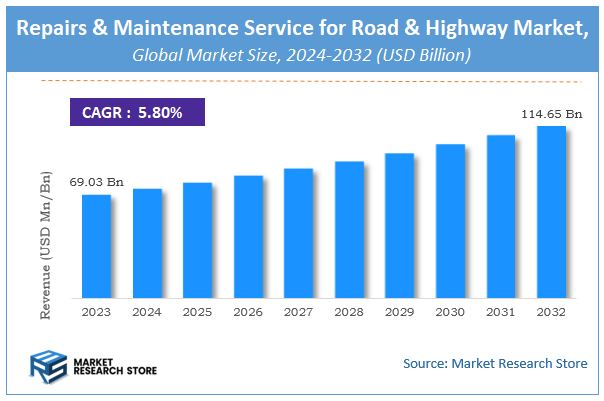
According to Market Research Store, the global repairs and maintenance service for road and highway market size was valued at around USD 69.03 billion in 2023 and is estimated to reach USD 114.65 billion by 2032, to register a CAGR of approximately 5.8% in terms of revenue during the forecast period 2024-2032.
The repairs and maintenance service for road and highway report provides a comprehensive analysis of the market, including its size, share, growth trends, revenue details, and other crucial information regarding the target market. It also covers the drivers, restraints, opportunities, and challenges till 2032.
To Get more Insights, Request a Free Sample
Global Repairs and Maintenance Service for Road and Highway Market: Overview
Repairs and maintenance services for roads and highways encompass a wide range of activities aimed at ensuring the safety, functionality, and longevity of transportation infrastructure. These services include routine maintenance such as pothole filling, crack sealing, surface treatments, repainting road markings, cleaning drainage systems, and vegetation control. Periodic and preventive maintenance involves resurfacing, upgrading road shoulders, and structural rehabilitation of pavements and bridges. Emergency repairs are also crucial to address damage from accidents, weather events, or natural disasters.
Key Highlights
- The repairs and maintenance service for road and highway market is anticipated to grow at a CAGR of 5.8% during the forecast period.
- The global repairs and maintenance service for road and highway market was estimated to be worth approximately USD 69.03 billion in 2023 and is projected to reach a value of USD 114.65 billion by 2032.
- The growth of the repairs and maintenance service for road and highway market is being driven by the increasing need to preserve aging infrastructure, enhance traffic safety, and support uninterrupted transportation networks in urban and rural areas alike.
- Based on the type, the pavement management segment is growing at a high rate and is projected to dominate the market.
- On the basis of application, the highway segment is projected to swipe the largest market share.
- In terms of technique, the preventative segment is expected to dominate the market.
- By region, Asia-Pacific is expected to dominate the global market during the forecast period.
Repairs and Maintenance Service for Road and Highway Market: Dynamics
Key Growth Drivers:
- Aging Road Infrastructure: Many countries, especially in developed regions, are facing the challenge of deteriorating road networks that require consistent maintenance and repair to ensure safety and functionality.
- Government Initiatives and Budget Allocations: Increased public spending and infrastructure development programs are fueling demand for road and highway maintenance services.
- Rising Urbanization and Traffic Loads: Growing populations and vehicle ownership are putting extra pressure on roads, accelerating wear and tear and prompting the need for regular maintenance.
- Focus on Road Safety and Quality: There is a growing emphasis on improving road safety standards, which directly boosts the demand for quality repairs and timely maintenance services.
- Technological Advancements in Maintenance Equipment: Innovations in road repair materials, machinery, and techniques are improving service efficiency and encouraging wider adoption of maintenance solutions.
Restraints:
- High Cost of Road Repairs and Maintenance: The overall expense involved in repairing and maintaining extensive road networks can strain public and private budgets, especially in low-income regions.
- Disruption to Traffic During Maintenance: Repair activities often lead to traffic delays and public inconvenience, which can result in resistance or delay in project execution.
- Limited Availability of Skilled Labor: A shortage of trained professionals and operators for advanced road maintenance equipment can hinder the timely completion of repair projects.
Opportunities:
- Smart Road Maintenance Solutions: Integration of technologies such as IoT, AI, and sensors enables predictive maintenance, reducing long-t
- erm costs and improving planning.
- Private Sector Involvement through PPP Models: Public-private partnerships (PPPs) are creating new investment opportunities and bringing efficiency into road maintenance and repair projects.
- Growing Demand in Emerging Economies: Developing countries are expanding their transportation infrastructure, opening up significant opportunities for repair and maintenance service providers.
- Sustainability and Green Materials: The shift toward eco-friendly and recyclable road repair materials is offering new niches and helping companies align with environmental standards.
Challenges:
- Weather-Related Disruptions: Extreme weather conditions such as heavy rainfall, snow, and heat can delay maintenance work and increase the complexity of repairs.
- Bureaucratic and Regulatory Hurdles: Delays in approvals, complex regulations, and inconsistent policies can stall maintenance projects and reduce market efficiency.
- Limited Funding in Underdeveloped Regions: Many rural or low-income areas struggle with inadequate funds, limiting the scope and frequency of road repair initiatives.
- Asset Management Complexity: Managing vast and geographically dispersed road networks with varied deterioration patterns poses challenges in prioritization and resource allocation.
Repairs and Maintenance Service for Road and Highway Market: Report Scope
This report thoroughly analyzes the Repairs and Maintenance Service for Road and Highway Market, exploring its historical trends, current state, and future projections. The market estimates presented result from a robust research methodology, incorporating primary research, secondary sources, and expert opinions. These estimates are influenced by the prevailing market dynamics as well as key economic, social, and political factors. Furthermore, the report considers the impact of regulations, government expenditures, and advancements in research and development on the market. Both positive and negative shifts are evaluated to ensure a comprehensive and accurate market outlook.
| Report Attributes | Report Details |
|---|---|
| Report Name | Repairs and Maintenance Service for Road and Highway Market |
| Market Size in 2023 | USD 69.03 Billion |
| Market Forecast in 2032 | USD 114.65 Billion |
| Growth Rate | CAGR of 5.8% |
| Number of Pages | 194 |
| Key Companies Covered | AECOM., Arcadis NV, Atkins, Balfour Beatty, CH2M Hill, Colas Group, Eiffage, Galfar Engineering & Contracting, HDR Inc., Kiewit Corporation, Raba Kistner Infrastructure, The Miller Group. |
| Segments Covered | By Type, By Application, By Technique, and By Region |
| Regions Covered | North America, Europe, Asia Pacific (APAC), Latin America, Middle East, and Africa (MEA) |
| Base Year | 2023 |
| Historical Year | 2018 to 2023 |
| Forecast Year | 2024 to 2032 |
| Customization Scope | Avail customized purchase options to meet your exact research needs. Request For Customization |
Repairs and Maintenance Service for Road and Highway Market: Segmentation Insights
The global repairs and maintenance service for road and highway market is divided by type, application, technique, and region.
Segmentation Insights by Type
Based on type, the global repairs and maintenance service for road and highway market is divided into pavement management, maintenance to road fixtures, seasonal maintenance, litter control, vegetation management, emergency repairs, and others.
In the repairs and maintenance service for road and highway market, the most dominant segment by type is Pavement Management. This segment includes activities such as resurfacing, sealing cracks, patching potholes, and applying protective layers to extend the life of roadways. Pavement management is essential due to its direct impact on traffic safety, vehicle performance, and road durability, making it the top priority for transportation agencies globally. With the continuous increase in vehicle load and aging infrastructure, consistent investment in pavement upkeep remains crucial, driving its dominance in the market.
Following closely is Maintenance to Road Fixtures, which covers the upkeep of essential roadside infrastructure such as signs, guardrails, lighting systems, and barriers. These elements are vital for ensuring driver safety and effective traffic management. Governments and municipalities often allocate substantial budgets to maintain these fixtures, especially in urban areas and along high-traffic routes.
Seasonal Maintenance ranks next, comprising services like snow and ice removal during winter, flood damage repair, and heat-related surface treatments. In regions with extreme seasonal changes, this type of maintenance is critical to keep roads safe and operational year-round. Although its demand is geographically and seasonally dependent, it accounts for a significant share in regions prone to such climatic variations.
Litter Control is another important segment, involving the regular removal of trash and debris from roadways and rest areas. While not directly affecting road integrity, it contributes to environmental quality and aesthetics, and reduces hazards caused by foreign objects on the road. Urban regions and areas with high pedestrian traffic typically see greater investments in this segment.
Next is Vegetation Management, which includes trimming overgrown shrubs, mowing grass, and removing trees that obstruct signs or pose hazards to drivers. Proper vegetation control ensures visibility and prevents accidents, especially in rural and suburban areas where roadside vegetation grows rapidly.
Emergency Repairs deal with unplanned, urgent maintenance needs caused by accidents, natural disasters, or sudden road failures like sinkholes and bridge collapses. Although less predictable and episodic, this segment plays a critical role in minimizing road closures and ensuring rapid restoration of infrastructure. Its reactive nature means it receives less routine investment compared to planned maintenance categories.
Segmentation Insights by Application
On the basis of application, the global repairs and maintenance service for road and highway market is bifurcated into highway, road and street, bridges, tunnels, service provider, public sector, and private sector.
In the repairs and maintenance service for road and highway market, the most dominant segment by application is the Highway segment. Highways form the backbone of national and regional transportation systems, handling high traffic volumes and heavy vehicle loads daily. Because of this, they require constant and large-scale maintenance to ensure safety, reduce congestion, and maintain economic productivity. Pavement repairs, signage upkeep, and emergency response measures are frequently prioritized on highways due to their strategic importance and extensive use.
Following highways is the Road and Street segment, which includes local roads, arterial routes, and urban streets. These are crucial for intra-city and short-distance travel. Although they do not experience the same volume and intensity of traffic as highways, their high frequency of use, especially in densely populated areas, drives consistent maintenance needs. Services such as pothole repairs, curb maintenance, signage replacement, and pedestrian safety features dominate this segment.
Bridges come next, playing a vital role in connecting transport networks over geographical obstacles like rivers, valleys, or other roads. Due to the structural complexity and safety concerns, bridge maintenance requires specialized inspection and repair techniques. Activities include structural reinforcements, corrosion control, and expansion joint replacements. While bridges are fewer in number compared to roads, the critical consequences of failure make their maintenance highly prioritized.
Tunnels follow, forming a smaller but highly specialized segment. Maintenance here focuses on lighting systems, ventilation, structural integrity, water drainage, and fire safety systems. Given the confined environments and potential for catastrophic incidents, tunnel maintenance involves advanced technology and stringent protocols, though it is less widespread geographically.
The Public Sector is also a significant application segment, encompassing municipal and state governments responsible for maintaining public infrastructure. This sector dominates in terms of funding and scale, with most road and highway maintenance contracts awarded to or managed by public authorities. Government budgets and infrastructure development plans heavily influence demand in this segment.
Service Providers, which include private contractors and companies offering outsourced maintenance services, form an integral application segment. They carry out work on behalf of the public or private sectors, especially for large-scale or specialized projects. Their role is expanding with increasing public-private partnerships (PPPs) and the outsourcing of maintenance tasks by municipal bodies to improve efficiency and reduce costs.
Finally, the Private Sector segment includes private developers and owners of toll roads, industrial park roads, or campus road networks. While smaller in scale compared to public sector projects, this segment is growing as private entities invest in quality infrastructure for operational efficiency and corporate social responsibility. However, their overall market share remains limited due to fewer privately managed roads.
Segmentation Insights by Technique
On the basis of application, the global repairs and maintenance service for road and highway market is bifurcated into preventative, reactive, and routine.
In the repairs and maintenance service for road and highway market, the most dominant segment by technique is Preventative Maintenance. This approach focuses on timely interventions to avoid the deterioration of infrastructure before major issues arise. Activities under this technique include sealing cracks, applying surface treatments, and performing minor adjustments that prolong the life of roads, highways, and related structures. Governments and agencies heavily invest in preventative maintenance because it is cost-effective in the long run and helps avoid expensive overhauls. It ensures roads remain safe and operational with minimal disruption to traffic flow, which is why this technique holds the largest market share.
Next in importance is Routine Maintenance, which involves regularly scheduled tasks such as cleaning drainage systems, clearing debris, repainting road markings, and inspecting road fixtures. Though often considered low-cost and repetitive, routine maintenance plays a critical role in maintaining daily usability and safety standards across the road network. It is essential in high-traffic areas where even small issues can quickly escalate if not consistently managed.
Reactive Maintenance, while crucial, holds a smaller share of the market compared to the other techniques. This method involves addressing issues after they have occurred—such as repairing potholes, fixing damaged guardrails, or conducting emergency interventions following accidents or natural disasters. Reactive maintenance is unpredictable and usually more costly due to the urgency and severity of the problems it addresses. Although every road network requires some level of reactive maintenance, most agencies aim to minimize it through robust preventative and routine strategies.
Repairs and Maintenance Service for Road and Highway Market: Regional Insights
- Asia-Pacific is expected to dominates the global market
Asia-Pacific is the most dominant region in the repairs and maintenance service for road and highway market. This dominance is largely attributed to the rapid pace of urbanization, industrial growth, and extensive government investments in infrastructure development across countries such as China, India, and Japan. China has one of the world’s largest expressway networks, and India continues to undertake expansive highway projects under national initiatives. The region is also actively incorporating modern construction technologies and intelligent maintenance systems to enhance efficiency and durability, which further solidifies its leading position in the global market.
Europe follows closely, supported by its advanced and mature infrastructure and a strong emphasis on safety, sustainability, and environmental responsibility. Countries like Germany, the UK, and France have implemented rigorous road maintenance protocols and smart infrastructure integration to ensure the longevity and performance of their networks. The presence of well-defined regulatory frameworks and public-private partnerships boosts the region’s ability to conduct timely and systematic repairs and upgrades.
North America also holds a substantial share in the market, driven primarily by the United States, which possesses an expansive yet aging network of highways requiring continuous upkeep. Federal and state-level initiatives focus heavily on modernization and the implementation of advanced traffic and pavement management systems. The growing adoption of predictive maintenance tools and smart sensors further strengthens the region’s efficiency in maintaining its transportation systems.
Latin America is witnessing steady development in road and highway maintenance, spurred by efforts to improve infrastructure for economic growth and regional trade. Countries like Brazil and Mexico are actively working to enhance their roadway systems, although progress is often hampered by funding limitations and disparities in infrastructure quality. However, ongoing reforms and increased focus on connectivity are helping boost the market's potential in this region.
Middle East and Africa represent emerging markets in this sector, with growth largely supported by urban expansion and infrastructure investment initiatives. In the Middle East, particularly in the Gulf countries, strategic projects aimed at economic diversification are driving demand for high-quality transportation networks. In Africa, several countries are investing in cross-border road development to enhance trade and mobility, although progress is often affected by limited financial and technical resources.
Repairs and Maintenance Service for Road and Highway Market: Competitive Landscape
The report provides an in-depth analysis of companies operating in the repairs and maintenance service for road and highway market, including their geographic presence, business strategies, product offerings, market share, and recent developments. This analysis helps to understand market competition.
Some of the major players in the global repairs and maintenance service for road and highway market include:
- AECOM
- Arcadis NV
- Atkins
- Balfour Beatty
- CH2M Hill
- Colas Group
- Eiffage
- Galfar Engineering & Contracting
- HDR Inc.
- Kiewit Corporation
- Raba Kistner Infrastructure
- The Miller Group
The global repairs and maintenance service for road and highway market is segmented as follows:
By Type
- Pavement Management
- Maintenance to Road Fixtures
- Seasonal Maintenance
- Litter Control
- Vegetation Management
- Emergency Repairs
- Others
By Application
- Highway
- Road and Street
- Bridges
- Tunnels
- Service Provider
- Public Sector
- Private Sector
By Technique
- Preventative
- Reactive
- Routine
By Region
- North America
- U.S.
- Canada
- Europe
- U.K.
- France
- Germany
- Rest of Europe
- Asia Pacific
- China
- Japan
- India
- South Korea
- Rest of Asia Pacific
- Latin America
- Brazil
- Rest of Latin America
- The Middle East and Africa
- GCC Countries
- South Africa
- Rest of Middle East Africa
Frequently Asked Questions
Table Of Content
Inquiry For Buying
Repairs and Maintenance Service for Road and Highway
Request Sample
Repairs and Maintenance Service for Road and Highway
