Unmanned Convenience Store Market Size, Share, and Trends Analysis Report
CAGR :

| Market Size 2023 (Base Year) | USD 215.36 Million |
| Market Size 2032 (Forecast Year) | USD 8097.17 Million |
| CAGR | 49.63% |
| Forecast Period | 2024 - 2032 |
| Historical Period | 2018 - 2023 |
Unmanned Convenience Store Market Insights
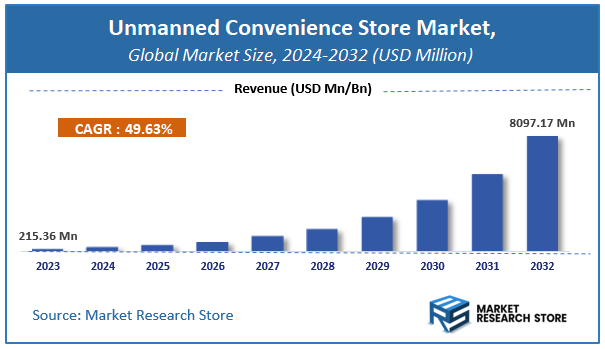
According to Market Research Store, the global unmanned convenience store market size was valued at around USD 215.36 million in 2023 and is estimated to reach USD 8097.17 million by 2032, to register a CAGR of approximately 49.63% in terms of revenue during the forecast period 2024-2032.
The unmanned convenience store report provides a comprehensive analysis of the market, including its size, share, growth trends, revenue details, and other crucial information regarding the target market. It also covers the drivers, restraints, opportunities, and challenges till 2032.
To Get more Insights, Request a Free Sample
Global Unmanned Convenience Store Market: Overview
Unmanned convenience store is a retail concept that operates without on-site staff, utilizing advanced technologies such as artificial intelligence, computer vision, Internet of Things (IoT), and mobile payment systems to provide a fully automated shopping experience. Customers typically gain entry by scanning a QR code via a mobile app, after which cameras, sensors, and shelf weight systems track the items they select. Purchases are automatically charged to their digital wallets or linked accounts upon exit, eliminating the need for traditional checkout counters or cashiers.
The growth of unmanned convenience stores is driven by increasing demand for contactless retail experiences, operational efficiency, and round-the-clock accessibility. These stores reduce labor costs, minimize human error, and optimize inventory management through real-time data collection and predictive analytics. Urbanization, rising smartphone penetration, and changing consumer preferences toward fast, frictionless shopping are also key factors boosting their adoption. Furthermore, advancements in facial recognition, automated restocking, and remote monitoring make unmanned stores scalable and secure. As retail continues to evolve in the digital age, unmanned convenience stores represent a transformative shift toward smart, autonomous retailing.
Key Highlights
- The unmanned convenience store market is anticipated to grow at a CAGR of 49.63% during the forecast period.
- The global unmanned convenience store market was estimated to be worth approximately USD 215.36 million in 2023 and is projected to reach a value of USD 8097.17 million by 2032.
- The growth of the unmanned convenience store market is being driven by a powerful combination of technological advancements, evolving consumer preferences, and operational benefits for retailers.
- Based on the technology, the automated checkout systems segment is growing at a high rate and is projected to dominate the market.
- On the basis of store size, the small-format stores segment is projected to swipe the largest market share.
- In terms of product offering, the food and beverages segment is expected to dominate the market.
- Based on the payment method, the credit and debit cards segment is expected to dominate the market.
- Based on the target audience, the millennials and gen Z segment is expected to dominate the market.
- By region, North America is expected to dominate the global market during the forecast period.
Unmanned Convenience Store Market: Dynamics
Key Growth Drivers:
- Rising Demand for Convenience and 24/7 Accessibility: Modern consumers, especially in urban areas, prioritize speed and convenience. Unmanned stores offer round-the-clock access to essential goods, catering to busy lifestyles and late-night shopping needs, making them highly attractive.
- Technological Advancements (AI, Computer Vision, IoT): The rapid evolution of AI, computer vision, and IoT sensors is the core enabler. These technologies accurately track customer movements, item selection, and automate payment, making the cashier-less experience seamless and reliable.
- Reduction in Labor Costs and Operational Efficiencies: A primary motivator for retailers is the significant reduction in labor costs associated with staffing traditional stores. Unmanned stores minimize staffing needs, allowing for cost savings that can improve profit margins and free up human resources for other tasks.
- Increasing Adoption of Contactless and Digital Payments: The global shift towards cashless transactions, mobile payments, and digital wallets perfectly aligns with the operational model of unmanned stores. Consumers are increasingly comfortable with these payment methods, accelerating adoption.
- Enhanced Inventory Management and Data Insights: Unmanned store technologies provide real-time data on inventory levels, popular products, peak shopping times, and customer behavior. This data empowers retailers to optimize stock, manage supply chains, and make data-driven decisions to enhance profitability and reduce waste.
- Response to Labor Shortages and High Minimum Wages: In many regions, retailers face challenges with labor shortages and rising minimum wage requirements. Unmanned stores offer a viable solution to these operational hurdles, ensuring consistent service even with limited human staff.
- Post-Pandemic Preference for Touchless Retail: The COVID-19 pandemic accelerated consumer preference for contactless shopping experiences, bolstering the appeal of unmanned stores that minimize human interaction during the purchasing process.
Restraints:
- High Initial Setup and Technology Integration Costs: Deploying an unmanned convenience store requires substantial upfront investment in advanced sensors, cameras, AI software, robust IT infrastructure, and complex integration with existing retail systems. This high initial cost can be a significant barrier for many retailers, especially SMEs.
- Public Skepticism and Trust Issues (Theft and Privacy): While technology aims to prevent theft, incidents of shoplifting or perceived ease of theft can create public skepticism. Additionally, the extensive use of cameras and sensors raises significant privacy concerns for consumers, potentially deterring adoption.
- Limited Product Variety and Freshness Challenges: Many existing unmanned stores focus on packaged goods and snacks due to the complexities of tracking fresh produce or items requiring variable weighing. Maintaining freshness and offering a wide variety, especially for perishables, remains a logistical and technological challenge.
- Lack of Human Interaction and Customer Service: Some consumers prefer the human element of traditional retail, including assistance from staff, personalized recommendations, or help with issues. The absence of staff can be a deterrent for customers who value social interaction or require assistance.
- Technical Glitches and System Failures: Despite advancements, the complex technology in unmanned stores is susceptible to technical malfunctions, software bugs, or network outages. Such glitches can disrupt operations, lead to customer frustration, and result in lost sales.
- Regulatory Hurdles and Ambiguity: The regulatory landscape for unmanned retail is still evolving in many parts of the world. Issues around data privacy, age verification for restricted products (e.g., alcohol, tobacco), and labor laws related to automation can create uncertainty and hinder expansion.
- Exclusion of Non-Tech-Savvy or Cash-Preferring Customers: Unmanned stores often rely heavily on smartphone apps and cashless payment methods. This can exclude demographics who are less tech-savvy or prefer cash transactions, limiting the potential customer base.
Opportunities:
- Hybrid Models and Semi-Automated Kiosks: Developing hybrid models where stores are unmanned during off-peak hours but staffed during peak times, or integrating semi-automated self-service kiosks, offers a balance between cost savings, customer service, and technology adoption, making them more palatable for a wider range of retailers.
- Expansion into Niche Locations: Unmanned stores can thrive in non-traditional retail locations with high foot traffic or specific convenience needs, such as office buildings, transportation hubs (airports, train stations), university campuses, hospitals, and residential complexes, offering highly localized and convenient access.
- Integration with Advanced AI for Personalized Experiences: Further leveraging AI to provide hyper-personalized shopping experiences, such as AI-driven recommendations based on past purchases, dynamic pricing, and even interactive digital signage that adapts to customer behavior, can significantly enhance customer satisfaction and sales.
- Sustainable Retail Practices: Unmanned stores can incorporate advanced energy management systems, optimize inventory to reduce waste, and promote sustainable product sourcing, aligning with growing consumer demand for eco-friendly retail and potentially creating a competitive advantage.
- Data Monetization and Business Intelligence: Beyond internal operational improvements, retailers can potentially monetize the anonymized and aggregated customer data collected by unmanned stores by providing valuable market insights to suppliers or for broader urban planning and consumer research.
- Enhanced Security Through AI and Biometrics: Continuous development of AI-powered surveillance systems, facial recognition for entry/exit (with proper privacy safeguards), and advanced anomaly detection can further reduce shrinkage and enhance security, making unmanned stores more viable and reliable.
- Partnerships with E-commerce Giants and Tech Providers: Collaborations between traditional retailers and e-commerce giants (like Amazon, Alibaba) or specialized tech providers can accelerate the adoption of unmanned retail technologies, leveraging their expertise, resources, and established customer bases.
Challenges:
- Ensuring Robust Security Against Theft and Vandalism: Despite advanced technology, preventing sophisticated theft attempts, dealing with vandalism, and ensuring the safety of unmanned premises, especially during unstaffed hours, remains a significant and continuous challenge requiring ongoing investment in security systems and rapid response protocols.
- Maintaining Technical Reliability and Uptime: The continuous operation of unmanned stores relies heavily on the uninterrupted performance of complex technological systems. Any downtime due to software bugs, hardware failures, or network issues can lead to significant customer frustration, lost sales, and damage to brand reputation.
- Addressing Data Privacy and Regulatory Compliance: Navigating the complex and evolving global landscape of data privacy laws (e.g., GDPR, CCPA, India's DPDP Act) for the extensive data collected by cameras and sensors in unmanned stores is a major legal and ethical challenge. Ensuring transparency and consumer consent is crucial.
- Managing Customer Support and Problem Resolution: Without on-site staff, providing immediate customer support for issues like technical difficulties (e.g., payment errors, entry problems), product inquiries, or disputes over charges becomes a critical challenge, requiring robust remote support systems.
- High Maintenance and Support Costs for Complex Systems: While labor costs are reduced, the specialized nature of the technology means higher maintenance costs, requiring trained technicians and potentially expensive spare parts or software updates, which can eat into cost savings.
- Consumer Acceptance and Behavioral Adaptation: A significant challenge is to encourage widespread consumer acceptance, particularly among demographics less comfortable with technology or those who miss human interaction. Educating consumers and making the technology intuitive are crucial for mass adoption.
- The "Amazon Go Effect" and Market Dominance: The dominance of early movers like Amazon Go sets a high standard for unmanned store technology and customer experience. Smaller players or new entrants face the challenge of competing with such established tech giants and their massive R&D budgets.
Unmanned Convenience Store Market: Report Scope
This report thoroughly analyzes the Unmanned Convenience Store Market, exploring its historical trends, current state, and future projections. The market estimates presented result from a robust research methodology, incorporating primary research, secondary sources, and expert opinions. These estimates are influenced by the prevailing market dynamics as well as key economic, social, and political factors. Furthermore, the report considers the impact of regulations, government expenditures, and advancements in research and development on the market. Both positive and negative shifts are evaluated to ensure a comprehensive and accurate market outlook.
| Report Attributes | Report Details |
|---|---|
| Report Name | Unmanned Convenience Store Market |
| Market Size in 2023 | USD 215.36 Million |
| Market Forecast in 2032 | USD 8097.17 Million |
| Growth Rate | CAGR of 49.63% |
| Number of Pages | 188 |
| Key Companies Covered | Amazon, EAT BOX, Rainbow, Bingobox, Sumao, F5 Future Store |
| Segments Covered | By Technology, By Store Size, By Product Offering, By Payment Method, By Target Audience, and By Region |
| Regions Covered | North America, Europe, Asia Pacific (APAC), Latin America, Middle East, and Africa (MEA) |
| Base Year | 2023 |
| Historical Year | 2018 to 2023 |
| Forecast Year | 2024 to 2032 |
| Customization Scope | Avail customized purchase options to meet your exact research needs. Request For Customization |
Unmanned Convenience Store Market: Segmentation Insights
The global unmanned convenience store market is divided by technology, store size, product offering, payment method, target audience, and region.
Segmentation Insights by Technology
Based on technology, the global unmanned convenience store market is divided into automated checkout systems, mobile payment solutions, artificial intelligence and machine learning integration, and internet of things (IOT) devices.
Automated Checkout Systems dominate the Unmanned Convenience Store Market as they form the technological backbone that enables a fully cashier-less shopping experience. These systems typically use sensor fusion, computer vision, and shelf-monitoring technologies to automatically detect products picked by customers and calculate the bill without requiring manual scanning. Their ability to reduce wait times, eliminate queues, and provide seamless entry-exit tracking drives widespread deployment across urban and high-traffic areas. Retailers adopt these systems to improve operational efficiency, reduce labor costs, and offer 24/7 availability, making them the most critical and widely implemented technology in unmanned store operations.
Mobile Payment Solutions play a central role in enabling frictionless transactions in unmanned retail environments. These systems integrate with mobile apps, QR codes, digital wallets, and NFC (Near Field Communication) technologies, allowing customers to pay instantly without interacting with staff or machines. They also support loyalty programs, digital receipts, and personalized offers, enhancing the overall user experience. As mobile adoption increases globally, particularly in Asia and North America, mobile payment integration has become a core element of unmanned store success, offering both convenience and security to tech-savvy consumers.
Artificial Intelligence and Machine Learning Integration is increasingly shaping the functionality and intelligence of unmanned convenience stores. AI and ML are used to optimize inventory management, analyze shopper behavior, improve product placement, and provide real-time recommendations. These technologies enable predictive restocking, theft detection, dynamic pricing, and personalized marketing. With the ability to process large volumes of data in real time, AI-powered systems help retailers adapt quickly to demand patterns, reduce waste, and enhance customer experience, making them essential for long-term scalability and operational excellence.
Internet Of Things (IoT) Devices support the infrastructure of unmanned convenience stores by enabling interconnectivity between shelves, refrigerators, lighting systems, security cameras, and entry gates. IoT devices gather and transmit data on product movement, temperature control, energy usage, and customer traffic patterns. These devices allow for real-time store monitoring and maintenance, contributing to both customer safety and efficient operations. The IoT ecosystem is foundational for enabling real-time responsiveness and automation in unmanned formats, particularly in stores with a broad range of perishable and high-turnover items.
Segmentation Insights by Store Size
On the basis of store size, the global unmanned convenience store market is bifurcated into small-format stores, medium-format stores, and large-format stores.
Small-Format Stores dominate the Unmanned Convenience Store Market due to their compact layout, low operational costs, and suitability for densely populated urban areas, transit hubs, campuses, and office complexes. These stores typically occupy limited space and are designed for high-turnover essentials like snacks, beverages, and everyday items. Their size allows for faster implementation of automation technologies such as sensor-based product tracking, AI-powered cameras, and mobile payment systems. With limited inventory and quick entry-exit experiences, small-format stores are ideal for convenience-driven consumers seeking speed, accessibility, and 24/7 availability. Their scalability, low footprint, and alignment with smart city infrastructure contribute to their leading position in the market.
Medium-Format Stores represent a growing segment, offering a broader product range than small formats while maintaining automation efficiency. These stores are often deployed in residential areas, suburban shopping complexes, or high-footfall public spaces and can stock groceries, hygiene products, and ready-to-eat meals. Medium-sized formats balance space optimization with operational automation, integrating advanced technologies like inventory-tracking IoT sensors, dynamic shelf displays, and smart refrigeration systems. They serve a wider demographic and can accommodate localized demand while maintaining a cashier-less model. This segment is witnessing rising interest from retailers looking to scale up from pilot models without the complexity of full-scale supermarkets.
Large-Format Stores are an emerging segment in the unmanned retail market, typically used for testing extended automation capabilities across diverse product categories. These stores are suited for hypermarkets, big-box retail environments, and future-ready flagship retail locations. Large-format unmanned stores require more complex AI, machine learning algorithms, and high-density sensor networks to manage varied product types, prevent shrinkage, and ensure accurate billing. Although fewer in number due to higher infrastructure costs and technology integration challenges, large-format stores showcase the market’s long-term potential for fully automated, multi-category retail operations. Their development is driven by advancements in smart shelving, robotics, and high-capacity data processing systems.
Segmentation Insights by Product Offering
On the basis of product offering, the global unmanned convenience store market is bifurcated into food and beverages, health and beauty products, household essentials, and electronics and gadgets.
Food and Beverages dominate the Unmanned Convenience Store Market as they represent the most frequently purchased and time-sensitive category, particularly suited for impulse buys and daily consumption. These products include ready-to-eat meals, snacks, bottled drinks, dairy, and packaged foods that cater to on-the-go consumers. With automated shelving, temperature-controlled smart fridges, and real-time stock monitoring, unmanned stores optimize storage and replenishment for perishable and high-turnover goods. This segment benefits from high purchase frequency, convenience-oriented packaging, and compatibility with AI-driven shelf tracking and automated checkout systems. Their universal appeal and daily demand make Food and Beverages the foundational revenue driver in nearly all unmanned retail formats.
Health and Beauty Products represent a steadily expanding segment, especially in urban locations where consumers seek fast access to personal care items such as hand sanitizers, face masks, skincare products, pain relievers, and hygiene essentials. These products have high value-to-size ratios and low perishability, making them ideal for compact unmanned store environments. CRM-enabled systems and AI-driven recommendations can be leveraged to promote personalized selections based on previous purchases or customer demographics. As convenience, hygiene, and self-care trends rise, especially post-pandemic, health and beauty offerings continue to gain prominence in unmanned retail setups.
Household Essentials are another critical category, comprising cleaning supplies, paper products, batteries, laundry detergent, and other everyday utility items. These goods appeal to both routine and emergency needs and align with the convenience-first promise of unmanned stores. Inventory tracking through RFID or smart sensors helps manage replenishment cycles efficiently, while predictive analytics enables dynamic stock planning based on usage patterns. Their inclusion supports the expansion of unmanned stores into residential neighborhoods and mixed-use developments, where quick access to household necessities adds value to daily life.
Electronics and Gadgets are a niche but high-margin segment within the unmanned store model. These offerings typically include mobile accessories, chargers, earbuds, USB devices, and small electronics that consumers often purchase on the go or in transit zones like airports and railway stations. Advanced security systems, AI-powered cameras, and smart lockers are used to monitor these items and prevent theft. Though less frequent in volume, this segment contributes to higher transaction values and serves a targeted demand for utility-driven electronic needs in tech-savvy urban markets.
Segmentation Insights by Payment Method
On the basis of payment method, the global unmanned convenience store market is bifurcated into credit and debit cards, mobile wallets, and cryptocurrency.
Credit and Debit Cards dominate the Unmanned Convenience Store Market as they are the most widely used and trusted form of digital payment across global retail ecosystems. These cards are compatible with automated checkout terminals and payment kiosks, requiring minimal consumer adaptation. Integration with secure EMV chip readers and tap-to-pay NFC technologies ensures fast, contactless transactions that align with the cashier-less, frictionless experience unmanned stores aim to deliver. Their ubiquity, along with widespread financial institution support and consumer familiarity, make credit and debit cards the foundational payment option in both developed and emerging unmanned retail markets.
Mobile Wallets represent a rapidly growing segment fueled by the global surge in smartphone adoption and the preference for touch-free digital payments. Platforms such as Apple Pay, Google Pay, Paytm, Alipay, and WeChat Pay enable seamless integration with unmanned store ecosystems through QR code scanning, facial recognition, or near-field communication (NFC). These wallets also support loyalty rewards, digital receipts, and personalized offers, making them particularly attractive to tech-savvy consumers. In regions like East Asia and parts of Europe, mobile wallets often surpass card usage, and their compatibility with AI-driven customer engagement tools reinforces their rising significance in this space.
Cryptocurrency is an emerging payment method in the unmanned retail sector, mainly adopted by experimental or tech-forward stores looking to cater to niche customer bases. Integration with blockchain-backed payment gateways allows stores to accept Bitcoin, Ethereum, and other digital currencies, offering anonymity, low transaction fees, and international compatibility. However, regulatory uncertainty, volatility, and limited mainstream adoption currently restrict its growth. Despite these barriers, cryptocurrency acceptance symbolizes innovation and may gain traction in future-proof retail models, particularly in digitally advanced regions or tech-focused retail chains testing new economic ecosystems.
Segmentation Insights by Target Audience
On the basis of target audience, the global unmanned convenience store market is bifurcated into millennials and gen z, busy professionals, health-conscious consumers, and tech-savvy shoppers.
Millennials and Gen Z dominate the Unmanned Convenience Store Market as they represent the most engaged and adaptable demographic when it comes to embracing automation, digital payments, and self-service retail formats. These age groups value speed, convenience, and 24/7 access, aligning perfectly with the autonomous store concept. Their familiarity with mobile apps, QR codes, and contactless payments makes them ideal users of unmanned stores, which often integrate features such as real-time promotions, app-based product discovery, and digital feedback mechanisms. Retailers actively design marketing and tech experiences around this segment’s expectations, driving widespread adoption and innovation in store formats catering to younger, urban populations.
Busy Professionals form a highly relevant audience, particularly in metropolitan areas where time efficiency and accessibility are paramount. This segment seeks quick purchases during commutes, work breaks, or after hours, making the round-the-clock, queue-free model of unmanned stores especially attractive. Typically located in or near office buildings, transit hubs, and business parks, unmanned stores cater to this group with curated product selections such as ready meals, beverages, hygiene essentials, and health-focused snacks. Integration with mobile ordering and automated payment systems further appeals to their need for fast, frictionless experiences.
Health-Conscious Consumers are increasingly drawn to unmanned convenience stores that offer tailored selections of organic, low-calorie, gluten-free, and vegan products. With the rise in demand for transparency and nutritional labeling, unmanned stores utilize digital shelf tags, smart fridges, and app-based ingredient scanning to empower informed decision-making. These consumers appreciate the ability to avoid crowded spaces, shop at off-peak hours, and quickly access healthy options without the distractions or delays of traditional retail. Retailers are responding by refining their product curation and incorporating health-focused branding into unmanned retail environments.
Tech-Savvy Shoppers are a key growth driver in this market, actively seeking out innovative retail experiences that merge convenience with technology. This audience values the novelty and efficiency of AI-powered stores, sensor-driven product tracking, mobile integration, and personalized recommendations. Often early adopters of emerging digital trends, tech-savvy shoppers are quick to embrace features like facial recognition entry, digital receipts, and app-based loyalty programs. Their engagement with cutting-edge retail technologies not only sustains market momentum but also generates valuable user feedback that shapes the evolution of unmanned store platforms.
Unmanned Convenience Store Market: Regional Insights
- North America is expected to dominate the global market
North America dominate the Unmanned Convenience Store market due to early technology adoption, significant investment in retail automation, and strong consumer openness to self-service models. The U.S. dominates the regional landscape, driven by key players such as Amazon Go, 7-Eleven’s Evolution stores, and AiFi-powered outlets. These stores incorporate AI-driven shelf monitoring, computer vision, RFID tracking, and frictionless checkout systems. Increasing labor costs and the demand for 24/7 retail access have accelerated the deployment of unmanned formats in airports, campuses, offices, and urban centers. Regulatory flexibility, widespread use of contactless payments, and strong internet infrastructure further support the market’s maturity in the region.
Europe is progressing steadily in the adoption of unmanned convenience stores, particularly in countries like the United Kingdom, Germany, France, and the Netherlands. Retail giants such as Tesco and REWE are piloting AI-enabled micro-store formats that emphasize speed, hygiene, and operational efficiency. European consumers’ preference for sustainable, low-touch retail experiences, especially post-pandemic, aligns well with the autonomous store model. Data privacy regulations like GDPR have influenced the development of secure, privacy-compliant surveillance and data tracking systems. Urban areas with dense populations and tech infrastructure are primary deployment sites, while rural expansion remains limited.
Asia-Pacific is the fastest-evolving region in this market, with China, Japan, and South Korea leading the transformation. China, in particular, has witnessed a surge in unmanned retail models backed by Alibaba’s Bingobox, JD.com, and other tech-driven startups that integrate facial recognition, QR code payments, and smart shelves. Japan’s high labor costs and declining working population have made unmanned formats attractive for convenience store chains such as Lawson and FamilyMart. South Korea’s GS25 and CU brands are expanding AI-powered smart stores in universities and residential zones. The region is marked by a tech-literate population, advanced mobile payment ecosystems, and a cultural preference for automation in everyday retail.
Latin America is at an early stage of adoption, with slow but emerging interest in countries like Brazil, Mexico, and Chile. Unmanned store initiatives in the region are mainly pilot projects led by logistics and tech startups targeting corporate parks and university campuses. Economic constraints, digital infrastructure gaps, and varying regulatory clarity pose challenges. However, the growing youth population and increasing smartphone usage are driving curiosity and gradual consumer acceptance of automated retail models. Expansion is currently urban-centric, with future growth likely to follow improvements in fintech integration and public-private retail partnerships.
Middle East & Africa region is gradually entering the unmanned store landscape, led by the UAE and Saudi Arabia. The presence of smart cities like Dubai and NEOM has prompted retail brands and government-led innovation hubs to explore autonomous store concepts. These outlets focus on high-end, tech-oriented consumers and often feature in airports, malls, and business districts. In Africa, adoption remains limited, constrained by infrastructure and affordability issues, though interest in mobile-enabled micro-retail models is growing in South Africa and Kenya. Overall, the region holds potential but is still in its nascent phase of implementation.
Unmanned Convenience Store Market: Competitive Landscape
The report provides an in-depth analysis of companies operating in the unmanned convenience store market, including their geographic presence, business strategies, product offerings, market share, and recent developments. This analysis helps to understand market competition.
Some of the major players in the global unmanned convenience store market include:
- Amazon
- EAT BOX
- Rainbow
- Bingobox
- Sumao
- F5 Future Store
The global unmanned convenience store market is segmented as follows:
By Technology
- Automated Checkout Systems
- Mobile Payment Solutions
- Artificial Intelligence And Machine Learning Integration
- Internet Of Things (Iot) Devices
By Store Size
- Small-Format Stores
- Medium-Format Stores
- Large-Format Stores
By Product Offering
- Food And Beverages
- Health And Beauty Products
- Household Essentials
- Electronics And Gadgets
By Payment Method
- Credit And Debit Cards
- Mobile Wallets
- Cryptocurrency
By Target Audience
- Millennials And Gen Z
- Busy Professionals
- Health-Conscious Consumers
- Tech-Savvy Shoppers
By Region
- North America
- U.S.
- Canada
- Europe
- U.K.
- France
- Germany
- Rest of Europe
- Asia Pacific
- China
- Japan
- India
- South Korea
- Rest of Asia Pacific
- Latin America
- Brazil
- Rest of Latin America
- The Middle East and Africa
- GCC Countries
- South Africa
- Rest of Middle East Africa
Frequently Asked Questions
Table Of Content
Inquiry For Buying
Unmanned Convenience Store
Request Sample
Unmanned Convenience Store
